Stanislaus County, CA · $1.85M
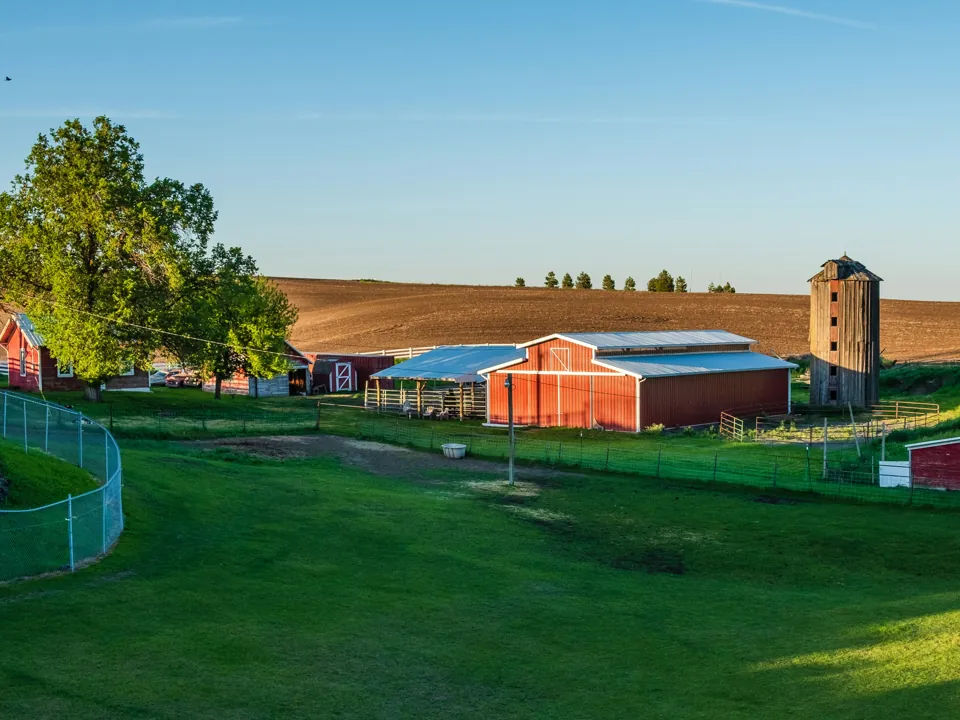
18 acres: two rental houses, a barn, a machine shed, a well and pump, irrigation and 12 acres of young almonds. This is the published sample.
First-year deduction
$337,000
A farm is several kinds of property bought for one price. The house, the barn, the well, the irrigation, the fences and the trees each have their own recovery period, and most of them are shorter than the house's.
Farm cost segregation is a study that divides the price of a farm among its land, its houses, its farm buildings, its site improvements and its trees or vines, and gives each the recovery period the tax code assigns it. Land is not depreciable, and on a farm it is usually most of the price. A rental house is 27.5-year property, with 5- and 15-year property inside and around it. A general barn, shop or machine shed is 20-year property. A structure built and used for one kind of livestock or for growing plants, such as a milking parlor or a greenhouse, is 10-year property. Trees and vines that bear fruit or nuts are 10-year property and are depreciated straight line. Wells, buried irrigation mainline and drainage are 15-year land improvements. Fences, pumps and farm machinery that came with the property are 7-year property. It fits an owner who rents out the houses, or who farms or leases the land, and whose tax preparer has not elected the alternative depreciation system for the property.
On a farm with one or more rental houses on it, 8–65% of depreciable basis is property with a recovery period of 20 years or less: the 5-, 7-, 10-, 15- and 20-year classes under 26 U.S.C. § 168, Rev. Proc. 87-56 and IRS Pub. 225. A farm with no house on it runs higher, because nearly everything on it is shorter-life property. Land is not depreciable and is usually most of a farm's price, so the land figure decides more of the result than anything else. Bonus depreciation applies to these classes only if the taxpayer has not elected the alternative depreciation system.
| Property type | Reclass to 5/7/15-yr | Year-1 federal benefit | Study cost |
|---|---|---|---|
| STR | 19–39% | $45K–$280K | From $495 |
| SFR | 5–32% | $10K–$165K | From $495 |
| Condo | 10–17% | $18K–$68K | From $495 |
| Brownstone | 5–20% | $60K–$640K | From $495 |
| Rowhouse | 5–18% | $10K–$170K | From $495 |
| Duplex | 8–21% | $19K–$105K | From $995 |
| Fourplex | 14–29% | $56K–$230K | From $995 |
| Office | 16–29% | $84K–$650K | From $1,995 |
| Retail | 20–37% | $90K–$690K | From $1,995 |
| Industrial | 15–28% | $78K–$840K | From $2,495 |
| Self-storage | 19–36% | $140K–$1.6M | From $2,495 |
| Medical office | 16–29% | $84K–$540K | From $2,995 |
| Mixed-use | 12–23% | $63K–$515K | From $1,995 |
| Multifamily | 14–28% | $44K–$200K | From $995 |
| Multifamily 5+ | 14–26% | $110K–$1.0M | From $1,995 |
| Triplex | 8–26% | $25K–$165K | From $995 |
| Restaurant | 16–29% | $72K–$430K | From $2,995 |
| Vet | 19–36% | $85K–$540K | From $2,995 |
| Gym | 21–40% | $110K–$900K | From $2,995 |
| Dealership | 25–47% | $465K–$4.2M | From $2,995 |
| ADU | 7–14% | $8K–$39K | From $495 |
| Commercial | 18–34% | $94K–$765K | From $1,995 |
| Data center | 43–65% | $2.5M–$29M | $4,995–$54,995 (sub-$100M); $100M+ by proposal |
| Senior living | 21–39% | $315K–$2.3M | By proposal |
| Funeral homes | 18–30% | $135K–$900K | By proposal |
| Child day care | 15–28% | $56K–$630K | From $2,995 |
| Adult day care | 14–26% | $78K–$780K | From $2,995 |
| Church | 10–22% | $37K–$825K | From $2,995 |
| Farm this page | 8–65%† | $19K–$780K | From $995 |
Reclassification ranges from the bands we publish per property type (measured on our delivered studies where we have enough of a type, modeled elsewhere); Year-1 federal benefit assumes 37% bracket and full first-year usability. Study costs are Cost Seg Smart pricing — comparable engineering studies elsewhere range $5,000–$15,000+. The ADU figure is an ADU acquired with a house; one the owner built or converted is priced on its documented construction cost, from $995. See full provider comparison.
† Farm: the figure is property with a recovery period of 20 years or less, on a farm with one or more rental houses on it. It counts 10- and 20-year property, which no other row has, and its dollar figure is a first-year deduction, not tax saved. A farm is quoted from a list of what is on it; see how.
Illustrative, modeled properties, not client engagements. Each figure is the depreciation deduction in the first year from property with a recovery period of 20 years or less, at 100% bonus depreciation. It is a deduction, not the tax saved: what it saves depends on your bracket and on whether you can use the loss.
A calculator multiplies a price by a typical share. A farm has no typical share: one that is mostly house and one that is mostly barns and trees give very different results at the same price. Send us what is on yours and we will reply with an estimate for your property and a fixed fee.
Most of what is not the house or the land. A general barn, a shop and a machine shed are 20-year property. A milking parlor, a poultry house or a greenhouse, built and used for that one purpose, is 10-year property. Bearing trees and vines are 10-year property. A well, buried irrigation mainline and drainage tile are 15-year land improvements. Fences, pumps, the above-ground part of an irrigation system and farm machinery that came with the property are 7-year property. Inside and around a rental house, appliances and floor coverings are 5-year property and paving, landscaping and fencing are 15-year. A rental house itself is 27.5-year property.
Because on a farm the land is usually most of what you paid for, and land is not depreciable. On the first farm we were asked to quote, the county's own roll put land at 61 percent of the total. Everything a study can do happens in what is left. That is also why we do not estimate farm land from a statistical model built for houses: we take it from the county roll, an appraisal or your closing documents, and we say which.
Trees and vines that bear fruit or nuts are 10-year property, and the tax code requires the straight-line method for them. Their value comes from an appraisal if you have one, from the county's own tree and vine value if the county publishes one, and otherwise from what it costs to establish the orchard and how many productive years it has left. An orchard at the end of its productive life carries little or no value. The cost of clearing, levelling and ripping the ground is part of the land and is not depreciable.
It depends on what it was built for and what it is used for. A general-purpose barn, a hay barn, a shop or a machine shed is 20-year property when it is used in farming. A structure designed, built and used for one kind of livestock or for growing plants is 10-year property. A barn on a farm that is not used in farming at all, for example one that stores the landlord's things for the rental houses, follows the houses. We ask what each building is used for, and the final study waits for the answer.
Three things, because any of them can change the whole result. Has the farming business made the election under section 163(j)(7)(C)? Has the taxpayer elected not to apply the uniform capitalization rules of section 263A to plants? Has the alternative depreciation system been elected for this property? If the answer to any of them is yes, bonus depreciation is not available and the recovery periods are longer. Most small farms have made none of them.
Send us the list of what is on the farm: each house and building with its size and what it is used for, the well and irrigation, the fences, and the trees or vines with their acreage and age. We reply with a proposal that states the fee and an estimate for your property. The fee follows the purchase price, from $995, and the proposal states yours. Start on the order form: choose Farm and list what is on it. You pay from the proposal rather than at checkout, because the study is built from that list.
Drop your email and we'll unlock all sample reports — STR, SFR, multifamily, commercial, per-city. No spam, no nag.
One email unlocks every sample on the site. We use it to send the reports + an optional 5-day cost-seg primer (unsubscribe anytime).