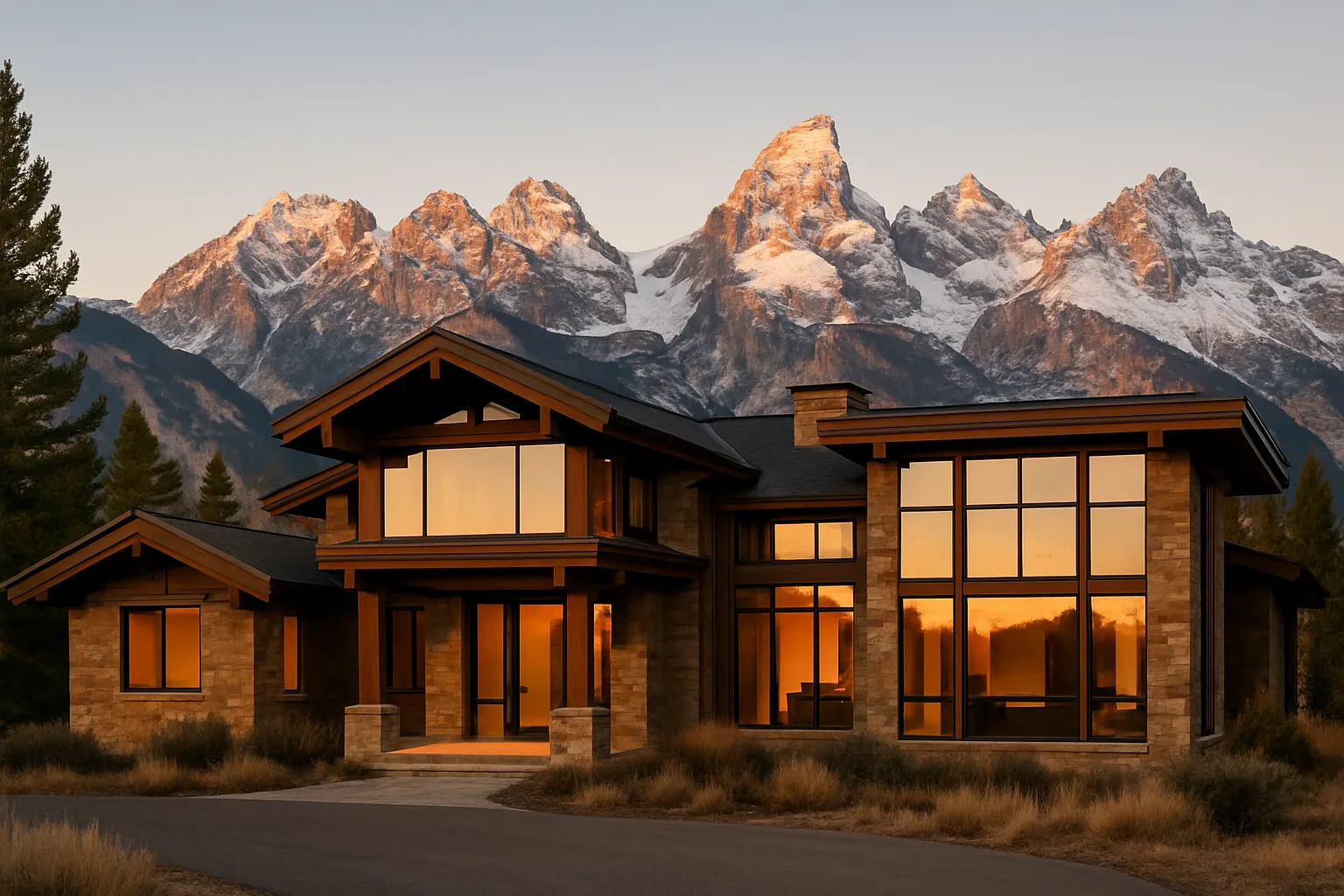
Wyoming has no state income tax. Jackson Hole drives one of the highest-basis vacation rental markets in the country, and Yellowstone and Grand Teton pull year-round visitor flow into Cody, Dubois, and the Wapiti Valley. For investors holding $1M+ STR properties, the federal cost segregation deduction is the entire deduction: no state add-back, no separate depreciation schedule, no state-level recapture at sale. See Your Wyoming Tax Savings →
- IRS Audit Techniques Guide methodology
- 40+ page CPA-ready report
- Delivered in about an hour
- Audit support included
Wyoming sits in the same clean-math category as Florida, Nevada, Texas, and Tennessee, but with a different investor mix. Most Wyoming STR investment activity concentrates in Teton County (Jackson Hole proper) and the Snake River corridor, with secondary activity in Cody as the eastern Yellowstone gateway. Investors target dual-season traffic: winter ski demand at Jackson Hole Mountain Resort and Snow King, plus summer Grand Teton and Yellowstone visitors June–September. Property values in Teton County are among the highest in the country for any non-coastal market. Median STR purchase prices routinely run $1.5M–$3M, with luxury cabins and lodge-style properties pushing higher.
That basis matters. Cost segregation captures a percentage of basis, so high-basis markets like Jackson Hole produce some of the largest absolute first-year deductions of any state on the residential side. A $2M Jackson Hole cabin commonly produces $400K–$500K in accelerated depreciation in the first year under current federal bonus rules.
does cost segregation increase audit risk →
How Cost Segregation Works in Wyoming
Wyoming has no individual state income tax. The prohibition is constitutional — Wyoming Constitution Article 15, Section 18 explicitly bars the state from levying a tax on income. The Wyoming Department of Revenue collects excise, mineral, and property taxes. There is no state income tax filing requirement for individuals, and pass-through entities (LLCs, partnerships, S-corps) flow only to the federal return.
For cost segregation this means: you file accelerated depreciation on your federal return, there’s no Wyoming depreciation schedule, no state add-back, and no state-level recapture when you sell. Your CPA tracks one set of MACRS schedules. At the 37% federal bracket, every $100K reclassified produces $37K in first-year federal tax savings; the entire benefit is federal.
Real Example: $1.45M Jackson Hole vacation rental:
- $1,450,000 purchase price
- $1,160,000 depreciable basis (excluding land)
- $295,000 accelerated depreciation (reclassified to 5/7/15-year MACRS)
- $109,150 estimated federal tax savings (37% bracket)
- $0 Wyoming state tax impact
Representative Wyoming Year-1 federal savings: $45,000 to $185,000 depending on basis and FF&E density.
What Investors in Wyoming Should Know
No state income tax. The cost segregation benefit flows entirely through your federal return. There is no Wyoming return, no state depreciation schedule, and no state recapture at sale. Pass-through entities (LLCs, S-corps, partnerships) pass income only to federal, and Wyoming doesn’t see it.
Jackson Hole is the dominant market. Teton County concentrates a disproportionate share of Wyoming’s STR investment activity. Median STR purchase prices routinely run $1.5M–$3M+. The high-basis market means absolute first-year deductions are unusually large: $300K–$600K in accelerated depreciation per property is common.
Year-round demand patterns. Unlike pure-seasonal markets, Jackson Hole sees both winter ski demand (Jackson Hole Mountain Resort, Snow King) and summer national-park demand (Grand Teton, Yellowstone). Properties calibrated for both seasons generate consistent nightly rates 9–10 months of the year. That demand stability supports the investment thesis: you’re not timing around a single peak season.
Heavy FF&E in luxury cabins. Competitive Jackson Hole STRs are not minimally furnished. Premium kitchens, hot tubs, fireplaces, ski-tuning rooms, mudrooms with heated floors, custom built-ins: all of this qualifies for 5-year MACRS treatment. The FF&E density on a $2M Jackson Hole cabin is materially higher than a $750K STR in a less competitive market.
Cody and the eastern corridor. Cody anchors Yellowstone’s east entrance and supports a meaningful vacation rental economy on lower entry prices ($400K–$800K typical). The acceleration profile is similar in percentage terms; the absolute dollars are smaller, which means the study cost ratio favors larger Jackson Hole properties.
Multi-Property Investors and Form 3115 Lookback
Jackson Hole investors generally own 2–3 high-basis vacation rentals plus a primary residence; the Wyoming SFR investor base in Cheyenne and Casper often holds 5+ properties across the F.E. Warren / energy-sector workforce market. Properties acquired 2+ years ago without a cost segregation study are Form 3115 lookback candidates: the missed federal acceleration recaptures in a single tax year via §481(a). With Wyoming’s zero state income tax, every recaptured dollar flows entirely to federal. Multi-property study bundles run 5%–15% off per property. See bundle pricing →
Key Markets in Wyoming
Jackson Hole, WY
The dominant Wyoming market. Jackson, Wilson, Teton Village, and the surrounding Snake River corridor support some of the highest-basis vacation rentals in the country. Luxury cabins and lodge-style STRs routinely run $1.5M–$3M, with heavy FF&E packages calibrated to ski-season and Grand Teton/Yellowstone summer guest expectations. The combination of high basis, year-round demand, and Wyoming’s zero state income tax makes Jackson Hole one of the cleanest cost segregation markets nationally. See Jackson Hole breakdown →
Cody, WY
Cody anchors Yellowstone’s east entrance and supports a vacation rental economy on lower entry prices than Jackson Hole. Representative cabin investments run $400K–$800K. Summer Yellowstone traffic dominates demand. Per-dollar acceleration rates are comparable to Jackson Hole; the smaller absolute basis means cost segregation is most efficient at $500K+ purchase prices.
Cheyenne, WY
The state capital and largest city. Cheyenne’s investor base skews toward long-term single-family and small multifamily rentals serving F.E. Warren AFB families and the regional economy. SFR cost segregation generally pencils above $300K purchase price; the acceleration rate is lower than vacation-rental markets due to less FF&E, but the federal-only tax math still produces meaningful Year-1 savings.
Casper, WY
Energy-economy market with cyclical SFR demand tied to the oil and gas sector. Mid-priced rentals ($250K–$450K) dominate the investor base. Cost segregation pencils best for investors with multiple properties or higher-basis SFRs.
Property Types That Benefit Most in Wyoming
Luxury STR cabins in Jackson, Wilson, Teton Village. The primary use case. Heavily furnished $1.5M+ properties with premium kitchens, hot tubs, mudrooms, and ski-tuning storage produce the highest absolute first-year deductions.
Vacation-rental cabins in Cody, Dubois, Pinedale. Lower-basis ($400K–$800K) cabins with strong summer demand. Per-dollar acceleration rates are comparable to Jackson Hole; absolute dollars are smaller.
Single-family rentals in Cheyenne, Casper, Laramie. Wyoming’s military and energy-sector economies support steady SFR demand. Cost segregation pencils above ~$300K purchase price.
Commercial / hospitality, statewide. Mountain lodges, ranch resorts, and small hotels across the Tetons and Yellowstone corridor benefit from Wyoming’s no-state-tax math at the entity level.
Have one of these property types? See what your Wyoming property would save.
When Cost Segregation Typically Makes Sense in Wyoming
It generally makes sense when:
- Purchase price above ~$500K for vacation rentals, ~$300K for SFR
- Property is furnished or you plan to furnish it (FF&E is where most acceleration comes from)
- You materially participate in your STR operation (100+ hours/year, more than anyone else)
- You’re a W-2 earner who can use accelerated deductions to offset salary income via STR material participation
- You hold the property for 3+ years (depreciation recapture applies at sale: up to 25% on real-property gain and ordinary rates on some personal-property components, though there’s no state recapture)
It may not make sense if:
- Property is under ~$300K with minimal improvements
- You’re a passive investor with no other passive income (the deductions may carry forward unused under §469)
- You plan to sell within 12–18 months
- The property is a vacant land hold
Cost Segregation by City in Wyoming
Opportunities vary by market. Select a city below to see estimated savings and a detailed MACRS breakdown.
Jackson Hole, WY
Median luxury STR: $1,800,000 · ~$95,000–$185,000 Year-1 federal savings · See Jackson Hole breakdown →
Wyoming Cost Segregation Guides
- Short-Term Rental Cost Segregation
- Single-Family Rental Cost Segregation
- Cost Segregation Calculator
- Bonus Depreciation Hub
- What Is Cost Segregation?
See Your Estimated Wyoming Savings
Run your numbers in under 30 seconds. 100% bonus depreciation is available now under federal law. Verify state-specific treatment with your CPA. See Your Wyoming Tax Savings →
Starting at $495 for residential studies under $300K basis. Delivered in about an hour for simple residential SFR / STR; 3-5 business days for properties over $3M or commercial. Money-back guarantee.
For properties over $10M basis (large multifamily, hospitality, institutional commercial): same-day preliminary, ~2 weeks post-close final. By proposal.
CPA use note: These figures estimate the size of the depreciation deduction. Whether the loss is usable in the current year depends on passive-activity rules, STR material participation, REPS status, entity structure, depreciable basis, and state conformity. Your CPA decides how and when it is applied. Specialty and site components (equipment, casework, docks, pools, arenas, tenant improvements, and similar) are only classified when you own them and they are included in the depreciable basis being studied.
How should Wyoming investors choose a cost segregation provider?
For a Wyoming investor buying a property in the $1,450,000 range, the choice of provider is a major controllable variable in the return. The IRS Audit Techniques Guide sets the quality characteristics an engineering-based study should meet — industry-standard construction cost data, MACRS classification, and component-level documentation — but it does not make every provider's work identical; rigor, cost, and turnaround still vary.
Traditional engineering studies often run several thousand dollars and can take several weeks, because they include on-site inspections, sales discovery calls, and scheduling overhead. The IRS Cost Segregation Audit Techniques Guide does not prescribe an on-site inspection as a standalone requirement; it sets out the quality characteristics of an engineering-based study — component-level classification, a documented and supportable cost derivation, and a clear audit trail — and describes how a physical inspection can contribute to meeting them.
Modern automated providers (such as Cost Seg Smart) deliver an engineering-based, IRS ATG-aligned study using property records, documents, photos, and recognized construction-cost data, typically from $495 and often the same day. For a Wyoming investor at a high combined bracket, that cost and speed difference is meaningful. The CPA-Ready Guarantee (full refund if the report can't be used by your CPA) plus the 60-day money-back policy makes the decision essentially risk-free on the report itself.
The automated path is best-fit for owners who can provide closing documents and property photos online (no in-person visit required) and want the report in time to file the current year's return rather than the next one.
All Cost Seg Smart studies include the CPA-Ready Guarantee (full refund if your CPA can't use the report) plus a 60-day money-back policy. Straightforward residential studies are often delivered the same day and completed remotely; larger or more complex commercial studies take longer and may include an on-site observation.