Cost Segregation Benchmarks 2026

An open-data analysis of 260 cost segregation studies across 13 US residential and commercial property types — reclassification percentages, year-1 federal savings, and US provider pricing.

Published April 30, 2026 Cost Seg Smart Research n = 260 studies (20 per type) CC-BY 4.0
Executive Summary — Three Findings
  • Furnished short-term rentals reclassify ~73% more depreciable basis than unfurnished single-family rentals. Median STR: 30.4% of basis to 5/7/15-year property. Median SFR: 17.6%. The gap is FF&E — furniture, appliances, fixtures, decor — all 5-year personal property under MACRS.
  • Year-1 federal tax savings on a $500K STR: ~$43,695 (median, 37% bracket, 100% bonus). On the same $500K basis, an unfurnished SFR yields ~$25,740. A medical office produces ~$49,119. A condo: ~$13,543. The full per-type table is below.
  • US cost segregation pricing ranges from $495 to $15,000+ — a 30× spread — for the same IRS-compliant methodology. The variance reflects delivery method (automated remote vs. on-site engineering) and overhead, not report quality. All tiers can produce IRS-defensible studies under the Audit Techniques Guide (Pub 5653).

Cost segregation is a 25-year-old US tax strategy with a marketing problem. Every provider claims customers save "tens of thousands." Few publish numbers. Almost none publish data.

This report is the first open-data benchmark for the industry. We analyzed 260 cost segregation studies spanning 13 property types — from $300K urban condos to $8M garden-style apartment complexes — and published the median reclassification percentages, year-1 federal tax savings, and replacement-cost reconciliation factors. The dataset is licensed CC-BY 4.0: anyone can use, share, or republish with attribution.

Our goal is simple: stop the vague claims. Make it easy for journalists, CPAs, real estate investors, and policymakers to cite real numbers when they discuss cost segregation outcomes.

How to read this report. These are modeled outcomes, not customer guarantees. The numbers come from a single engine applying real RSMeans 2024 cost data and IRS-recognized MACRS classification rules to representative US property profiles. Individual results depend on property characteristics, accounting elections, taxpayer circumstances, and applicable state/local law. Variance across providers using different engineering methodologies is typically ±2–4 percentage points for the same property. The dataset uses n = 20 per property type (260 total studies); per-type IQRs are reported alongside medians so readers can see real dispersion, not just point estimates.

Methodology

All 260 studies were generated using the Cost Seg Smart engine (version 2.2.0, calibrated 2026-03-14). The engine applies RSMeans 2024 construction cost data, MACRS classification per Rev. Proc. 87-56, and the methodology described in the IRS Cost Segregation Audit Techniques Guide (Pub 5653). Each study undergoes 16 automated quality-control checks before inclusion; failed studies are excluded from the dataset entirely.

Property characteristics — square footage, year built, purchase price, location, structural features — are drawn from real US metropolitan property profiles representative of typical investor purchases at each property type. Where studies are explicitly labeled engineering simulations rather than completed customer engagements, this distinction is preserved in the dataset.

260
Total studies in dataset (all 13 property types)
97%
QC pass rate across the full sample (97% if QC=REVIEW counted as pass)

Year-1 federal tax savings are computed as: (5-year basis + 7-year basis + 15-year basis) × bonus depreciation × federal marginal rate. We assume 100% bonus depreciation (current law under OBBBA) and the 37% federal marginal rate — the most relevant bracket for high-income real estate investors who commission cost seg studies. State income tax is excluded for cross-state comparability; including it would increase savings by 5–13% depending on state.

The full methodology page includes engine version disclosures, sample composition, exclusion criteria, and limitations.

Reclassification Percentages by Property Type

The headline number for cost segregation is the reclassification percentage — what share of the depreciable basis (purchase price minus land value) gets moved from the default 27.5-year (residential) or 39-year (commercial) recovery period into shorter 5, 7, or 15-year MACRS classes. Higher reclassification = more accelerated depreciation = larger year-1 deduction.
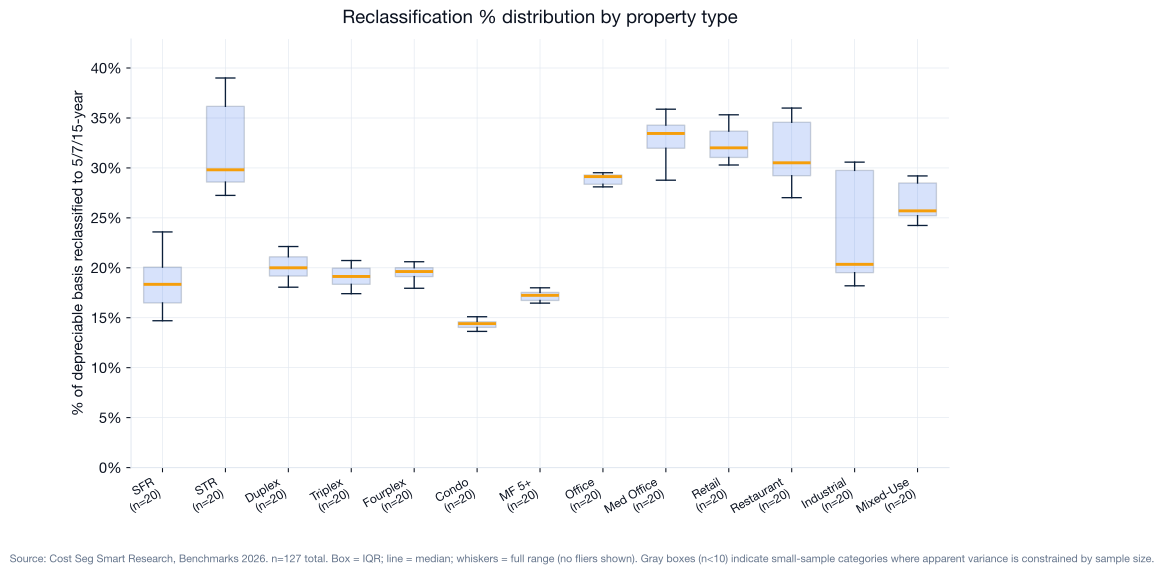
Box-and-whisker chart showing the distribution of total accelerated reclassification percentage across 13 property types in 260 cost segregation studies (n=20 per type). Medical office, retail, and restaurant lead at 30-34% medians; STR sits at 29.8%; condo is lowest at 14.4%.

Figure 1. Reclassification % distribution by property type. Each box shows IQR; line shows median. n = 20 in every category. STR shows the widest dispersion (IQR 28.6–36.2%) reflecting variation in FF&E packages across furnished rentals. Industrial shows the second-widest band (IQR 19.5–29.8%) reflecting site-improvement intensity differences across logistics versus light industrial properties. Residential long-term categories (SFR, duplex, multifamily) cluster more tightly because their component composition is more standardized.

Property Type n Median Accel % P25 P75 Median 5yr % Median 15yr %
Single-Family Rental2018.3%16.5%20.1%8.4%9.8%
Short-Term Rental2029.8%28.6%36.2%19.2%10.9%
Duplex2020.0%19.2%21.1%11.7%8.5%
Triplex2019.1%18.3%20.0%11.2%7.7%
Fourplex2019.6%19.1%20.0%11.9%7.4%
Condo2014.4%14.0%14.6%13.5%0.9%
Multifamily 5+ Units2017.2%16.7%17.5%9.8%7.2%
Office2029.1%28.4%29.3%17.4%10.4%
Medical Office2033.5%32.0%34.3%23.8%8.3%
Retail2032.0%31.0%33.7%18.5%13.1%
Restaurant2030.5%29.2%34.6%21.6%7.8%
Industrial2020.3%19.5%29.8%5.8%13.5%
Mixed-Use2025.7%25.2%28.5%14.0%10.8%

Source: Cost Seg Smart Research, Benchmarks 2026. n = 260, with n=20 in every property-type bucket.

Key Finding 1

Furnished STRs reclassify ~63% more depreciable basis than unfurnished SFRs (median 29.8% vs. 18.3%). The gap is FF&E — furniture, fixtures, equipment — all 5-year personal property under MACRS.

Why some property types reclassify more than others

The dataset shows a clear hierarchy that reflects each property type's component composition:

Medical office (33.5%) contains the highest concentration of 5-year personal property in this dataset: exam-room cabinetry, specialized lighting, plumbing fixtures dedicated to clinical use, and integrated medical equipment. Per IRS guidance, equipment tied to the trade or business is 5-year personal property, not building structure.

Retail (32.0%) and restaurant (30.5%) follow closely. Retail tenant fit-outs (display systems, security infrastructure, decorative finishes) and restaurant kitchens (commercial cooking equipment, walk-ins, specialty plumbing) both qualify as 5-year personal property in volume.

STR (29.8%) sits with the commercial leaders despite being residential. The driver is FF&E: furniture, fixtures, appliances, decor, outdoor amenities like hot tubs and fire pits. All 5-year personal property under MACRS. STR's IQR (28.6–36.2%) is the widest of any category, reflecting how FF&E packages vary substantially across furnished rentals.

Office (29.1%) and mixed-use (25.7%) sit in the next tier with moderate-to-high tenant fit-out content.

Industrial (20.3%, IQR 19.5–29.8%) shows the dataset's second-widest dispersion. Light industrial and flex space typically reclassify in the 25–30% range (heavy site improvements, racking, specialty electrical), while pure warehouse and distribution properties cluster at the lower end (mostly long-term shell with limited specialty equipment). The sub-classification matters as much as the headline label.

Small multifamily and SFRs (17–20%) are constrained by the simpler component mix: appliances, flooring, fixtures, and landscaping. Less specialized equipment means less to reclassify.

Multifamily 5+ (17.2%) is slightly below 2–4 unit MF because of scale efficiencies: shared building systems are amortized across more units, lowering the per-unit MEP component allocation that would otherwise reclassify.

Condos (14.4%) are at the bottom because of scope, not study quality. A condo owner's depreciable basis covers interior finishes, fixtures, and the unit's allocated share of building systems — but not the building shell, foundation, common-area amenities, or site improvements (those belong to the HOA). Less depreciable scope means less to reclassify.

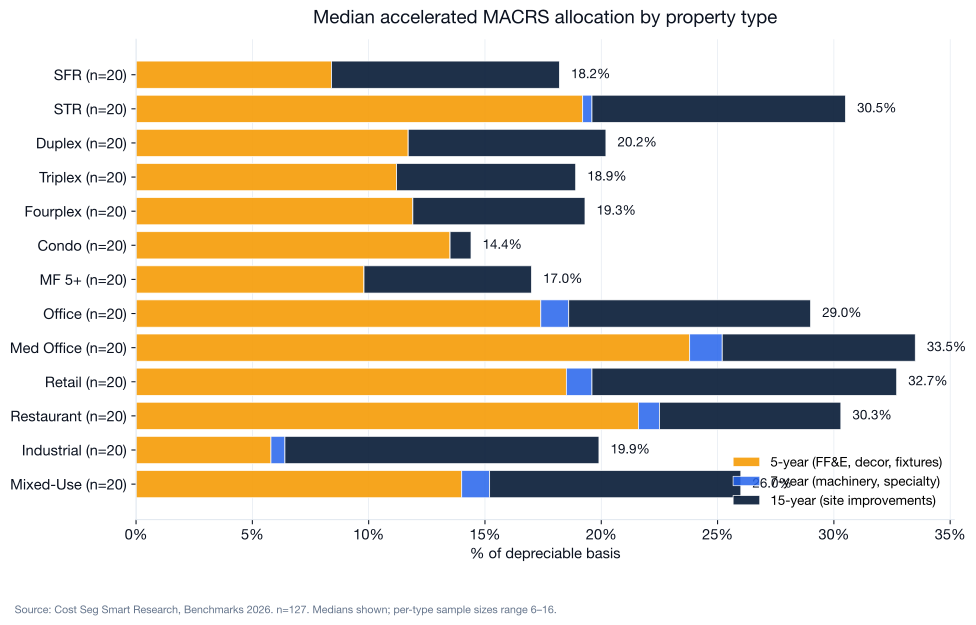
Stacked horizontal bar chart showing the median 5-year, 7-year, and 15-year MACRS class breakdown for each of 13 property types. Restaurant has the highest 5-year share at 26.1%; industrial has the highest 15-year share at 23.1%.

Figure 2. Median allocation across 5-year, 7-year, and 15-year MACRS classes by property type.

Year-1 Federal Tax Savings by Property and Price

Reclassification percentage matters, but what gets paid out is dollars. We computed year-1 federal tax savings for every study in the dataset using 100% bonus depreciation (per OBBBA, current law) and the 37% top federal marginal rate. State tax is excluded.
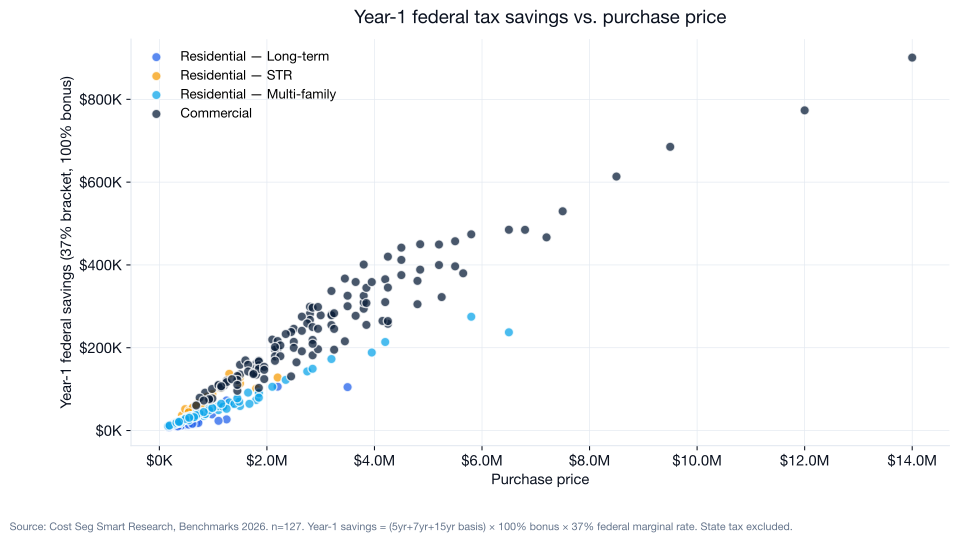
Scatter plot of year-1 federal tax savings vs. purchase price across 260 studies, color-coded by property category (STR, long-term residential, multi-family, commercial). Commercial properties cluster in the upper-right; residential follows a tighter linear band.

Figure 3. Year-1 federal tax savings vs. purchase price across 260 studies, by property category.

Year-1 savings normalized to $500,000 purchase price

To make property types directly comparable, we scaled each study's savings to a $500K purchase price. This isolates the property-type effect from the price effect.

Property Type Median Year-1 Savings ($500K basis) Implied Effective Year-1 Deduction
Medical Office$49,119~$133K
Retail$45,433~$123K
Restaurant$43,577~$118K
Short-Term Rental$43,695~$118K
Office$39,608~$107K
Mixed-Use$37,836~$102K
Industrial$33,462~$90K
Duplex$28,049~$76K
Fourplex$27,789~$75K
Multifamily 5+$25,902~$70K
Single-Family Rental$25,740~$70K
Triplex$24,098~$65K
Condo$13,543~$37K

Year-1 savings = (5/7/15-yr basis) × 100% bonus × 37% federal marginal rate. State tax excluded. Effective deduction = savings ÷ 0.37.

Key Finding 2

Year-1 federal tax savings on a $500K STR: median $43,695 (37% bracket, 100% bonus). On the same $500K SFR: $25,740. The study itself typically pays back in weeks at automated-provider pricing; far longer at traditional firm pricing.

An important wrinkle for SFR/long-term rental investors: most can only use these losses against passive income or under Real Estate Professional Status. STR owners with material participation can offset W-2 income directly — the so-called "STR loophole" under §469. Cost segregation amplifies whatever benefit you can deduct; it doesn't change whether you can deduct.

Pricing Across US Providers

We compiled public pricing data on US cost segregation providers from their published price lists, third-party reviews, and competitive research. The result: a 30× spread for the same IRS-compliant methodology.

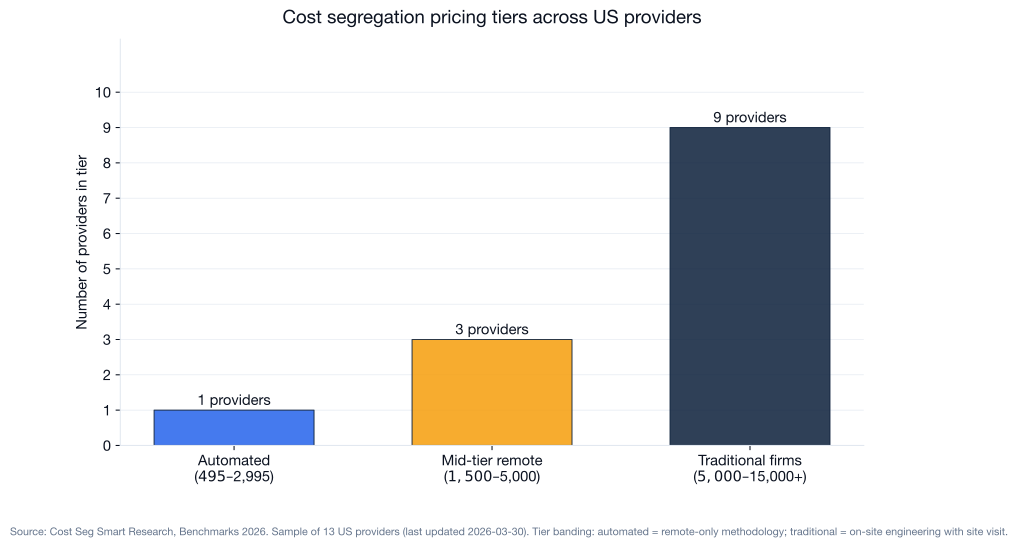
Bar chart of three US cost segregation provider pricing tiers: automated ($495-$2,995), mid-tier remote ($1,500-$5,000), and traditional firms with on-site visits ($5,000-$15,000+).

Figure 4. Cost segregation provider pricing tiers in the US.

Tier Typical Price Turnaround Site Visit Methodology
Automated remote$495–$2,995Under 1 hr to 1 weekNoEngineering, RSMeans, ATG-compliant
Mid-tier remote$1,500–$5,0001–4 weeksSometimesEngineering, RSMeans, ATG-compliant
Traditional engineering$5,000–$15,000+4–8 weeksYesEngineering, on-site, ATG-compliant
Key Finding 3

US cost segregation pricing ranges from $495 to $15,000+ — a 30× spread for the same IRS-compliant methodology. The variance reflects delivery method and overhead, not report quality. All tiers can produce IRS-defensible studies under the Audit Techniques Guide.

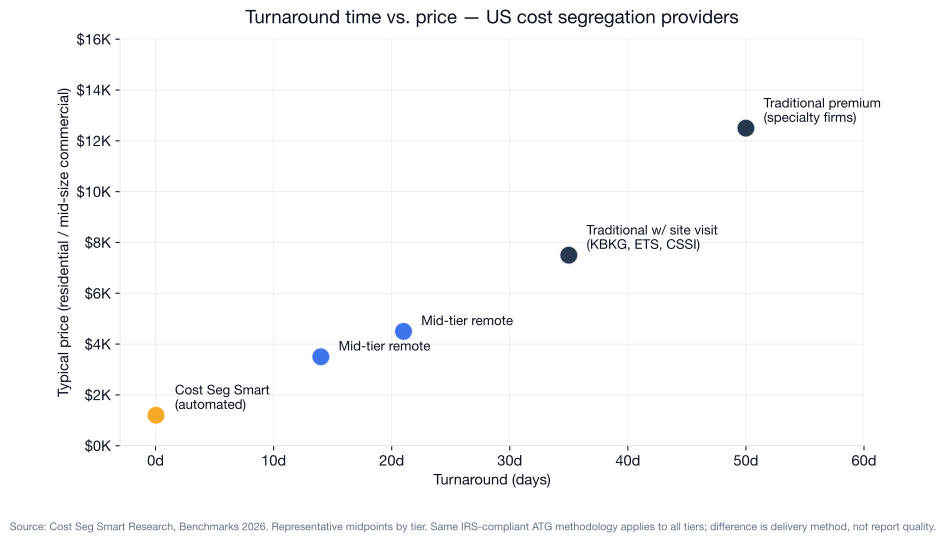
Scatter plot of turnaround time in days versus typical price across the three US cost segregation provider tiers. Automated remote sits at <1 day and ~$1,200; mid-tier remote at 14-21 days and $3,500-$4,500; traditional firms at 35-50 days and $7,500-$12,500.

Figure 5. Turnaround time vs. price across US provider tiers.

Why the spread is this wide

Three structural factors drive the 30× price spread:

Site visit overhead. Traditional engineering firms include the cost of an on-site engineering inspection — typically $1,500–$3,500 in travel, time, and labor. Remote providers use property data, satellite imagery, and assessor records to gather equivalent component-level information without traveling. The IRS does not require a site visit for an ATG-compliant study; it's a workflow choice, not a methodological one.

Customer-acquisition cost. Traditional firms typically work through CPA referral networks, which command 10–20% referral fees. Remote providers acquire customers via search and content, which is cheaper at volume.

Margin structure. Engineering firms staff PE-licensed engineers as the primary deliverable, which carries fixed labor costs. Automated providers use software-driven workflows that scale at near-zero marginal cost per study.

Bonus Depreciation Context (2022–2026)

The reclassification percentage is half of the year-1 savings calculation. The other half is the bonus depreciation rate — how much of the reclassified basis you can actually deduct in year one rather than spreading it across the recovery period.

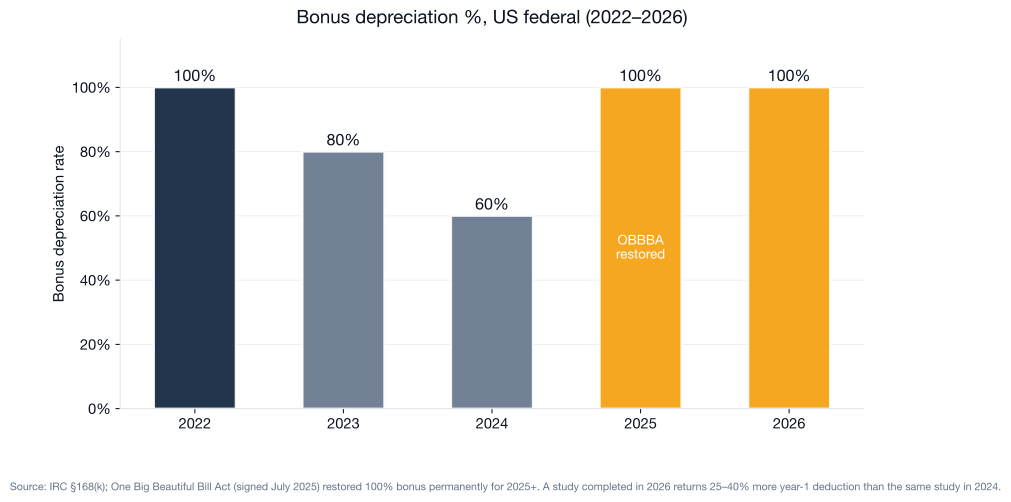
Bar chart showing US federal bonus depreciation rates 2022 through 2026: 100%, 80%, 60%, 100%, 100%. The 2025 jump back to 100% reflects the One Big Beautiful Bill Act signed July 2025.

Figure 6. US federal bonus depreciation rates, 2022–2026.

The One Big Beautiful Bill Act (OBBBA), signed July 2025, permanently restored 100% bonus depreciation for property placed in service after 2024. The full reclassified basis can now be deducted in year one again — a 25–40% increase in year-1 deduction relative to the same study completed under the 2024 60% rate.

Practical implication for the dataset: all year-1 savings figures in this report assume 100% bonus. If you're computing savings for a property placed in service in 2023 or 2024, scale by the applicable bonus rate (80% or 60%) and add the unbonused portion back via straight-line MACRS depreciation over the recovery period.

Audit Risk — What the Data Says

"Will this trigger an audit?" is the first question every cost segregation customer asks. The honest answer based on IRS data and the methodology behind these studies:

The IRS individual audit rate is currently <0.5%. The IRS does not publish data correlating cost segregation usage with audit rate. There is no public evidence that a cost segregation study, on its own, increases audit probability.

What does correlate with adverse outcomes:

The IRS audits process, not deduction size. A well-documented study within typical industry ranges, supported by component-level cost data, is the documented best practice. This dataset's distributions can be used as a sanity check: if a study produces a result outside the IQR for its property type, that's worth investigating.

When Cost Segregation Doesn't Make Sense

The data above shows what cost segregation can produce. It doesn't say everyone should do one. Five scenarios where the math doesn't justify a study:

01

Properties under ~$200K basis

Year-1 savings scale with depreciable basis. Below ~$200K, even a $495 study often produces savings smaller than the study fee plus the time cost of CPA filing changes (Form 3115).

02

Low marginal tax bracket

Year-1 tax savings = accelerated basis × marginal rate. At a 12–22% bracket, the same study produces 30–65% less benefit than at the 37% bracket assumed in this dataset. Run your specific math before ordering.

03

Passive losses you can't deploy

Most long-term rental owners can only use cost-seg losses against other passive income or via Real Estate Professional Status. If you have neither REPS nor passive income, the deduction carries forward but doesn't reduce your tax bill this year. STR owners with material participation are the exception.

04

Properties you plan to sell within 2–3 years

Accelerated depreciation creates depreciation recapture on sale (taxed at up to 25%). Short hold periods can convert short-term cash benefit into a wash. The math still works for some quick flips, but it's not automatic.

05

Properties already substantially depreciated

If you're past year 5 on a residential property and never did cost seg, a Form 3115 lookback can still recover missed depreciation. But if you're past year 15–20, the remaining basis is small enough that the study fee may not pay back. Worth running the numbers either way.

06

Short-term rentals you're about to convert to long-term

Cost segregation on a furnished STR captures FF&E in 5-year property. If you convert to unfurnished long-term within 1–2 years, you may face partial-disposition recapture on the FF&E. Wait until you commit to the use-case before ordering the study.

Studies that do make sense almost always have a few characteristics in common: depreciable basis > $250K, marginal tax bracket > 30%, ability to use the resulting losses (passive income, REPS, or material STR participation), and a hold period of 5+ years. If any of those are missing, talk to your CPA before ordering.

Frequently Asked Questions

What is the typical cost segregation reclassification percentage?
Median across 260 studies (n=20 per property type): 18.3% for unfurnished SFR, 29.8% for STR, 14.4% for condos, 17.2% for 5+ unit multifamily, 33.5% for medical office, 32.0% for retail, 30.5% for restaurants, 29.1% for office, 25.7% for mixed-use, 20.3% for industrial. Full distribution above. These are modeled medians; individual studies vary by property characteristics and engineering methodology.
Does cost segregation trigger an IRS audit?
No clear evidence that a study itself increases audit probability. Audit risk correlates with study quality (outlier reclassification rates, missing methodology documentation), not with simply having a study. The IRS audits process, not deduction size. The 120-page IRS Audit Techniques Guide for Cost Segregation (Pub 5653) is the documented standard for what an examiner looks for.
How much does a cost segregation study cost in the US?
$495 to $15,000+ for the same IRS-compliant methodology. Automated providers: $495–$2,995. Mid-tier remote: $1,500–$5,000. Traditional engineering with on-site visits: $5,000–$15,000+. Report quality is methodology-dependent, not price-dependent — all tiers can produce IRS-defensible studies under the Audit Techniques Guide.
How much can I save in year one with cost segregation?
Median year-1 federal tax savings on a $500K STR at 37% marginal: ~$43,695. On a $500K SFR: ~$25,740. On a $500K medical office: ~$49,119. State tax adders typically increase these by 5–13%. At lower marginal brackets (12–22%), divide these figures by 0.37 then multiply by your bracket.
What property types benefit most?
By median reclassification % — medical office 33.5%, retail 32.0%, restaurant 30.5%, STR 29.8%, office 29.1%, mixed-use 25.7%, industrial 20.3%. Residential long-term rentals (SFR, duplex, triplex, fourplex) cluster around 18–20%. Condos are lowest at 14.4%. Each property type has n=20 in this dataset.
Does bonus depreciation still apply in 2026?
Yes. OBBBA (signed July 2025) permanently restored 100% bonus depreciation for property placed in service after 2024. Historically: 100% (2017–2022), 80% (2023), 60% (2024), 100% (2025+). For property placed in service in 2023 or 2024, scale year-1 savings by the applicable bonus rate; the unbonused portion still depreciates straight-line.
Can I use cost segregation on a property I bought years ago?
Yes. The IRS allows a "lookback" study via Form 3115 (Application for Change in Accounting Method). You catch up missed depreciation in a single year via Section 481(a) adjustment without amending prior returns. Works on any prior placed-in-service date, though the remaining basis (and therefore the benefit) shrinks the further out you are.
What's the difference between automated and traditional studies?
Both use the same IRS-compliant methodology (engineering-based, RSMeans cost data, MACRS classification per Rev. Proc. 87-56). The difference is delivery: automated remote (under 1 hr to 1 week, no site visit) vs. traditional on-site (4–8 weeks, engineer visits property). The Audit Techniques Guide does not require a site visit. Across providers, the underlying methodology is largely the same; the differences are in delivery, pricing, and speed.
Why are some property types more variable than others?
STR shows the widest distribution (IQR roughly 28.6–36.2%) because furniture, fixtures, and equipment vary substantially across furnished rentals — a $500K beach cottage and a $500K mountain ski cabin can reclassify materially differently based on their FF&E packages. Industrial also shows wide variance (IQR 19.5–29.8%) reflecting site-improvement intensity differences across logistics warehousing versus light industrial flex space. Residential long-term categories (SFR, duplex, triplex, fourplex, multifamily) cluster more tightly because their component composition is more standardized. All 13 categories now have n=20 in this v1.2 release; per-type IQRs are reported alongside medians so readers can see real dispersion.

Cite This Report

This report and dataset are released under Creative Commons Attribution 4.0 International (CC-BY 4.0). You may use, share, and adapt the contents for any purpose, including commercial, with attribution.

Download the Dataset

Open Data — Free to Use, Share, and Republish

The full per-study dataset (260 rows) and per-property-type aggregate summary are available below. Both are released under CC-BY 4.0.

Per-study CSV (260 rows, 28 columns) — flat data, one row per study, includes year-1 savings normalized to $500K basis
Aggregate summary JSON — per-type medians, percentiles, sample sizes
Full methodology page — engine version, exclusions, limitations

Citation requests, data inquiries, methodology challenges: research@costsegsmart.com

Important. This report is for informational purposes only and does not constitute tax, legal, or accounting advice. Cost segregation outcomes depend on individual property characteristics, accounting elections, taxpayer circumstances, and applicable federal, state, and local law. Consult a qualified CPA or tax advisor before making decisions based on this data. Cost Seg Smart makes no representations about specific savings outcomes for any individual property or taxpayer.