Renovation cost segregation: depreciate what you built, faster.
Turn your capitalized renovation invoices into a CPA-ready depreciation schedule. Already have the invoices? We classify them — line by line, with the document cited behind every dollar. Priced on what you spent, starting at $995.
Remote for most residential properties · No land allocation · No purchase required · No building modeling
Did you buy a property — or improve one you already own?
They're different studies. A purchase needs land and building allocation; a renovation only needs your documented costs classified.
Kitchen remodel, pool and deck, landscaping, a commercial interior refresh — we classify your documented improvement costs into 5-, 15-, and building-life classes, with a fixed-asset schedule your CPA can enter directly. This is your study.
You bought the property, so the study allocates land, values the building, and classifies components. Your renovation is studied with it: included under $100,000, and $595 from $100,000 to $1 million. Residential from $495.
Start a full study →Lease the space and paid for the build-out yourself? That's a tenant-improvement study →
The easiest cost segregation engagement there is
A renovation study removes every hard part of a traditional study — because the evidence already exists. You have invoices; we classify them.
↓ classified
15-Year Land Improvement · 100% assumed bonus
↓ scheduled
Fixed-asset entry: 15-yr · 150DB · HY · PIS 2026-06-20
Have invoices? Upload them — we do the rest. No forms full of building facts: the documents are the intake.
Every classified dollar traces to an invoice page
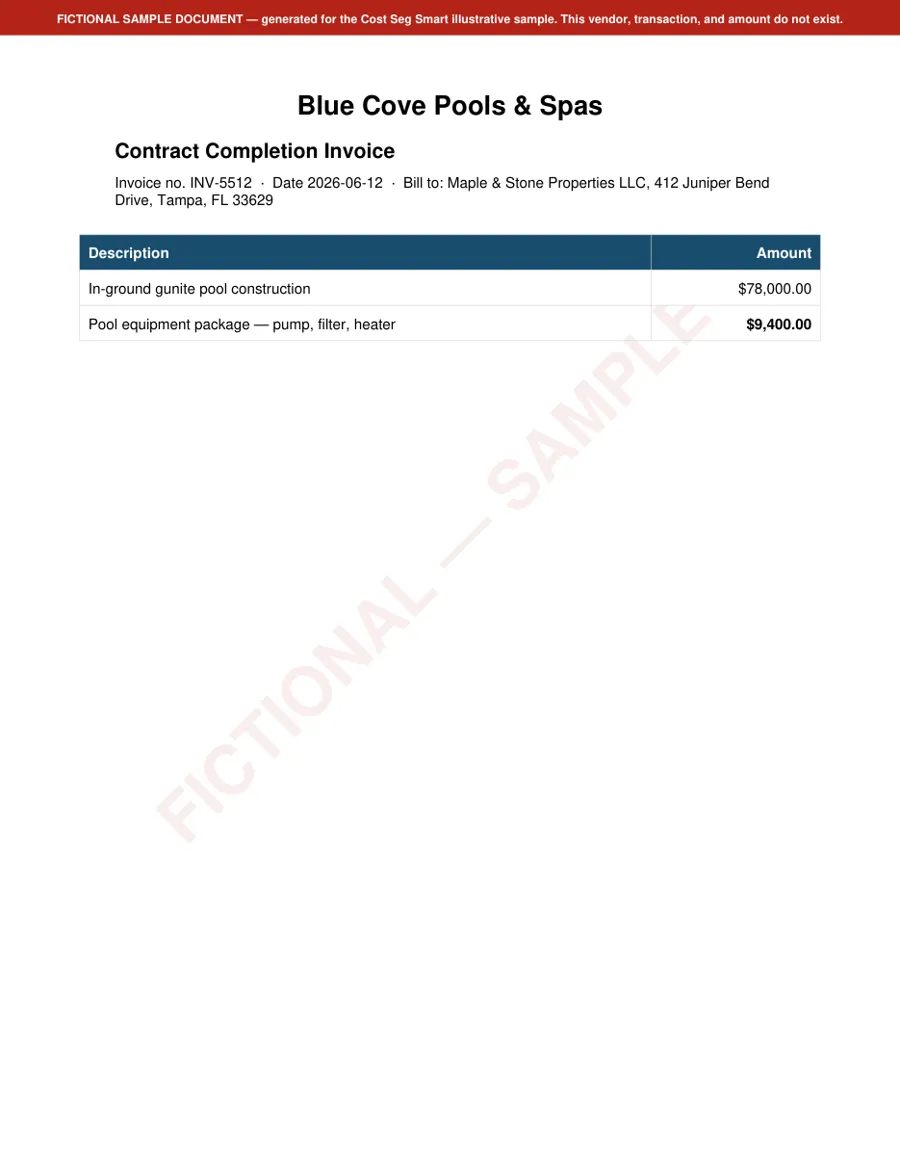
A renovation study has a superpower a purchase study can't match: the evidence already exists. You paid real invoices to real contractors — so instead of modeling components from square footage, we classify your actual documented costs and cite the document and page behind every line. The study's Evidence Manifest reads like an audit binder: Invoice 5512, page 1, $78,000 — in-ground gunite pool construction — 15-year land improvement.
See it yourself: our published sample is a fictional $300K renovation with its complete (fictional) invoice set published alongside it — open the report next to the invoices and follow any dollar from source document to depreciation schedule.
What accelerates in a renovation — and what honestly doesn't
A renovation study has no land and no purchase-price shell to dilute the result — every dollar analyzed is an improvement dollar. Outdoor-heavy residential projects and QIP-qualifying commercial interiors routinely see 50–80% of the documented cost land in accelerated classes.
Shares are of TOTAL DOCUMENTED IMPROVEMENT COST for a typical project of that shape; your study derives every figure from your actual cost lines.
Outdoor & site improvements
15-year MACRS · bonus-eligibleThe workhorse of residential renovation studies. Exterior improvements are land improvements — not 27.5-year building property — and they are bonus-eligible under §168(k).
Personal property — appliances, flooring & equipment
5-year MACRS · bonus-eligibleMovable, non-structural property inside the renovation. Appliances in a residential rental are 5-year property under IRS Pub. 527.
Qualified Improvement Property (commercial interiors)
15-year straight-line · bonus-eligible · §168(e)(6)For NONRESIDENTIAL renovations: interior improvements to a building already in service — partitions, finishes, interior systems — qualify as QIP when the statutory gates are met. Often the majority of a commercial interior refresh.
Building residual
27.5-year (residential) / 39-year (nonresidential)Structural work stays with the building — honestly. Interior drywall and plumbing in a residence, roofing anywhere, and residential cabinetry (held conservatively under our documented firm policy) remain at the building recovery period.
Qualified Improvement Property: the commercial renovation engine
For nonresidential renovations, Qualified Improvement Property (§168(e)(6)) is usually the single biggest lever: interior improvements to a building already in service recover over 15 years straight-line instead of 39 — and they're bonus-eligible under §168(k) (100% for property placed in service after January 19, 2025). An interior refresh that would sit at 39-year for four decades can, when the gates are met, deduct almost entirely in year one.
The statute has hard edges — QIP excludes enlargements, elevators and escalators, internal structural framework, and any building not yet in service — so we apply it behind a documented, fail-closed gate: the study asks the statutory questions in plain English, requires your certification, and prints the gate answers, dollar tallies, and excluded lines in a dedicated QIP exhibit. If a condition isn't affirmed, the costs stay at 39-year. Your CPA never has to wonder why QIP was applied.
QIP never applies to residential rental property — residential renovations accelerate through 15-year land improvements and 5-year personal property instead.
Worked example: the $300K renovation in our sample report
These figures are transcribed from our published sample study — a fictional renovation run through the real engine, invoices and all. Results vary with your documented scope; year-1 figures depend on §168(k) eligibility, §469 status, entity structure, and your CPA's position.
- Situation
- Kitchen remodel + pool, spa & deck + landscaping (residential rental)
- Documented improvement cost
- $300,000 across 9 invoices, 21 cost lines, 3 projects
- Classified into accelerated MACRS
- 76.5% = $229,460 (15-year land improvements + 5-year personal property)
- Estimated year-1 federal deduction
- $231,277 (100% §168(k) bonus on eligible classes)
- Study fee
- $1,495
The sample also shows what doesn't accelerate: residential cabinetry is deliberately held at 27.5-year under our documented policy, explained inside the study. Honest residuals are what make the accelerated classes defensible.
Pricing
Priced on your total improvement cost — the basis being analyzed. No purchase price, no appraisal, no proposal round: every size gets an instant price.
CPA firms get flat wholesale pricing on this study - ask us. Form 3115 §481(a) lookback workpapers available where a prior-year renovation is being caught up.
What makes a renovation study sharp
The study is only as good as the paper trail — fortunately, renovations leave a great one. A cost schedule or spreadsheet is the fastest intake; invoices upgrade every line's evidence tier:
We classify every line — you never assign recovery periods. Lines too general to classify stay conservatively at the building life, flagged with exactly what documentation would sharpen them.
Add-on to this study
Removed something to make room for the new work? Write off what came out.
When a renovation removes building components the owner had already placed in service (an old roof section, a rooftop unit, a storefront, the interior finishes a gut demo took out) their remaining undepreciated basis normally stays inside the 39-year building and keeps depreciating for decades. Treas. Reg. §1.168(i)-8 lets the owner elect to recognize that basis in the year of removal, by reporting the disposition on a timely filed original return (including extensions) for that year. The partial asset disposition study computes and documents the adjusted basis of each removed component, and your preparer decides whether to make the election.
It applies only when all four are true
- The removed components were placed in service by you (first ready and available for rent, or used in your business) before removal. A building you bought and gutted before it was ever ready and available for rent has nothing to dispose of.
- The filing window for the year of removal, including extensions, is still open. There is no late election.
- The building is not in a general asset account.
- The component was yours, not a tenant's improvement carried on the tenant's books.
Each additional building is its own engagement at the same flat fee. A "not sure" answer never holds the study: we compute on a stated conservative assumption and print the question for your preparer.
You receive a disposed-asset schedule (original cost by method, accumulated depreciation attributable, adjusted basis, amount realized, recognized gain or loss), the methodology per item, a for-the-preparer section and import rows, inside the renovation study. How partial dispositions work →
Frequently asked
Can you depreciate renovation costs faster than 27.5 or 39 years?
How is this different from a regular cost segregation study?
Is a kitchen remodel on my rental property worth a study?
What is Qualified Improvement Property (QIP) and when does my renovation qualify?
I renovated in a prior year and just depreciated everything at 27.5/39 years. Too late?
What documents do I need?
What does a renovation study cost?
Do you visit the property?
You already spent the money. Classify it correctly.
Send your invoices or cost schedule and we'll classify every documented dollar — with a fixed-asset schedule your CPA can enter directly, and an evidence manifest behind every line.
Bought the property instead? You want a standard cost segregation study.