Short-term rental and Airbnb cost segregation studies
Move a typical 19–39% of depreciable basis into 5- and 15-year property that bonus depreciation can deduct in year one. Fees start at $495, set by purchase price.
- 26%median share reclassified on our delivered STR studies
- $495starting fee, set by purchase price
- 1–2 business daysmost residential studies, once your documents are in
Updated October 17, 2026
Your year-one deduction
- Year-one depreciation, no study
- $6,667
- Year-one depreciation, with a study
- $108,933
- Study fee
- $895
Illustrative, modeled: 20% land, 26% of the building reclassified, placed in service in July 2026 at 100% bonus. An estimate for planning, not tax advice. Your CPA confirms your basis, recovery period and whether the loss is usable.
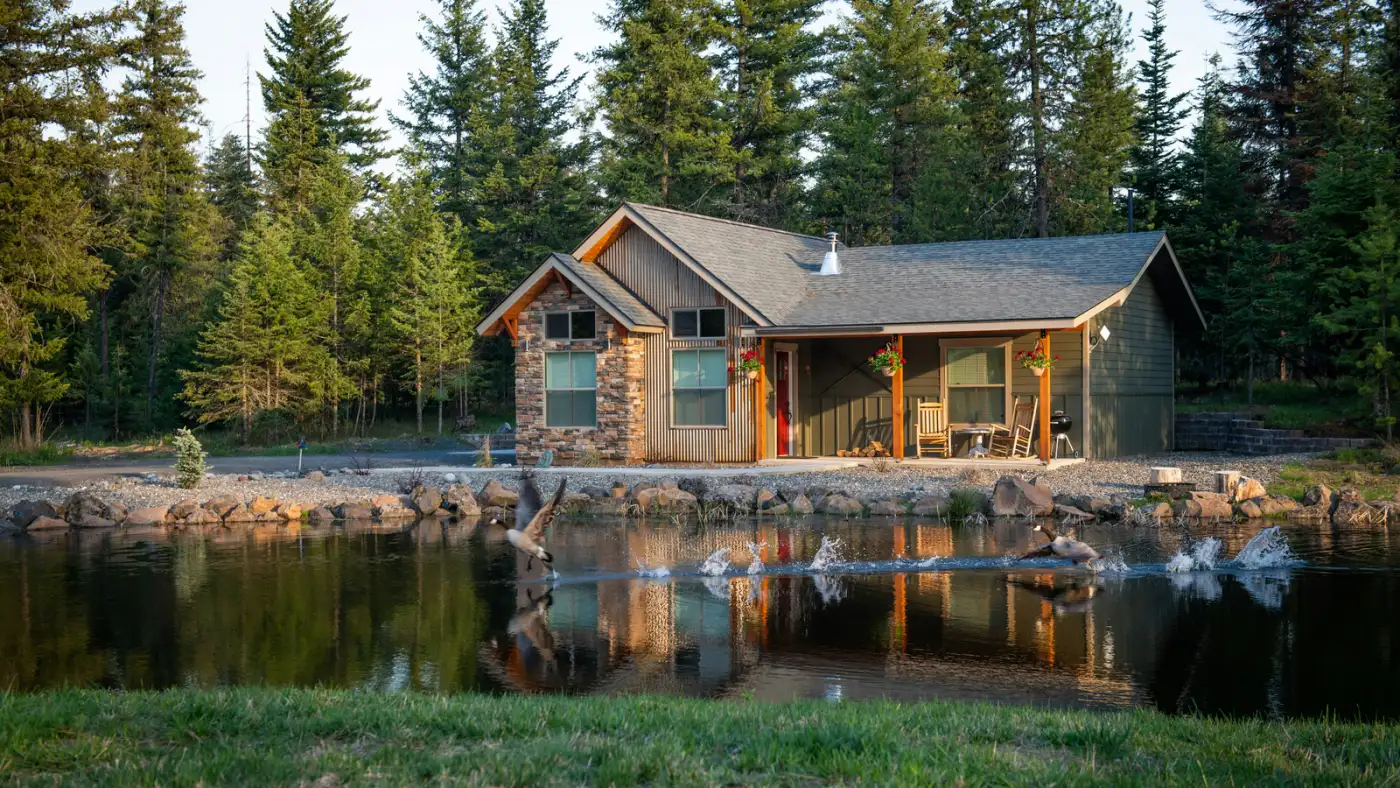
A cost segregation study moves the furniture, appliances and site work in a furnished short-term rental out of the 27.5- or 39-year building and into 5- and 15-year property, typically 19–39% of depreciable basis. Property acquired and placed in service after January 19, 2025 takes 100% bonus depreciation on it in year one. An average stay of 7 days or less only takes the rental out of the rental-activity rule; material participation decides whether the loss is nonpassive, so a short stay alone does not offset W-2 income. Fees start at $495. Most residential studies are delivered in 1–2 business days once your documents are in.
What our delivered short-term rental studies show
The median short-term rental study we delivered to outside clients reclassified 26% of depreciable basis, and most landed between 20% and 36%.
Measured as (5-, 7- and 15-year property) ÷ depreciable basis (purchase price less land), not the purchase price. Studies for outside clients only; internal and test orders are excluded. As of October 1, 2026. The band we quote before a study (19–39%) is deliberately wider, because it is what we tell a buyer to expect before their own study runs. Furnishing level, amenities, lot size and the land share move a property within it, and yours can land outside it.
Will the deduction lower this year's tax?
The study decides how much depreciation you have. Questions about you, not the house, decide whether it lowers this year's tax. Answer two to see what the rules point to.
Average the year's actual stays, not the listing minimum. 30 days or less also counts when you provide substantial services.
Most often 500+ hours in the year, or 100+ hours and more than anyone else, including cleaners and managers.
Answer both questions to see how the passive loss rules are likely to treat the deduction.
Personal use: use the home yourself for more than the greater of 14 days or 10% of the days it is rented at a fair price, and §280A limits deductions to rental income. Your CPA makes these calls on your facts. Your answers stay in this page; nothing is stored or sent.
The 7-day average stay
Under Treas. Reg. §1.469-1T(e)(3)(ii)(A), a property whose average customer stay is 7 days or less is not a "rental activity" for the passive loss rules (30 days or less also works when you provide substantial services). This test only takes the property out of the rental-activity rule. It does not make the loss nonpassive by itself, and it ends the $25,000 allowance for actively managed rentals, which applies only to rental activities.
Material participation
Treas. Reg. §1.469-5T has seven tests. The two most owners use: 500 or more hours in the year, or 100 or more hours and more than any other individual, including your cleaner, co-host or manager. Meet one and the loss is nonpassive. Miss them and the deduction is still yours, but it is passive. Keep a contemporaneous log; our time log template shows what to record.
Personal use under §280A
Use the property yourself for more than the greater of 14 days or 10% of the days it is rented at a fair price, and IRC §280A treats it as a residence: deductions are limited to rental income, so most of a first-year loss cannot be used that year.
In plain terms: a short average stay alone does not let a loss offset W-2 income. You need the short stay and material participation, with personal use under the limit. Each is your CPA's call, on your facts.
A $500,000 furnished Airbnb, step by step
20% allocated to land (our residential default; your county assessor's ratio replaces it), acquired after January 19, 2025 and placed in service in July 2026, so the reclassified property takes 100% bonus depreciation. We use the short-term rental's representative reclassification share, 26%, and a 37% federal bracket. A model of the math, not a client's study.
- Reclassified to 5- and 15-year (26% of basis)$104,000
- Remaining building, 27.5 or 39 years$296,000
- Land, not depreciable (20%)$100,000
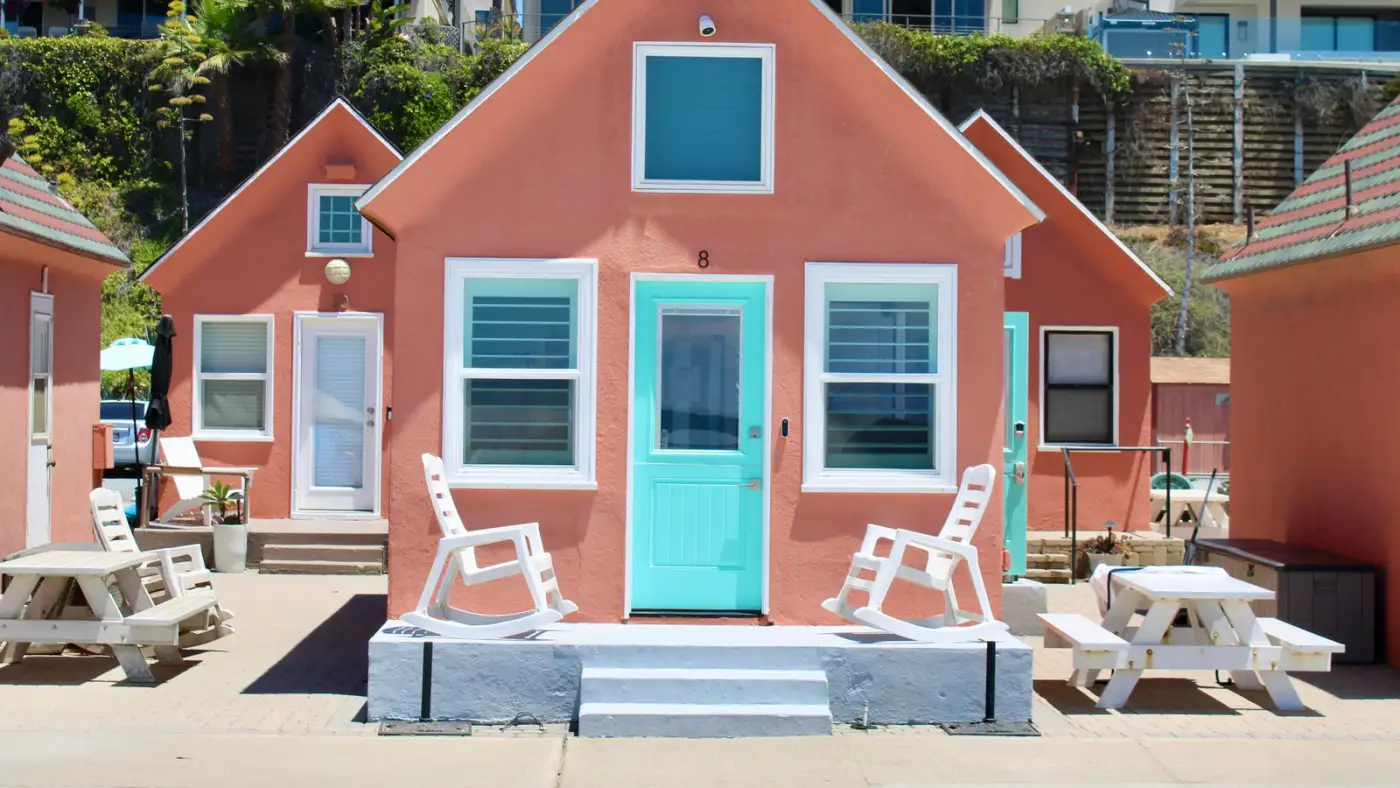
Personal property
- Furniture, beds, décor, TVs, kitchenware and linens
- Appliances, washer and dryer, carpet and other removable flooring
- Portable hot tub, game and outdoor furniture, smart locks and cameras
Furniture and appliances in a residential rental are 5-year property. A furnished rental often conveys a full household of it with the purchase.
Land improvements
- Patios, decks and walkways
- Fencing, landscaping and the driveway
- Site lighting, an in-ground pool and fire pits
Often larger on a vacation property built around outdoor space.
The building
- Structure, roof and framing
- General plumbing and wiring
- HVAC
Stays with the building. This is the part a study does not accelerate.
Classification follows IRS Publication 946, Rev. Proc. 87-56 and the Cost Segregation Audit Techniques Guide (Pub 5653). Why furnished rentals land higher: why short-term rentals often reclassify more.
Year 1
| Filed at 27.5 years | Filed at 39 years | |
|---|---|---|
| Depreciable basis | $400,000 | $400,000 |
| Reclassified to 5- and 15-year (26%) | $104,000 | $104,000 |
| Year-1 depreciation, no study | $6,667 | $4,701 |
| Year-1 depreciation, with a study | $108,933 | $107,479 |
| Extra Year-1 deduction | $102,267 | $102,778 |
| Worth at 37%, if the loss is usable | $37,839 | $38,028 |
| Study fee | $895 | $895 |
Years 1, 5 and 10, cumulative (27.5 years)
| Through | No study | With a study | Difference | Worth at 37% |
|---|---|---|---|---|
| Year 1 | $6,667 | $108,933 | $102,267 | $37,839 |
| Year 5 | $64,848 | $151,988 | $87,139 | $32,242 |
| Year 10 | $137,576 | $205,806 | $68,230 | $25,245 |
Both columns include the building. Without a study the whole $400,000 runs on the 27.5-year schedule; with one, the reclassified $104,000 is deducted in Year 1 and the rest of the building follows the same schedule. Over the full recovery period both reach the same $400,000: a study changes when you deduct, not how much, and recapture applies on a sale.
Should you buy a short-term rental for the deduction?
No. Buy the property that works on cash flow and treat the study as what makes a good deal better. The numbers above assume you have income to offset, that the loss is usable this year, and that you will hold long enough for an earlier deduction to be worth more than the recapture on sale. A study is weaker if you plan to sell within a year or two, your bracket is low, land is most of the price, or the loss will be passive with no passive income to use it. It is not for your own home: only the rented use of a property is depreciable.
An estimate for planning, not tax advice. The estimate at the top uses the same method for your own price; the rental property depreciation calculator takes your exact month, closing costs and land value.
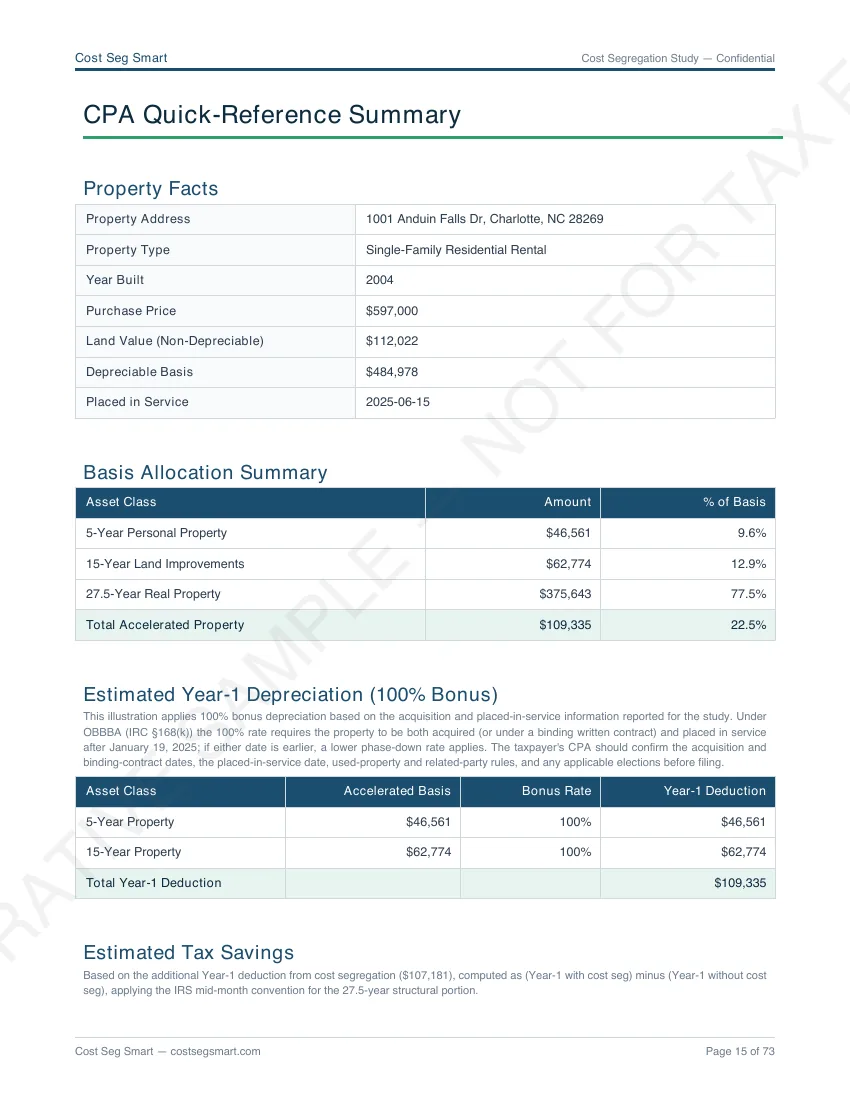
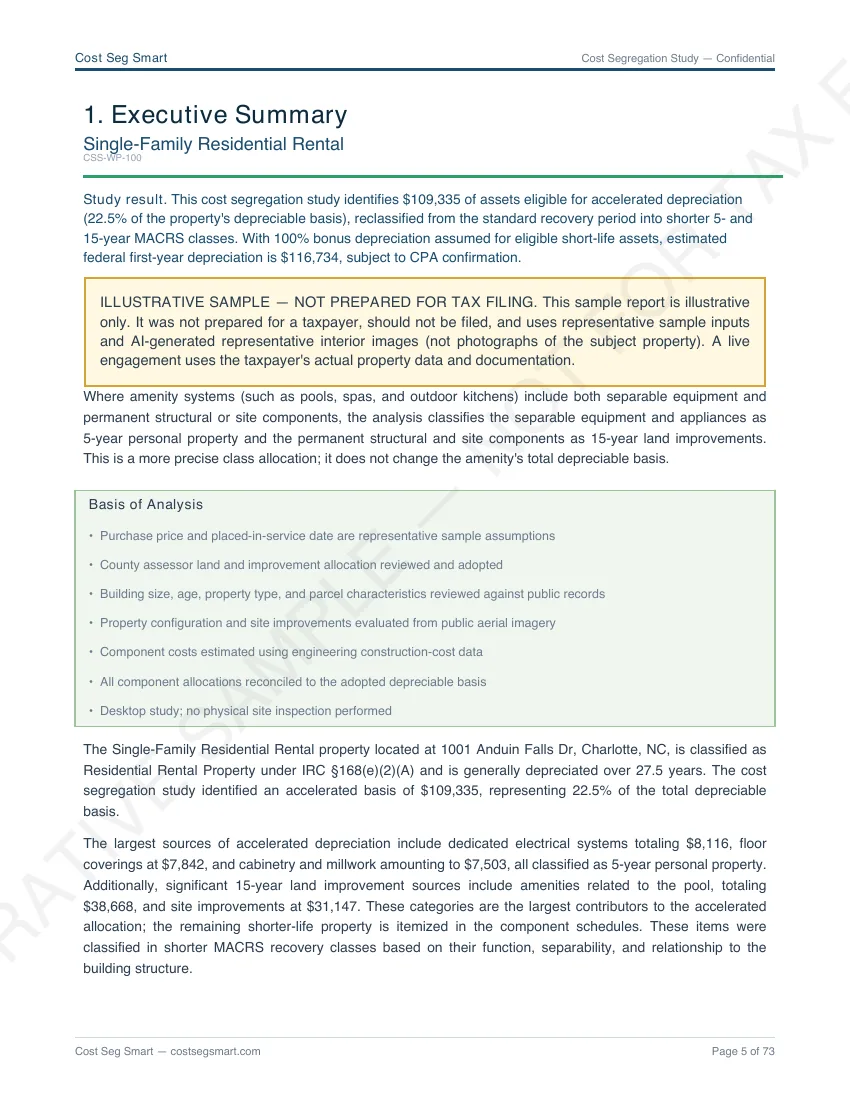
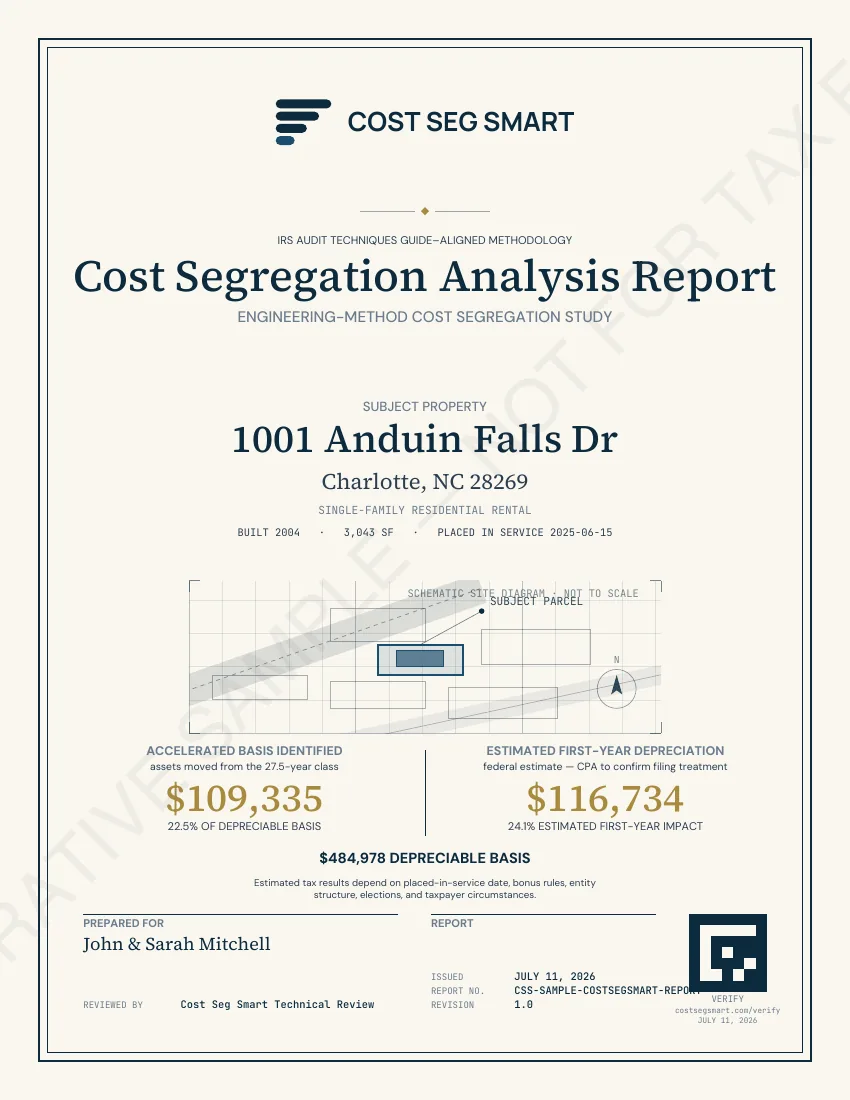
See a finished study first
A CPA-ready report and Excel fixed-asset file, run by our engine on illustrative properties. Inside the report:
- Component-level reclassification into 5-, 15- and 27.5- or 39-year property
- Year-1 tax impact, with and without the study
- CPA quick-reference summary and filing sheet for Form 4562
- Recapture considerations under §1245 and §1250
- Legal authority: IRC §168, Rev. Proc. 87-56 and the Cost Segregation Audit Techniques Guide
- Excel fixed-asset file for your CPA's software
Pages shown are from an illustrative sample study, not a client's property.
Ready now?
Order online, see your exact fee before you pay, and upload your documents after checkout.
One fee, set by purchase price
You see your exact fee on the order form before you pay. Move the estimate's price and your tier lights up.
- Your property <$300K $495
- Your property $300K–$700K $895
- Your property $700K–$1M $995
- Your property $1M–$1.5M $1,295
- Your property $1.5M–$2M $1,595
- Your property Above $2M See pricing
Most residential studies are delivered in 1–2 business days once your documents are in. Portfolios take one to two business days per property, scheduled with you. Studies with an on-site observation take about a week. Higher values are on the pricing page.
Optional add-ons
24-hour rush delivery
Your 24-hour turnaround begins once payment and all required documentation are received, weekends and holidays included. If we need anything before we can begin, we'll tell you. If we miss the deadline, we refund the rush fee. Not available with an in-person site visit.
In-person site visit
Residential rentals (1–4 units): an in-person visit by an independent field data collector, $595 in the 48 contiguous states and DC, travel included. Full refund of the site visit if you cancel before the visit. No refund for a no-show or no access on the scheduled day; the study then proceeds remotely.
Renovations
Renovation costs under $100,000 are analyzed inside your study at no extra charge. From $100,000 to $1 million we add Renovation Cost Segregation ($595), and above that we quote the work.
Add-ons are chosen on the order form and shown in your total before you pay.
Included in every study
- Engineering-based, property-specific analysis
- Direct coordination with your CPA
- Free revisions for 12 months; corrections of our errors always free
- Renovation analysis under $100,000 included
- Lifetime written audit support
- CPA-ready depreciation schedules and Excel fixed-asset file
Everything included in your study fee. Form 3115 preparation available separately.
CPA-Ready Guarantee
Free corrections whenever your CPA finds an issue on our side, then a refund if your CPA still can't use it.
Your CPA
CPA coordination included. We answer your accountant's technical questions in writing, provide supporting schedules, and get on a call or meeting with your CPA when either of you asks.
Revisions
Revisions you ask for are free for 12 months after we first deliver the study, then $195 per revision round. Changes your licensed CPA, EA or tax attorney asks for are free for 36 months after first delivery. Corrections of any error on our side are always free.
Form 3115 for a past year
When a prior-year lookback applies, your report includes the §481(a) catch-up schedule and supporting workpapers, and your CPA prepares, signs, and files Form 3115 with your return. Preparing and signing the form itself is available as a separately engaged, separately priced add-on; filing it, and deciding whether a method change is appropriate, stays with your CPA either way.
Audit support
Lifetime audit support, included: written answers to your CPA's technical questions about our methodology, for the life of the study — no expiry. It does not include IRS representation. Scope.
Three steps, all online
-
 Step 1
 Order online
Enter the address and purchase price, see your fee and pay. About two minutes.
-
 Step 2
 Upload your documents
Your closing statement, your listing link and any photos. Add invoices for furnishings or work done after closing.
-
 Step 3
 Get a CPA-ready study
Most residential studies are delivered in 1–2 business days once your documents are in. Quality-checked before delivery, with the schedules your CPA enters on Form 4562.
Most residential studies, short-term rentals included, are completed remotely from your documents, photos and public records. When a walkthrough would improve the study, we do it with you on a video call, about 30 to 45 minutes, at no charge, anywhere in the US. For commercial and 5+ unit property, in-person visits are available in California, Arizona, Nevada, Oregon and Washington for $895, travel included, and elsewhere by quote. Residential rentals (1–4 units): an in-person visit by an independent field data collector, $595 in the 48 contiguous states and DC, travel included. Residential rentals (1–4 units): an in-person visit by an independent field data collector, $595 in the 48 contiguous states and DC, travel included.
Recovery period, bonus depreciation and recapture
27.5 or 39 years? Your CPA decides
A building is residential rental property, depreciated over 27.5 years, only when at least 80% of its gross rent comes from dwelling units (IRC §168(e)(2)(A)). The code does not count a unit in a hotel, motel or other establishment that is used mostly on a transient basis, so a dwelling rented mostly to short-stay guests may not meet the test, and many CPAs file a short-term rental as 39-year nonresidential real property. Others file it at 27.5 years on their facts. We prepare the study at either, as your CPA directs; the 5- and 15-year property is the same, and only the building's remaining schedule changes.
100% bonus depreciation
Property both acquired and placed in service after January 19, 2025 takes 100% bonus depreciation (IRS Notice 2026-11). Property acquired on or before that date stays on the prior phase-down: 20% when placed in service in 2026. More in bonus depreciation in 2026.
Bought in an earlier year
You can still have a study. A Form 3115 change in accounting method takes the depreciation you missed in the current year as a §481(a) adjustment, without amending past returns.
When you sell
Depreciation on the 5- and 7-year property is recaptured as ordinary income under §1245. On the 15-year land improvements, the bonus taken above straight-line is recaptured as ordinary income under §1250. Straight-line depreciation on the building is unrecaptured §1250 gain, taxed at up to 25%. A §1031 exchange can defer all of it. See depreciation recapture after a study.
State taxes
Not every state follows federal bonus depreciation. See the state conformity table and the Florida short-term rental guide.
Short-term rental cost segregation FAQ
How much does a short-term rental cost segregation study cost?+
The fee is set by purchase price on our residential ladder, starting at $495. A $500,000 short-term rental is $895. The order form shows your exact fee before you pay, and the full table, with optional add-ons, is on our pricing page.
Is cost segregation worth it for an Airbnb?+
Usually, when you can use the deduction this year. In our modeled $500,000 example the study adds $102,267 of Year-1 depreciation, worth about $37,839 at a 37% bracket, for a study fee of $895. It is weaker if you will sell within a year or two, your bracket is low, land is most of the price, or the loss will be passive with no passive income to absorb it.
What is the Airbnb or short-term rental loophole?+
If the average guest stay is 7 days or less, Treas. Reg. §1.469-1T(e)(3)(ii)(A) says the property is not a rental activity under the passive loss rules. If you also materially participate, the loss is nonpassive and can offset wages and business income. The short stay alone does neither; it only removes the automatic passive label that applies to rentals.
Does the short-term rental loophole still work in 2026?+
Yes. The 7-day average stay rule and the material participation tests still apply. Bonus depreciation is 100% for property both acquired and placed in service after January 19, 2025 (IRS Notice 2026-11). Property acquired on or before that date stays on the prior phase-down: 20% when placed in service in 2026.
Can a short-term rental loss offset my W-2 income?+
Only if both are true: the average stay is 7 days or less (or 30 days or less with substantial services), and you materially participate under Treas. Reg. §1.469-5T, most often 500+ hours, or 100+ hours and more than anyone else, including cleaners and managers. Personal use above the §280A limit can also cap the deduction. Your CPA makes these calls on your facts.
Is a short-term rental depreciated over 27.5 or 39 years?+
It depends on the facts, and your CPA decides. 27.5 years applies to residential rental property, where at least 80% of rent comes from dwelling units, and a unit used mostly by transient guests may not count as one. Many CPAs file a short-term rental at 39 years. We prepare the study at either; the 5- and 15-year property is the same, and only the building's schedule changes.
What happens to the deduction when I sell?+
Depreciation on the 5- and 7-year property is recaptured as ordinary income under §1245. On the 15-year land improvements, the bonus taken above straight-line is recaptured as ordinary income under §1250. Straight-line depreciation on the building is unrecaptured §1250 gain, taxed at up to 25%. A §1031 exchange can defer all of it.
I bought my Airbnb years ago. Can I still get a study?+
Yes. When a prior-year lookback applies, your report includes the §481(a) catch-up schedule and supporting workpapers, and your CPA prepares, signs, and files Form 3115 with your return. Preparing and signing the form itself is available as a separately engaged, separately priced add-on; filing it, and deciding whether a method change is appropriate, stays with your CPA either way. The depreciation you missed is taken in the current year as a §481(a) adjustment, without amending past returns.
Do you need to visit the property?+
Usually not. Most residential studies, short-term rentals included, are completed remotely from your documents, photos and public records, and the IRS does not require an on-site inspection. When a walkthrough would improve the study, we do it with you on a video call, about 30 to 45 minutes, at no charge, anywhere in the US. For commercial and 5+ unit property, in-person visits are available in California, Arizona, Nevada, Oregon and Washington for $895, travel included, and elsewhere by quote. Residential rentals (1–4 units): an in-person visit by an independent field data collector, $595 in the 48 contiguous states and DC, travel included.
What do you need from me?+
The address and purchase price, your closing statement, the date the rental was first available to guests, your listing link and any photos. Invoices help for furnishings or improvements you added after closing. We pull county and assessor records and aerial data ourselves.
How fast will I get the study?+
Most residential studies are delivered in 1–2 business days once your documents are in. Portfolios take one to two business days per property, scheduled with you. Studies with an on-site observation take about a week. Every study is quality-checked before delivery and arrives as a CPA-ready PDF with an Excel fixed-asset file.
Does my state allow the same deduction?+
Not always. Some states do not follow federal bonus depreciation and require an add-back, which spreads the state deduction over several years; states with no income tax are unaffected. The federal deduction does not change. Our state conformity table shows each state's treatment and source.
Figures on this page are estimates for planning, not tax advice. Confirm your basis, land allocation, placed-in-service date, recovery period and passive activity position with your tax professional.
Go deeper
- The short-term rental loophole, explainedThe 7-day rule, the 30-day substantial-services rule and what each one does.
- Material participation for STR ownersAll seven tests in Treas. Reg. §1.469-5T, and the two most owners use.
- Material participation time logA template and a filled-in example of what to record, and when.
- Is cost segregation worth it for an Airbnb?When the study pays for itself and when it does not.
- Florida short-term rental cost segregationNo state income tax, the corporate add-back and Florida market notes.
- STR cost segregation benchmarks by marketModeled first-year figures across short-term rental markets.
Order your short-term rental's study. From $495.
Enter the address and purchase price, see your exact fee, and pay. Most residential studies are delivered in 1–2 business days once your documents are in.