Remote cost segregation studies, ordered online.
Can a cost segregation study really be done without visiting the property?
Yes. Many residential rental properties can be analyzed remotely when reliable purchase records, property data, photographs, and other documentation adequately identify the building and its components. More complex or poorly documented properties may still benefit from an on-site inspection.
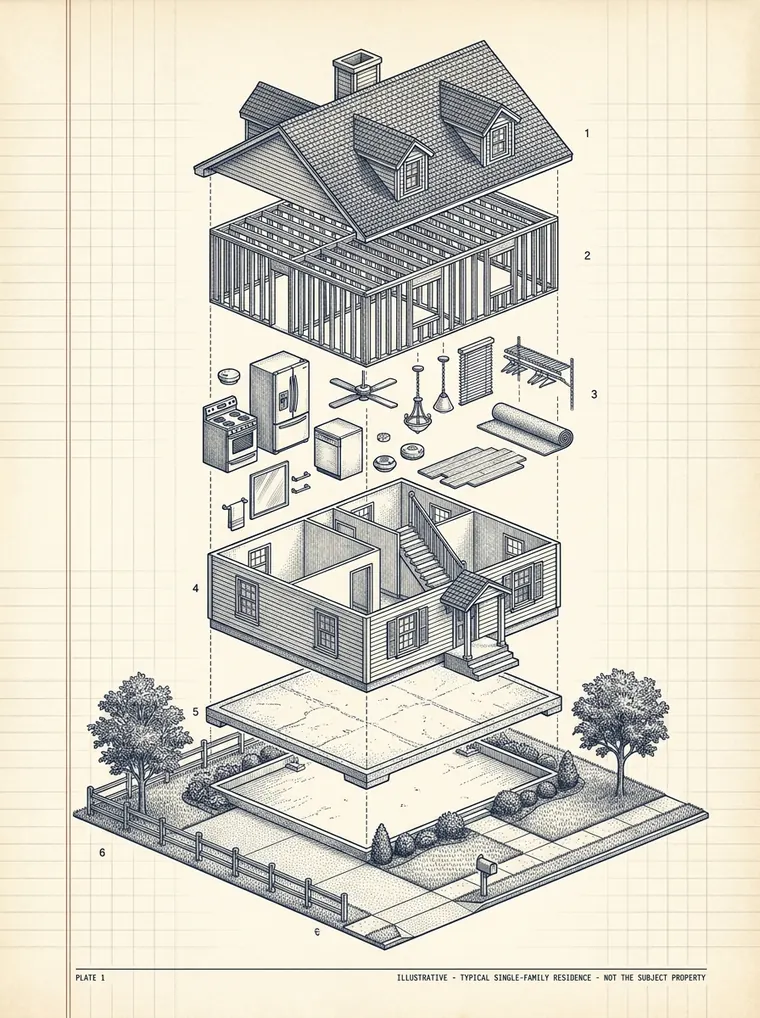
A remote cost segregation study performs an engineering-based analysis from documentation — closing records, county and assessor data, photographs, and aerial imagery — rather than an on-site inspection. It applies the same general cost-segregation framework and the same MACRS recovery periods, and produces the same type of CPA-ready component schedule. Whether remote documentation is sufficient depends on the property, the records available, and the complexity of the assets being classified.
Is a remote cost segregation study defensible?
The IRS Cost Segregation Audit Techniques Guide evaluates the quality of a study through its methodology, documentation, asset identification, cost analysis, and reconciliation. It does not establish a blanket rule that every cost segregation study must include an on-site inspection.
Whether remote documentation is sufficient depends on the property, the available records, and the complexity of the assets being classified. That is the real decision — not "remote versus on-site" as a slogan, but whether the evidence in hand can reliably identify and classify the building's components.
How a remote study is actually done
The work is engineering-based, and it is not a single linear checklist. Several independent evidence sources feed the analysis in parallel; the analysis classifies the building's components; and a validation stage reconciles and reviews the result before it ships.

Evidence inputs
- Purchase and closing records
- County and assessor records
- Property photographs
- Aerial and mapping data
- Improvement invoices and plans, when available

Engineering analysis
- Component identification
- Quantity and cost modeling
- Tax classification
- Recovery-period assignment

Validation and delivery
- Basis reconciliation
- Automated quality checks
- Team review when a check flags it
- CPA-ready report
Because the inputs are independent, they cross-check one another: county records confirm what photographs suggest, aerial data confirms site improvements, and the reconciliation stage catches inputs that don't agree.
Remote cost segregation vs. traditional cost segregation
The clearest way to compare is by engagement model — how the work is typically scoped and delivered — rather than by claiming one is universally equal to or cheaper than the other. Both aim for the same result: a well-documented, CPA-ready study.
| Traditional engagement model | Cost Seg Smart remote model | |
|---|---|---|
| Property review | May include a scheduled site inspection | Primarily document- and photo-based |
| Turnaround | Often measured in days or weeks | Most residential studies completed in 1–2 business days |
| Pricing | Frequently several thousand dollars | Residential studies start at $495 |
| Best suited for | Complex, unusual, or highly customized properties | Well-documented residential and ordinary commercial properties |
Timelines and pricing vary by provider, property size, complexity, documentation, and service scope.
When a remote study fits — and when we visit
Being honest about fit is part of a defensible study. Most residential properties are a strong remote fit; some need more documentation; and for certain properties we perform an on-site visit ourselves.
- Single-family rentals, condos, and townhomes
- Short-term rentals (Airbnb / VRBO)
- Duplexes and smaller multifamily
- Ordinary commercial with standard construction
- …with adequate photos and records
- Heavily renovated properties
- Limited or no photographs
- Mixed-use buildings
- Detached or accessory structures
- Incomplete improvement records
- Warehouse, industrial, and manufacturing
- Specialized or larger multifamily
- Specialized residential and unusual construction
- Specialized medical facilities and data centers
- Highly customized tenant improvements
- Any property whose material components can't be reliably identified from documentation
We perform site visits on commercial, warehouse, industrial, and specialized or larger multifamily and residential properties when a visit will materially change the components we can identify — and therefore the report. Remote is our default only when a visit wouldn't change the answer, so you're not paying for effort that doesn't improve the study. In-person visits happen in California, Arizona, Nevada, Oregon and Washington, including Southern California and the San Francisco Bay Area, typically scheduled within about a week.
Virtual site visit. When a walkthrough would improve the study, we do it with you on a video call, about 30 to 45 minutes, at no charge, anywhere in the US. For commercial and 5+ unit property, in-person visits are available in California, Arizona, Nevada, Oregon and Washington for $895, travel included, and elsewhere by quote. Residential rentals (1–4 units): an in-person visit by an independent field data collector, $595 in the 48 contiguous states and DC, travel included. The video walkthrough covers greater Houston, Miami, Orlando and South Carolina. See how a site visit works.
Built for documented, repeatable review
These are the attributes that make a remote study defensible — the substance is the analysis and the review behind every report.


Every study is reviewed before delivery by our Technical Lead. If your CPA flags an issue, we revise the report at no charge.
Remote cost segregation FAQ
Can a remote cost segregation study support federal tax reporting?
A remote study produces the same core work product as a traditional study: an engineering-based analysis that identifies building components, models their cost, and assigns each to its MACRS recovery period, with a documented, reproducible basis your CPA files from. The IRS does not preapprove any study format; what matters is the quality of the analysis and the documentation behind it. A well-documented remote study gives your CPA what they need to report accelerated depreciation and to support the position if it is ever questioned. Whether remote documentation is sufficient depends on the property and the records available.
Is a remote study as accurate as one with a site visit?
For well-documented residential and ordinary commercial properties, generally yes. The component mix of a single-family rental, condo, short-term rental, or small multifamily is well-characterized by its property type, size, finishes, and site improvements — all established from closing records, county and assessor data, photographs, and aerial imagery. Accuracy in cost segregation comes from correct component identification, defensible cost modeling, and sound recovery-period assignment, not from physical presence itself. An on-site visit mainly adds value where components are unusual, custom, or hard to identify from documentation. Where the available records cannot reliably identify the material components — a heavily renovated property with no records, or a specialized industrial system — a study may need additional documentation or an on-site inspection. Our process flags those cases rather than forcing a result: every study runs through basis reconciliation and automated quality checks before delivery, and our team reviews any study a check flags.
Which properties are a good fit for a remote study?
Ordinary residential rentals — single-family, condos, townhomes, duplexes, and short-term rentals — plus smaller multifamily and many ordinary commercial buildings are strong fits when reliable purchase records, property data, and photographs adequately identify the building and its components. These property types have well-understood component mixes, so the documentation carries the analysis. Fit is really about documentation sufficiency and complexity, not a single property category. Renovated or lightly documented properties can often still be analyzed remotely with some additional records, and highly specialized buildings may be better served by an on-site inspection.
When do you perform an on-site visit?
We perform on-site visits ourselves for properties where a visit will materially change the components we can identify — and therefore the report: commercial, warehouse, industrial, and specialized or larger multifamily and residential properties, along with specialized medical facilities, data centers, highly customized tenant improvements, and unusual construction. We also perform or request a visit when documentation is too limited to reliably identify the material components. Remote is our default only when a visit wouldn't change the answer, because we don't think the added effort justifies the added cost to you when it wouldn't improve the study. In-person visits happen in California, Arizona, Nevada, Oregon and Washington; elsewhere we do the walkthrough with you on a video call, and an in-person visit is available by quote. Residential rentals (1–4 units): an in-person visit by an independent field data collector, $595 in the 48 contiguous states and DC, travel included.
Can commercial properties be done remotely?
Many ordinary commercial properties — office, retail, and similar buildings with standard construction and adequate documentation — can be analyzed remotely using the same general cost-segregation framework. As complexity rises, with specialized systems, heavy process equipment, unusual layouts, or thin documentation, a site visit becomes more valuable — and for those we perform one ourselves when it will materially change the report. We scope commercial work case by case and recommend the approach that produces the most defensible study for your property.
What if I don't have photos?
Photographs help corroborate finishes, flooring, fixtures, and site improvements, but they are one input among several — closing records, county and assessor data, and aerial and mapping data also help identify components. If you have few or no photos, we can often still proceed, though the analysis may lean more conservative where a component can't be corroborated, and we may ask for specific additional documentation. If the available records can't reliably identify the material components, we'll tell you rather than guess.