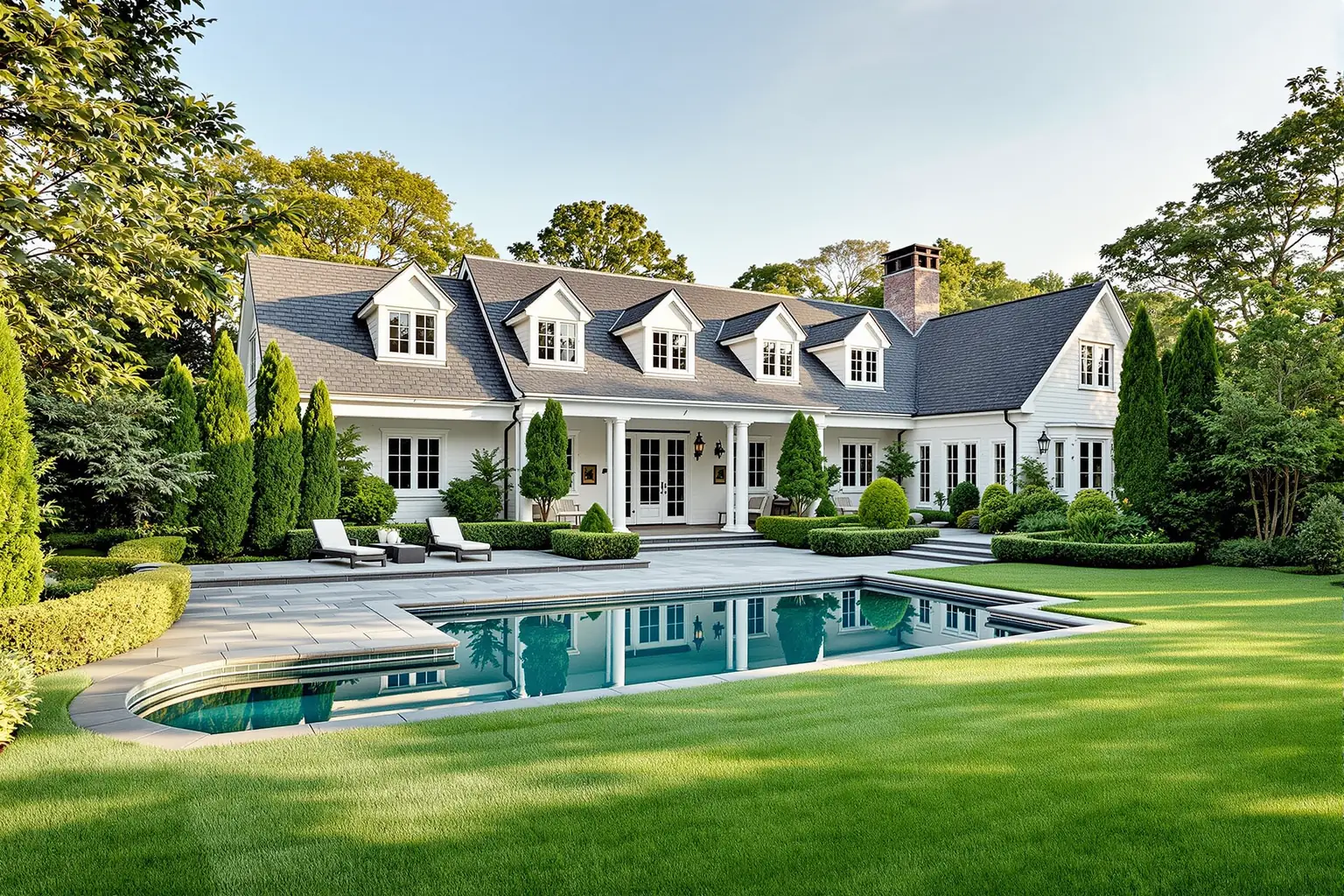
Every Southampton owner has heard the same thing: most of my value is land, and land does not depreciate, so depreciation is small. Land itself is indeed non-depreciable. But the improvements sitting on that land are legally distinct from the land, and on a Hamptons estate an unusually large share of value is site improvements: the pool, the sport courts, the bluestone, the irrigation, the hedges, the drainage. Those are 15-year depreciable land improvements, not land. The very thing that makes the Hamptons expensive, that you are buying grounds and not just a house, is what makes a properly engineered study pay.
Want a number for a specific Southampton property? Use the calculator. It is pre-set with property-type defaults you can adjust to match your basis and tax bracket.
Cost Segregation in Southampton, NY
A worked example (modeled)
Consider a furnished Southampton estate rental acquired for $6,500,000. Every figure here is a modeled illustration, not a measured result or a promise; your study and CPA determine the actual amounts.
Estate land is a very high share of value here, so land comes out first (the exact percentage is property-specific and set from an appraisal or §1060 allocation, never assumed). That leaves a depreciable building basis of roughly $2,600,000. An engineering-based study commonly reclassifies 19–39% of building basis into shorter recovery periods on residential work, and on a grounds-heavy estate it tends toward the upper end. Modeled at about 28%, that is roughly $730,000 reclassified: on the order of $200,000 of 5-year personal property (furnishings and equipment) and $525,000 of 15-year land improvements (pool, courts, bluestone, irrigation, drainage, landscaping), plus a small 7-year slice.
Under 100% bonus, that reclassified amount is deductible in year one on the federal return. At a 37% bracket the modeled first-year federal tax reduction is about $270,000, roughly 45 times a typical study fee. Treat it as a timing benefit, not a permanent elimination of tax.
The grounds are the story
A national residential template models a house. A Hamptons estate is mostly grounds, and the grounds are where a generic study leaves the most on the table. Gunite pools and spas, pool houses and cabanas, tennis and pickleball courts, bluestone and gravel motor courts, patios and walkways, retaining walls, specimen landscaping and privet hedges, elaborate irrigation, site drainage and dry wells, gated entries, and perimeter fencing are all 15-year land improvements, and their classification is well settled. A grounds-aware engineering study separates them out of the non-depreciable land bucket, where a naive land/building split leaves them. Furnished-estate FF&E adds a conservative 5-year layer on top. Aggressive 5-year treatment of decorative lighting and cabinetry is contested (AmeriSouth) and CPA-gated, so we keep those items conservative and lead with the defensible 15-year grounds.
New York does not conform to federal bonus
Get this exactly right, because national competitor pages advertise “100% bonus” without disclosing it. New York does not conform to federal §168(k) bonus depreciation. You add the federal bonus back and recompute New York depreciation on Form IT-398, reported through IT-225. But the reclassification still accelerates the state deduction, because New York’s recomputed depreciation uses regular MACRS over the shorter 5/7/15-year lives, which is dramatically faster than 27.5- or 39-year straight-line. So cost segregation still improves the New York result, as MACRS acceleration rather than bonus.
This matters more here than almost anywhere, because many Hamptons estate owners are New York City residents taxed on worldwide income at a combined New York State and City top marginal rate among the highest in the nation. A timing deduction is worth more against a higher rate. See bonus depreciation by state and our guide to cost segregation in New York City, and route the New York mechanics to your CPA.
Town, Village, and the 14-day minimum
Short-term-rental rules here are strict and split by jurisdiction. The Town of Southampton requires a rental permit for any rental of any duration and sets a 14-day minimum stay, which functions as a ban on true nightly and weekly rentals. The Village allows a one-week rental only twice per calendar year under its seasonal-use rules. None of that changes the depreciation math: cost segregation applies to any income-producing property, including a two-week-minimum seasonal rental or a long-term lease. Because the town minimum is 14 days, the federal under-7-day loophole usually does not apply, so owners typically reach non-passive treatment through real-estate-professional status or material participation, a fact-specific CPA determination.
Done remotely for most residential properties
The study is engineering-based but conducted remotely from your closing and appraisal documents, site and landscape plans, invoices, aerials, and photos. For most residential properties there is no on-site visit. We use industry-standard, nationally recognized construction cost data to support the component allocation. See how remote cost segregation works and what a cost segregation study is.
Southampton submarkets
- Village of Southampton: the estate section under the Village seasonal-use regime; trophy grounds mean large 15-year buckets.
- Sagaponack and Water Mill: among the priciest ZIP codes in the country, with extreme land share, so the grounds reframe hits hardest here.
- Bridgehampton, North Sea, and Shinnecock Hills: equestrian and estate properties with extensive grounds and outbuildings, and a broader price range.
Learn more about cost segregation
- Remote cost segregation: how an engineering-based study is delivered without a site visit
- What is cost segregation?: the full explanation of how the study works and what you receive
- Bonus depreciation by state: how New York non-conformity affects timing
- Cost segregation in New York City: the high-marginal-rate resident angle
- By property type: short-term rentals, multifamily, single-family rentals, warehouse & industrial
Ready to see your actual Southampton numbers?
Want a number for a specific Southampton property? Use the calculator, or start a preliminary analysis. Figures on this page are modeled illustrations; your study and CPA determine the actual amounts.
CPA use note: These figures estimate the size of the depreciation deduction. Whether the loss is usable in the current year depends on passive-activity rules, STR material participation, REPS status, entity structure, depreciable basis, and state conformity. Your CPA decides how and when it is applied. Specialty and site components (equipment, casework, docks, pools, arenas, tenant improvements, and similar) are only classified when you own them and they are included in the depreciable basis being studied.
How should Southampton, NY investors choose a cost segregation provider?
For a Southampton, NY investor buying a property in the $6,500,000 range, the choice of provider is a major controllable variable in the return. The IRS Audit Techniques Guide sets the quality characteristics an engineering-based study should meet — industry-standard construction cost data, MACRS classification, and component-level documentation — but it does not make every provider's work identical; rigor, cost, and turnaround still vary.
Traditional engineering studies often run several thousand dollars and can take several weeks, because they include on-site inspections, sales discovery calls, and scheduling overhead. The IRS Cost Segregation Audit Techniques Guide does not prescribe an on-site inspection as a standalone requirement; it sets out the quality characteristics of an engineering-based study — component-level classification, a documented and supportable cost derivation, and a clear audit trail — and describes how a physical inspection can contribute to meeting them.
Modern automated providers (such as Cost Seg Smart) deliver an engineering-based, IRS ATG-aligned study using property records, documents, photos, and recognized construction-cost data, typically from $495 and often within 1–2 business days. For a Southampton, NY investor at a high combined bracket, that cost and speed difference is meaningful. The CPA-Ready Guarantee (free revisions if your CPA flags a problem, and a refund if the report still can't be used) makes the decision essentially risk-free on the report itself.
The automated path is best-fit for owners who can provide closing documents and property photos online (no in-person visit required) and want the report in time to file the current year's return rather than the next one.
All Cost Seg Smart studies include the CPA-Ready Guarantee (free revisions if your CPA flags a problem, and a refund if the report still can't be used). Straightforward residential studies are often delivered in 1–2 business days and completed remotely; larger or more complex commercial studies take longer and may include an on-site observation.