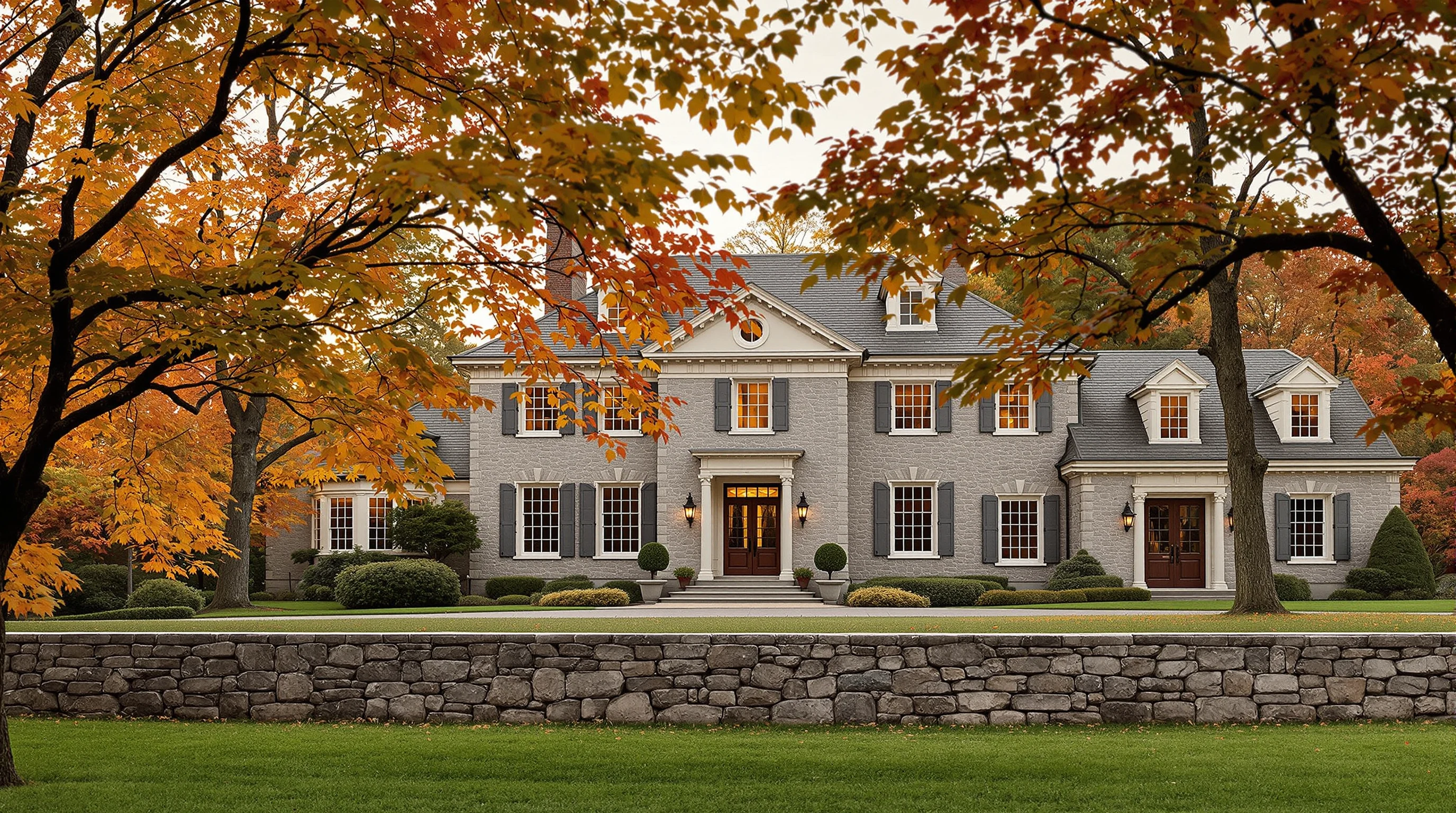
If you live in Westchester County, you escape NYC’s 3.876% city wage tax and pay only federal 37% + NIIT 3.8% + New York State 9.65% = ~50.5% combined at the top bracket. Westchester’s investor pool combines NYC-commuter finance/medicine with a unique concentration of Fortune 500 corporate HQs that aren’t in NYC: IBM, Mastercard, PepsiCo, Regeneron all headquartered in Westchester.
- $187,000 Accelerated Depreciation (typical STR worked example)
- $76,000 Est. Year-1 federal tax savings (37% + 3.8% NIIT; NY portion deferred over MACRS)
- 76x Return on Study Cost
Want a number for your specific situation? Use the calculator, preset for property-type defaults you can adjust to your basis and bracket.
Who are Westchester cost segregation investors?
Westchester County’s investor pool combines two distinct cohorts:
- Fortune 500 corporate HQ workforce: IBM HQ Armonk (senior tech and executive workforce, plus IBM Research Watson, Yorktown Heights), Mastercard HQ Purchase (technology and product leadership), PepsiCo HQ Purchase, Regeneron Pharmaceuticals HQ Tarrytown (one of the largest biotech employers in the U.S. by market cap), MBIA Armonk, Hitachi Tarrytown. Senior executives and senior engineering earn $400K–$2M+ with significant stock-based comp.
- NYC commuters: Senior finance MDs, BigLaw partners, attending physicians who chose Westchester for the school districts (Scarsdale, Chappaqua, Rye, Bronxville) and commute to NYC. Same federal + state stack as Manhattan residents but without NYC city wage tax, a 3.876 percentage-point savings. Senior comp $500K–$3M+.
The combined marginal-rate stack:
- Federal: 37%
- NIIT: 3.8%
- New York State: 9.65% (top rate)
- No NYC city tax (Westchester residents are not subject to NYC city wage tax)
- Combined: ~50.5%
The 3.876 percentage-point savings on NYC city tax is the structural reason most NYC-commuter senior executives live in Westchester rather than Manhattan. Cost-seg’s per-dollar value reflects this: ~$0.505 saved per accelerated dollar for Westchester residents vs ~$0.515 for Manhattan residents, but Westchester’s COL advantages (housing, taxes) tend to compound favorably.
Verify with your CPA: combined-rate math depends on filing status, AGI thresholds for NIIT, and the actual NY/NYC brackets your income lands in.
Why cost seg pays more if you live in Westchester
A typical $600K–$1.5M out-of-state STR reclassifies 19–39% of basis under permanent 100% bonus depreciation. At the federal Year-1 rate (37% + 3.8% NIIT), every $1 of accelerated depreciation is worth ~$0.408 in Year-1 cash savings federally.
New York does not conform to federal §168(k) bonus depreciation, so the NY state share of the deduction is deferred over standard 5/7/15-year MACRS rather than taken in Year 1; the federal Year-1 benefit is unaffected. See New York bonus depreciation.
The Westchester structural advantage: stock-vesting timing. IBM, Mastercard, PepsiCo, and Regeneron all use multi-year vesting schedules that generate concentrated taxable income spikes. A $187K cost-seg deduction generates ~$76K in federal Year-1 tax savings — well-aligned with a representative $200K–$500K vesting event.
Earning W-2 income? The W-2 earner’s guide to cost segregation covers the seven-day rule, the participation tests, and a self-check for which test your hours meet.
Where do Westchester investors buy property?
Westchester investors flow capital to STR markets within a 2-3 hour drive or short flight:
- The Catskills + Hudson Valley: Closest accessible STR, 1.5-2 hour drive. Local zoning tightening; underwrite carefully.
- The Berkshires, MA: Cultural + weekend STR, 2-hour drive.
- The Hamptons + Long Island: Premium summer STR.
- Vermont (Stowe, Killington, Manchester): Mountain STR, 4-hour drive.
- 30A / Destin, FL: Florida 0% state tax, premium beachfront, direct LGA/JFK flights.
- Outer Banks, NC: Atlantic coastal STR.
An illustrative Westchester investor’s worked example
An IBM Armonk senior VP earning $625K base + $400K RSU vesting + $150K performance bonus, residing in Chappaqua (Westchester County), buys a 4BR Catskills mountain estate for $825K with $30K immediate FF&E. After $200K in land, the $625K adjusted basis includes $75K in 5-year assets (hot tub, smart-home, theater system, kitchen package, decorative lighting), $28K in 7-year assets (custom furniture, themed bunk-room build-outs), and $84K in 15-year property (gravel drive, deck, retaining walls, fencing, outdoor lighting).
That’s $187K reclassified into accelerated depreciation in Year 1. At the federal Year-1 rate (37% + 3.8% NIIT), the federal tax savings come to roughly $76,000, about 76x the cost of the study. (The NY state share of the deduction is deferred over MACRS, not taken in Year 1; see the note above.) The deduction can be timed against the $400K RSU vesting event for concentrated offset.
Who doesn’t qualify for cost segregation in Westchester?
REPS is structurally impossible for a full-time IBM senior VP, Mastercard senior product lead, Regeneron senior research scientist, or NYC-commuting BigLaw partner. The STR exception (Reg. §1.469-1T(e)(3)(ii), 7-day average + 100-hour material participation) is the path.
For Westchester investors buying in the Catskills or Berkshires, the 1.5-3 hour drive makes the 100-hour material participation test particularly feasible through monthly on-site visits plus active remote management.
Cost segregation data for Westchester County, NY investors
The representative (median) outcome across 50 engine-modeled property scenarios matched to the Westchester County, NY investor profile. Year-1 savings shown are the federal benefit (37% + 3.8% NIIT). This state does not conform to federal bonus depreciation, so the state share is not accelerated; it recovers over standard MACRS.
Representative scenarios modeled via Cost Seg Smart's proprietary
engine — IRS ATG-aligned methodology, industry-standard 2026 construction cost data base costs,
calibrated metro multipliers. n=50 fixtures matched to
Westchester County, NY investor profile. Not derived from individual
client returns. Methodology v1.0.0, generated
May 2026 (reproducible seed: westchester-ny_v1_2026-05-17).
Year-1 savings shown are the federal benefit only (37% + 3.8% NIIT). This state does not conform to federal §168(k) bonus depreciation, so the state share is deferred over standard MACRS rather than realized in Year 1; the federal benefit is unaffected. Confirm specifics with your CPA.
Tax law current as of July 2026. Federal: OBBBA restored 100% bonus depreciation under §168(k), permanent for property both acquired and placed in service after January 19, 2025 (property acquired or placed in service on or before that date remains under the prior 40% phase-down); 2026+ stays 100%. State conformity varies; verify with your CPA.
CPA use note: These figures estimate the size of the depreciation deduction. Whether the loss is usable in the current year depends on passive-activity rules, STR material participation, REPS status, entity structure, depreciable basis, and state conformity. Your CPA decides how and when it is applied. Specialty and site components (equipment, casework, docks, pools, arenas, tenant improvements, and similar) are only classified when you own them and they are included in the depreciable basis being studied.
How should Westchester County, NY investors choose a cost segregation provider?
For a Westchester County, NY investor buying a property in the $825,000 range, the choice of provider is a major controllable variable in the return. The IRS Audit Techniques Guide sets the quality characteristics an engineering-based study should meet — industry-standard construction cost data, MACRS classification, and component-level documentation — but it does not make every provider's work identical; rigor, cost, and turnaround still vary.
Traditional engineering studies often run several thousand dollars and can take several weeks, because they include on-site inspections, sales discovery calls, and scheduling overhead. The IRS Cost Segregation Audit Techniques Guide does not prescribe an on-site inspection as a standalone requirement; it sets out the quality characteristics of an engineering-based study — component-level classification, a documented and supportable cost derivation, and a clear audit trail — and describes how a physical inspection can contribute to meeting them.
Modern automated providers (such as Cost Seg Smart) deliver an engineering-based, IRS ATG-aligned study using property records, documents, photos, and recognized construction-cost data, typically from $495 and often by the next business day. For a Westchester County, NY investor at a high combined bracket, that cost and speed difference is meaningful. The CPA-Ready Guarantee (free revisions if your CPA flags a problem, and a refund if the report still can't be used) makes the decision essentially risk-free on the report itself.
The automated path is best-fit for owners who can provide closing documents and property photos online (no in-person visit required) and want the report in time to file the current year's return rather than the next one.
All Cost Seg Smart studies include the CPA-Ready Guarantee (free revisions if your CPA flags a problem, and a refund if the report still can't be used). Straightforward residential studies are often delivered the next business day and completed remotely; larger or more complex commercial studies take longer and may include an on-site observation.