
Tampa is the rare Florida market where the long-term rental math beats the short-term rental math, and most owners do not realize it. Hillsborough County’s 30-day STR minimum killed the Airbnb playbook before it ever got going, which pushed the entire investor class into LTRs at 2020–2022 peak prices. Cost segregation plus a Form 3115 lookback is the only credible way to turn three years of overpaying into a refund.
- $90,000 Accelerated Depreciation
- $37,000 Est. Year-1 Tax Savings
- 47x Return on Study Cost
Want a number for a specific property here? Use the calculator, pre-set with property-type defaults you can adjust to match your basis and tax bracket.
If you live in Tampa but invest elsewhere
Tampa Bay’s investor pool clusters across three cohorts:
- Relocated finance + insurance: Raymond James Financial HQ St. Petersburg, JPMorgan Tampa (one of JPM’s largest ops centers outside NYC), Citi Tampa (15,000+ employees), MetLife Tampa, Charles Schwab Tampa, plus growing private wealth offices from BNY Mellon, Northern Trust, and US Bank wealth management. Many senior bankers, traders, and wealth advisors relocated from NYC/NJ/CT for the FL 0% state tax wedge. Senior finance professionals $400K–$2M+.
- Medical: Moffitt Cancer Center (one of 53 NCI-designated comprehensive cancer centers, attending physicians + senior research), AdventHealth Tampa, Tampa General Hospital, HCA West Florida Division, BayCare. Senior attendings $400K–$1.5M+.
- Tech + corporate: Bristol-Myers Squibb Tampa, OSI Restaurant Partners, Mosaic Company, plus growing tech-relocation employers (Reliaquest, Geographic Solutions, Capstone Logistics).
The combined marginal-rate stack:
- Federal: 37%
- NIIT: 3.8%
- Florida: 0% (no state income tax)
- Combined: ~40.8%
FL’s 0% state position is the structural reason Tampa has attracted aggressive finance relocation. A senior Raymond James VP or JPM Tampa MD relocated from NYC saves approximately 10.7 percentage points (NY 6.85% state + NYC 3.876% city) on their state-tax bill, meaningful at $500K+ income. Cost-seg’s per-dollar value is lower than NY/CA brackets but cleaner, with no state-side conformity adjustment to manage.
Where Tampa investors are buying:
- Florida Gulf Coast (Anna Maria Island, Siesta Key, Sanibel, Naples): Drivable in-state STR; FL 0% stays in stack.
- Naples, FL: Drivable premium Gulf STR.
- Smoky Mountains (Pigeon Forge, Gatlinburg): Tennessee 0% state tax, cabin STR; direct TPA flights.
- Charleston, SC: Historic walkable STR, drivable.
- Asheville, NC: Blue Ridge mountain STR market.
Verify with your CPA: combined-rate math depends on filing status and AGI thresholds for NIIT.
Cost Segregation in Tampa, FL
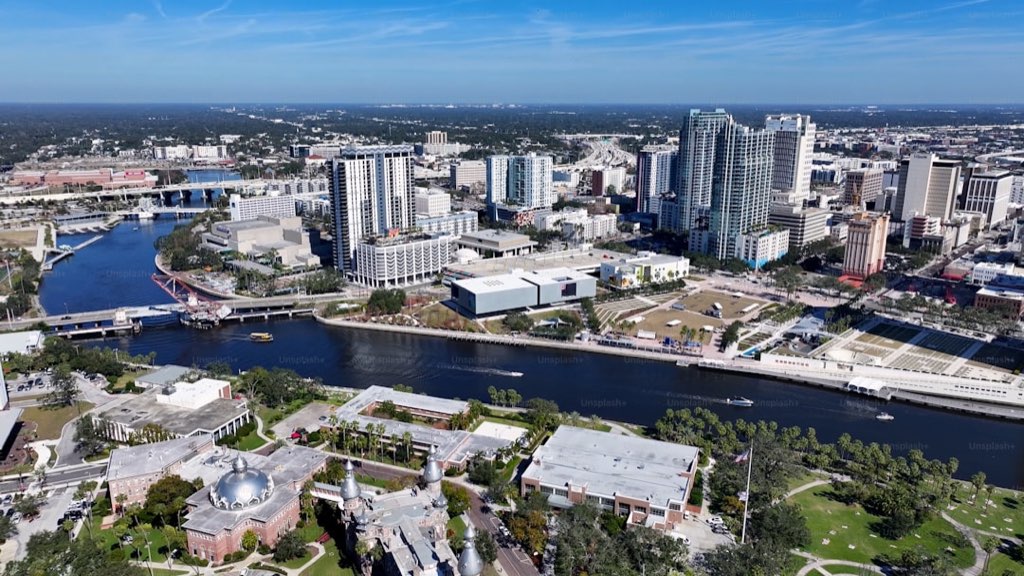
Tampa Investment Snapshot
- Representative Price Range $350K–$650K
- Revenue Range $2,200–$3,800/mo gross LTR rent
- Common Property Types Single-family rentals, bungalows, 1960s ranches, 2-flat conversions
- State Income Tax 0%
- Top Neighborhoods South Tampa, Seminole Heights, Riverview, Ballast Point, Westchase
- Representative Year-1 Savings $24,000–$48,000
The Tampa Market
Tampa is not Orlando and it is definitely not Destin. Hillsborough County prohibits rentals under 30 days outside a few narrowly-defined resort zones, which means the Airbnb pivot most Florida investors assume is available is not. Pinellas County (St. Pete, Clearwater) is more permissive, but the Tampa city investor playbook is overwhelmingly long-term rentals to local renters: nurses commuting to Tampa General, teachers, MacDill Air Force Base personnel, and the steady drip of New Yorkers and Californians who keep arriving every quarter.
The result is an LTR market that ran hot from late 2020 through mid-2022: purchase prices climbed 40–60% on properties in South Tampa, Seminole Heights, and Riverview while rents lagged. A 1,400 sq ft bungalow in Seminole Heights that traded for $310K in 2019 went for $475K in 2022 and rents for about $2,800/mo today. The cash-on-cash math is brutal at current rates. Every owner who closed in that window is sitting on a paper loss that cost segregation can convert into actual federal refund dollars.
The 2020–2022 buyer cohort is the single most under-served depreciation audience in Florida. Most have never heard of Form 3115, most CPAs have not raised it, and the lookback window is open for any year the property was placed in service.
Why Cost Segregation Hits Different in Tampa
Two things make Tampa different from the rest of Florida on cost seg math. First, the LTR-only constraint means the typical Tampa investor is not loaded up on FF&E: there is no $25K furniture package, no hot tub, no commercial-grade kitchenware. The 5-year bucket is real (appliances, flooring, window treatments, ceiling fans) but smaller as a share than a true STR. The 15-year bucket is where Tampa over-indexes: privacy fencing (every Tampa rental has it), driveways, screened lanais, pool cages, hurricane shutters, irrigation, and the heavy native landscaping needed to control the perpetual rainy-season runoff.
Second, Form 3115. If you bought your Tampa rental in 2020, 2021, or 2022 and never had a cost seg study, you have been depreciating the entire structure on a 27.5-year schedule. The IRS lets you correct that with a Change in Accounting Method filing (Form 3115) that sweeps three years of missed accelerated depreciation into the current year as a §481(a) catch-up adjustment. No amended returns, no audit risk premium. For a $475K Tampa rental purchased in 2021, that catch-up can clear $90K in additional first-year deduction without touching the prior years’ returns.
That is the Tampa play. Not “buy a property and run a study,” but “rescue the property you already bought at the top of the market.”
Worked Example: Tampa
A 3BR/2BA 1950s ranch in Ballast Point, purchased in late 2021 for $475K. After pulling $90K of land value, the depreciable basis lands at $385K. The cost seg study identifies $32K in 5-year property (kitchen appliances, washer/dryer, water heater, ceiling fans, flooring upgrades, blinds), $11K in 7-year property (casework and storage), and $47K in 15-year property (privacy fence around the entire backyard, paver driveway and walkway, pool cage and screen enclosure, irrigation system, palm and live oak landscaping, accent lighting). Total reclassified: $90K. At a 37% federal bracket and Florida’s 0% state tax, that is $37,000 in first-year federal savings.
The Form 3115 angle multiplies that. The owner held the property for tax years 2021, 2022, 2023, and 2024 with straight 27.5-year depreciation: roughly $14K/yr deducted versus what should have been $26K/yr if cost seg had been done at acquisition. Filing Form 3115 in tax year 2025 sweeps the missed $48K of catch-up depreciation into the current year on top of the $90K reclassified from go-forward. The owner’s 2025 return shows roughly $138K of accelerated deduction without amending a single prior return.
Who Is Doing This in Tampa
The Tampa investor we see most often is a W-2 professional in the $200K–$500K household income range, often a healthcare worker, software engineer, or someone who relocated from the Northeast or California in 2020–2022. They bought one or two long-term rentals in South Tampa, Seminole Heights, or the suburbs (Riverview, Brandon, Westchase) thinking they were buying into the Florida growth story. The properties cash-flow weakly or negatively at current rates. Rent growth has stalled.
What works for them is the REPS qualification, Real Estate Professional Status. If one spouse can claim 750+ hours/yr and more than half their working time in real estate activities, the accelerated depreciation flows against the W-2 income of both spouses. For a household with one stay-at-home or part-time spouse who manages two or three properties, REPS is achievable and the math becomes transformative. Without REPS, the deduction is locked into passive-loss carryforward, still useful, but slower.
FL Tax Considerations
- Florida has no state income tax. Your cost segregation savings are entirely federal: no state recapture, no state conformity issue, no extra forms. A $90K reclassification at the 37% federal bracket = $37,000 in year-one savings, full stop.
- Your estimate $37,000 Estimated Year-1 tax savings
- $90,000 Accelerated
- 47x ROI on study
- Adjust Your Numbers →
Based on a $475,000 Tampa LTR property at the 37% federal bracket. Your actual results vary.
Want a number for a specific property here? Use the calculator, pre-set with property-type defaults you can adjust to match your basis and tax bracket.
Common Tampa Investment Properties
- 1950s/60s ranch SFR in Ballast Point, South Tampa, or Beach Park
- Renovated bungalow in Seminole Heights
- New-build suburban SFR in Riverview, Brandon, or Westchase
- Pre-war 2-flat or duplex conversion near downtown
- Pool home in Carrollwood or Town ‘N Country
Depreciable Features We Commonly See
- Privacy fencing (chain-link, vinyl, or wood) around the perimeter
- Paver driveways, walkways, and screened lanais
- Pool cages and aluminum screen enclosures
- Hurricane shutters and impact-rated windows
- Irrigation systems and mature palm landscaping
- Tile and luxury vinyl plank flooring throughout (humidity standard)
- Updated HVAC, water heaters, and appliance packages
What People Worry About (and What Actually Happens) “Will this trigger an IRS audit?”
No. Cost segregation is explicitly supported by IRS guidelines (Rev. Proc. 87-56) and the IRS Audit Techniques Guide for Cost Segregation. Tens of thousands of studies are filed every year. Our reports are designed to withstand scrutiny; that’s why they run 40+ pages with component-level documentation. Form 3115 lookback filings are an explicitly authorized accounting method change, not an amended return, so they do not raise audit risk on prior years.
audit risk and cost segregation → “Is this aggressive tax strategy?”
Cost segregation is standard practice, not a loophole. The IRS has published formal guidance on how to do it correctly. Every Big 4 accounting firm offers it. We follow the same engineering-based methodology, just faster and at a fraction of the cost.
our engineering methodology → “What if I sell in a few years?”
When you sell, the accelerated 5- and 7-year (§1245) portion is recaptured at ordinary-income rates and the §1250 real-property portion at up to 25%. But if you 1031 exchange into another property, recapture is deferred indefinitely. For most investors, the upfront tax savings far outweigh the eventual recapture, especially when you factor in the time value of money. “My CPA hasn’t mentioned this.”
Most CPAs know about cost segregation but don’t proactively recommend it because they don’t do the engineering analysis in-house. That’s what we provide. The Form 3115 lookback in particular is something most generalist CPAs have never filed; we provide a CPA-ready package with the §481(a) calculation worked out and answer any questions they have directly. For Tampa 2020–2022 buyers specifically, catchupdepreciation.com lets you sanity-check the catch-up math on a $475K rental in 30 seconds before bringing it up with your CPA.
Why Cost Segregation Works for Long-Term Rentals
Long-term rentals do not pack the FF&E density of a short-term rental, but they still hold meaningful 5-year and 15-year property that the default 27.5-year schedule ignores. Appliances, flooring, water heaters, ceiling fans, blinds, and window treatments all fall into the 5-year MACRS class. For a $385K basis Tampa LTR, that 5-year bucket generally runs $25K–$40K, a meaningful first-year deduction that no straight-line schedule captures.
The 15-year site improvement bucket is where Florida LTRs disproportionately benefit. Privacy fencing, paver driveways, screened lanais, pool cages, irrigation systems, and mature landscaping all fall into the 15-year class rather than the default 27.5-year schedule. On a Tampa property with a fenced yard, screened porch, and irrigation, the 15-year bucket alone often clears $40K, more than the entire 5-year bucket on a representative interior renovation.
With 100% bonus depreciation permanently restored under the One Big Beautiful Bill Act (signed July 2025), every dollar reclassified into 5-year, 7-year, or 15-year MACRS classes is deductible in full in the first year. For LTR owners who qualify for Real Estate Professional Status (REPS), these deductions can offset W-2 and business income, not just passive rental income. For owners who do not qualify for REPS, the deductions still build a passive-loss carryforward that releases at sale or against future passive income.
Who This Example Applies To
- Long-term rental property owners (single-family, duplex, small multifamily)
- Investors who bought in 2020–2022 and want to recover missed depreciation via Form 3115
- Households with one spouse able to qualify for REPS (750+ hours/yr in real estate)
- Taxpayers in the 32–37% federal bracket
- Properties with fenced yards, screened lanais, or pool cages
If your property is unfurnished, owner-occupied, or you are a passive investor without REPS qualification, the deduction may build as a passive-loss carryforward rather than offsetting current W-2 income. Actual results vary based on property age, condition, renovations, and local construction costs.
Hear From a Long-Term Rental Owner Who Did This
This Tampa LTR investor ordered a cost segregation study and used the accelerated depreciation on their next tax return. Here’s what happened. CPA-Ready Guarantee Free revisions if your CPA flags a problem; refund if the report still can’t be used See a Sample Download Tampa sample report
Compare: Tampa LTR at Different Price Points
| Price | Accelerated | Tax Savings | Study Cost | ROI |
| $300K | $54,000 | $19,980 | $895 | 22x |
| $375K | $70,000 | $25,900 | $895 | 29x |
| $475K | $90,000 | $37,000 | $895 | 41x |
| $550K | $104,000 | $38,480 | $895 | 43x |
| $650K | $123,000 | $45,510 | $895 | 51x |
| $800K | $152,000 | $56,240 | $995 | 57x |
| $1M | $190,000 | $70,300 | $1,295 | 54x |
Compare: $475,000 Across Property Types
| Property Type | Accelerated | Tax Savings | Study Cost | ROI |
| Long-Term Rental | $90,000 | $37,000 | $895 | 41x |
| Short-Term Rental | $114,000 | $42,180 | $895 | 47x |
| Duplex | $84,000 | $31,080 | $995 | 31x |
| Fourplex | $84,000 | $31,080 | $995 | 31x |
Frequently Asked Questions What is a Form 3115 lookback and how does it work? ▼
Form 3115 is the IRS “Application for Change in Accounting Method.” For cost segregation, it lets a property owner who has been depreciating on a 27.5-year schedule switch to the engineering-based reclassification and recover the missed deductions from prior years as a §481(a) catch-up adjustment in the current year. No amended prior-year returns required. It works for any property placed in service in a closed tax year, which is why 2020–2022 Tampa buyers are the highest-ROI candidates right now. Why do Hillsborough County STR rules matter for cost segregation? ▼
The 30-day minimum stay rule in unincorporated Hillsborough County (and most of Tampa city) effectively prohibits Airbnb-style operation. That means most Tampa rentals are LTRs, which carry less FF&E than a representative STR. The cost seg math still works (privacy fencing, screened lanais, pool cages, and irrigation produce a strong 15-year bucket), but the percentage reclassified is generally lower than on a furnished STR in Destin or Orlando. What is REPS and do I need it? ▼
REPS (Real Estate Professional Status) requires 750+ hours/yr and more than half your working time in real estate activities. If one spouse qualifies, the other spouse’s W-2 income can be offset by the rental’s accelerated depreciation. Without REPS, the deduction is suspended as a passive loss carryforward, still recoverable at sale or against future passive income, but slower. Most Tampa LTR investors who hold 2+ properties and self-manage can qualify if structured correctly.
Learn More About Cost Segregation
- What Is Cost Segregation?: Full explanation of how the study works and what you receive
- How Much Does a Cost Segregation Study Cost?: Pricing breakdown by property type and value
- What Percentage Gets Reclassified? — Representative accelerated depreciation rates by property type
- Cost Segregation for Short-Term Rentals — The STR material participation strategy explained
Ready to See Your Actual Savings?
Want a number for a specific property here? Use the calculator, pre-set with property-type defaults you can adjust to match your basis and tax bracket.
Cost segregation data for Tampa, FL investors
The representative (median) outcome across 50 engine-modeled property scenarios matched to the Tampa, FL investor profile. Year-1 savings computed at the metro combined bracket of 40.80%.
Representative scenarios modeled via Cost Seg Smart's proprietary
engine — IRS ATG-aligned methodology, industry-standard 2026 construction cost data base costs,
calibrated metro multipliers. n=50 fixtures matched to
Tampa, FL investor profile. Not derived from individual
client returns. Methodology v1.0.0, generated
May 2026 (reproducible seed: tampa-fl_v1_2026-05-17).
Year-1 savings computed at 40.80% combined (federal 37% + NIIT 3.8%; this state has no personal income tax, so there is no state-side adjustment). Confirm specifics with your CPA.
Tax law current as of July 2026. Federal: OBBBA restored 100% bonus depreciation under §168(k), permanent for property both acquired and placed in service after January 19, 2025 (property acquired or placed in service on or before that date remains under the prior 40% phase-down); 2026+ stays 100%. State conformity varies; verify with your CPA.
CPA use note: These figures estimate the size of the depreciation deduction. Whether the loss is usable in the current year depends on passive-activity rules, STR material participation, REPS status, entity structure, depreciable basis, and state conformity. Your CPA decides how and when it is applied. Specialty and site components (equipment, casework, docks, pools, arenas, tenant improvements, and similar) are only classified when you own them and they are included in the depreciable basis being studied.
How should Tampa, FL investors choose a cost segregation provider?
For a Tampa, FL investor buying a property in the $475,000 range, the choice of provider is a major controllable variable in the return. The IRS Audit Techniques Guide sets the quality characteristics an engineering-based study should meet — industry-standard construction cost data, MACRS classification, and component-level documentation — but it does not make every provider's work identical; rigor, cost, and turnaround still vary.
Traditional engineering studies often run several thousand dollars and can take several weeks, because they include on-site inspections, sales discovery calls, and scheduling overhead. The IRS Cost Segregation Audit Techniques Guide does not prescribe an on-site inspection as a standalone requirement; it sets out the quality characteristics of an engineering-based study — component-level classification, a documented and supportable cost derivation, and a clear audit trail — and describes how a physical inspection can contribute to meeting them.
Modern automated providers (such as Cost Seg Smart) deliver an engineering-based, IRS ATG-aligned study using property records, documents, photos, and recognized construction-cost data, typically from $495 and often by the next business day. For a Tampa, FL investor at a high combined bracket, that cost and speed difference is meaningful. The CPA-Ready Guarantee (free revisions if your CPA flags a problem, and a refund if the report still can't be used) makes the decision essentially risk-free on the report itself.
The automated path is best-fit for owners who can provide closing documents and property photos online (no in-person visit required) and want the report in time to file the current year's return rather than the next one.
All Cost Seg Smart studies include the CPA-Ready Guarantee (free revisions if your CPA flags a problem, and a refund if the report still can't be used). Straightforward residential studies are often delivered the next business day and completed remotely; larger or more complex commercial studies take longer and may include an on-site observation.