The Outer Banks operates the largest short-term rentals on the Eastern Seaboard. An average OBX vacation home runs 6 to 12 bedrooms across two to three stories, with private pool and hot tub, elevator, multiple decks, gourmet kitchen, and complete furniture package, sleeping 12 to 24 guests at $5,000 to $14,000 per peak summer week. The cost segregation math on these properties is unlike any other vacation market in the country because the absolute basis is large ($850K–$2.4M) and the FF&E + 15-year site improvement buckets are extreme. We routinely see 30%+ reclassification rates on Corolla and Duck oceanfronts.

- $305,000 Accelerated Depreciation
- $112,850 Est. Year-1 Federal Savings
- 142x Return on Study Cost
Want a number for a specific OBX property? Use the calculator. It’s pre-set with property-type defaults you can adjust to match your basis and tax bracket.
Cost Segregation in the Outer Banks, NC
OBX Investment Snapshot
- Representative Price Range $725K–$1.4M (Kitty Hawk, Kill Devil Hills, Nags Head SFRs); $1.2M–$2.8M (Corolla, Duck, Southern Shores oceanfronts); $2.5M–$5M+ (4WD beaches, Pine Island estates)
- Revenue Range $5,000–$14,000/peak summer week; $85K–$220K annual gross on a top-tier rental
- Common Property Types 6-12BR oceanfront SFR, soundside SFR with private dock, Corolla 4WD-only oceanfront, Hatteras semi-soundfront with pool, Manteo historic cottage
- State Income Tax 4.5% flat (NC, 2026)
- Effective Property Tax 0.65–0.85% (Dare County), among the lowest in the country for a vacation market
- Top Submarkets Corolla, Duck, Southern Shores, Kitty Hawk, Kill Devil Hills, Nags Head, Hatteras Island
- Representative Year-1 Federal Savings $58,000–$185,000
The OBX Market
The Outer Banks investor map runs along the 200-mile barrier-island chain from the Virginia line at Corolla down through Hatteras and Ocracoke, anchored by Highway 12 (the only road) and the Wright Memorial / Washington Baum / Bonner / Oregon Inlet bridge sequence. The market is not one market; it’s a stack of distinct sub-markets with different price points, regulatory regimes, and rental profiles.
Corolla and the 4-Wheel-Drive beaches form the highest-priced submarket. Corolla itself runs $1.4M–$3.5M for an 8BR oceanfront with private pool, hot tub, and elevator. The 4WD beaches north of Corolla (Carova, accessible only via the beach) run $1.8M–$5.5M for the largest properties: homes built specifically as commercial-scale STRs, sleeping 24+ across 12-bedroom configurations. Many were built by investor groups in the 2010s as turnkey rental businesses. The 4WD beaches have no paved roads, no electricity grid in some sections (off-grid solar + generator), and a feral horse herd protected under the Currituck County Wild Horse Preservation Act (investor-marketing gold but operationally complex).
Duck and Southern Shores form the upper-mid premium tier. Duck is a small year-round town (population ~400) with a mile-long boardwalk, restaurants, and a strong family-oriented brand. Properties run $1.1M–$2.4M for a 6-8BR oceanfront with pool. Southern Shores is the older soundside-and-oceanfront zone with Sea Oats and Chicahauk neighborhoods popular with multi-generational family investors. Prices run $850K–$1.8M.
Kitty Hawk, Kill Devil Hills, and Nags Head form the Outer Banks’ main population corridor and the working-investor-portfolio market. Properties here run $625K–$1.2M for 4-6BR oceanfronts and soundsides. KDH and Nags Head have mature year-round residential populations, full restaurants and grocery, and the Wright Brothers National Memorial + Jockey’s Ridge State Park pull steady tourism even off-peak. The investor profile here is the “first OBX rental”: buyers from Northern Virginia, Tidewater Virginia, Raleigh, and Charlotte starting their vacation-rental portfolio.
Hatteras Island (Rodanthe, Waves, Salvo, Avon, Buxton, Frisco, Hatteras Village) is the surf-and-fishing-driven southern stretch. Prices run $475K–$1.1M (meaningfully lower than the Corolla/Duck/Nags Head corridor), but the market is heavily weighted toward second-home owners renting part-time rather than commercial-scale STR portfolios. Buxton and Avon have the strongest rental economics on the island. Hatteras Island access goes through Bonner Bridge over Oregon Inlet, which closes during nor’easters and major storms, material to your insurance and rental-revenue calculation.
Ocracoke is the southernmost OBX island, accessible only by ferry (45-minute Hatteras-Ocracoke free ferry; 2-hour Cedar Island and Swan Quarter NCDOT car ferries). Properties run $325K–$850K. Investor activity is small but the market exists: generally 3-4BR cottages renting at $2,000–$4,500/peak week.
Manteo and Roanoke Island sit on the inland side of the Albemarle / Croatan Sound, connected to the OBX proper via the Washington Baum Bridge. Manteo is the historic Dare County seat with the Roanoke Island Festival Park and a small but distinct 200-year-old waterfront. Investor activity here runs toward historic-cottage Airbnb rentals at $325K–$725K, a different play than the oceanfront mega-rental.
The OBX has a soft STR-licensing regime: Dare County requires a vacation-rental registration but no occupancy caps, no primary-residence requirement, and no STR-density restrictions. Currituck County (Corolla / 4WD) is similarly permissive. Hatteras / Ocracoke are part of the same Dare County framework. Insurance is the binding regulatory constraint, not zoning. Wind-and-hail and flood coverage on a $1.5M oceanfront runs $14K–$24K/year and shapes which properties are economically viable.
Why Cost Segregation Hits Different in the Outer Banks
The Outer Banks produces the largest absolute reclassification dollars per property of any East Coast residential market, for four structural reasons.
The 5-year FF&E bucket scales with bedroom count, and OBX is a high-bedroom market. A typical Corolla 8BR oceanfront sleeps 16–20 guests across king, queen, and bunk-room configurations. Furnishing to commercial-rental standards requires 8 complete bedroom sets (mattress + box spring + frame + linens × 3 sets + nightstands + lamps + dressers), 16 dining seats with table and bar, 3-4 sofas across living spaces, multiple smart TVs (one per bedroom plus living areas), full kitchen package including double dishwasher and double refrigerator, complete cookware-for-20 dishware/glassware/cookware, washer/dryer set (often two pairs), pool/beach gear (umbrellas, chairs, boogie boards, kayaks), and the full smart-home + security infrastructure. Total FF&E on a $1.25M Corolla oceanfront routinely runs $115K–$155K, substantially higher than even the highest-end Tahoe, Joshua Tree, or Smoky Mountains STRs because the bedroom count is higher.
The 15-year site improvement bucket is extreme on oceanfronts. A working OBX oceanfront carries: a private pool with associated equipment pad (pump, heater, automation, saltwater chlorinator), a hot tub on dedicated electrical, a substantial elevated wood-frame pool deck, a tiki bar or covered pool cabana, separate beach-walk access with elevated pedestrian boardwalk and dune crossover stairs (these are regulated under the NC Coastal Area Management Act and require specific permits), exterior outdoor showers (mandatory after beach use), driveway pavers and parking pad for 6-8 vehicles, fenced and gated rear yard, irrigation and salt-tolerant landscape, exterior accent and security lighting, dedicated propane tanks for grills and pool heater. The 15-year bucket on a representative $1.25M Corolla oceanfront runs $135K–$180K, with the dune-crossover and pool deck alone often clearing $45K–$60K of depreciable basis.
Hurricane-resilient construction adds a documentable depreciable layer. Properties built or rebuilt after the 2003 NC Building Code revisions (post-Hurricane Isabel) carry hurricane-rated impact windows and doors, wind-rated metal-clad roofing systems, reinforced foundation pilings (generally 6x6 or 8x8 ground-anchored timber pilings extending 8-12 feet below grade with hurricane-strap connectors), elevated first-floor construction (10-15 feet above grade in V-zone flood zones), and exterior-grade Hardiplank or composite siding. Engineering invoices and storm-mitigation upgrades are 27.5-year structural, but the storm-window package, exterior shutters, and wind-monitoring equipment reclassify into 5-year MACRS. Documented post-storm rebuilds (Isabel 2003, Hurricane Florence 2018, Hurricane Dorian 2019, Hurricane Idalia 2023) often produce the cleanest cost segregation outcomes because the rebuild scope has line-item invoices.
North Carolina flat-tax math. NC moved to a 4.5% flat income tax in 2026, declining further in 2027–2030 toward 3.99%. NC does not fully conform to federal §168(k) bonus depreciation. The federal Year-1 deduction is fully available, but the NC share is largely added back in Year 1 (NC allows 15% the first year, then 20%/yr over five years) and recovers over time (deferred, not lost). For an investor in the 37% federal bracket, the Year-1 federal benefit is ~40.8% (37% + 3.8% NIIT). A $305K reclassification produces about $124,440 in Year-1 federal savings; the NC share is deferred under the state add-back. See bonus depreciation by state.
Worked Example — Outer Banks
An 8BR/8.5BA oceanfront in Corolla’s Pine Island Reserve, built in 2018 to commercial-rental specs and acquired in fall 2024 for $1.25M. The property sits on a 15,000-sqft oceanfront lot, sleeps 18 across 8 bedrooms (3 king masters with private baths, 4 queen suites, 1 bunk room with 4 twins), with 4,800 sqft of conditioned space across three stories plus an elevated rooftop deck. After pulling $215K of land value (Pine Island Reserve ground value runs roughly $10/sqft of dune-side oceanfront), the depreciable basis lands at $1.0M.
The cost segregation study identifies $148K in 5-year property: 8 complete bedroom packages (mattress sets, frames, linens × 3 per bed, nightstands, lamps, dressers, decor); the dining setup (12-seat dining table + 4 bar stools + 4 deck-table seats + 6 pool-deck loungers); a complete living-room set across the great room and a secondary den (3 sofas, 8 accent chairs, coffee tables, end tables); 9 smart TVs (one per bedroom, plus living room, den, pool deck weatherproof outdoor TV); the full kitchen appliance package (range, double oven, microwave, two dishwashers, oversized refrigerator, secondary refrigerator/freezer in the garage, ice maker, espresso machine, stand mixer, all small appliances); cookware/dishware/glassware for 20 service settings; bathroom linens (4 sets per bath); two washer/dryer pairs (one per laundry zone); pool/beach gear (chairs × 16, umbrellas × 4, boogie boards × 8, kayaks × 4, beach cart × 2); smart-home Lutron lighting controls and Ring/Arlo security; smart locks; and decorative finishes throughout. $11K in 7-year property: built-in custom storage in the bunk room, kitchen banquette, the home’s built-in bar millwork, and the elevator’s interior casework. $146K in 15-year property: the saltwater pool with equipment pad, the hot tub on dedicated electrical, the 1,800-sqft elevated wood pool deck with composite Trex flooring, the tiki bar with palapa thatched roof, the elevated pedestrian boardwalk and dune crossover (engineered to NC CAMA spec, with stairs and viewing platform), two exterior outdoor showers, driveway pavers and 8-vehicle parking pad, fenced and gated rear yard, drip irrigation and beach-grass landscape, exterior accent and security lighting, the dedicated 1,000-gallon propane tank for the pool heater and grills, the EV charger in the garage, and the storm-shutter system on all street-facing windows.
Total reclassified: $305K, or roughly 30.5% of the depreciable basis. At 37% federal plus 3.8% NIIT, that is about $124,440 in Year-1 federal savings. NC does not fully conform to federal bonus depreciation, so the NC share is deferred under the state add-back (15% Year 1, then 20%/yr over five years) rather than taken in full in Year 1.
The MTR-style positioning matters less here than at most STR markets: OBX rentals operate on Saturday-to-Saturday weekly turnover, so average stay is 7 days exactly. That places the property in the STR special test under §469, where material participation requires only the 100-hour-and-no-one-spending-more or 500-hour test, not the standard rental rules. The owner (a Northern Virginia financial-services executive with $720K AGI) clears the 100-hour test through tenant communication, turnover-day quality control (he flies down for season-opening cleaning weekends), supply runs, and direct property management coordination. With material participation established, the accelerated deductions offset W-2 income directly.
Who Is Doing This in the Outer Banks
The OBX investor profile clusters around three distinct buyer types.
The Northern Virginia / DC corridor commuter investor is the dominant archetype. A federal contractor, defense executive, biotech operator, or BigLaw partner from the Loudoun-Fairfax-Arlington belt or a Bethesda-Potomac-Alexandria address acquires a 6-8BR Corolla or Duck oceanfront as a portfolio income asset. Annual household income in the $400K–$1.2M range, federal bracket 35–37%, and a personal connection to OBX as a multi-decade family-vacation destination. They make weekend trips during shoulder-season for property management, hire a local cleaning and turnover company (Brindley Beach, Twiddy, Sun Realty, Surf or Sound Realty are the major rental management firms; most owner-managers self-manage but use one of these for marketing distribution).
The Tidewater Virginia investor (Virginia Beach, Norfolk, Newport News, Richmond) is the more conservative LTR-leaning profile, often acquiring smaller (4-5BR) Kitty Hawk or KDH properties at $625K–$1.1M and running them as a mix of summer STR + winter long-term rental for retirees and remote workers. Annual income $200K–$500K, federal bracket 32–35%.
The Raleigh / Triangle technology investor (Research Triangle Park employees from Cisco, Red Hat (now IBM), SAS Institute, Lenovo, or the burgeoning Apple Triangle campus) has emerged as a fast-growing buyer cohort since 2020. The play here mirrors the NoVa investor profile but at lower entry points (Nags Head and Kill Devil Hills $625K–$950K rather than Corolla $1.5M+).
A fourth profile worth flagging: the multi-property OBX portfolio investor who has built up 4-12 properties over a decade and uses cost segregation as a recurring annual practice on each acquisition plus the occasional Form 3115 lookback on portfolio holdings. These investors often aggregate rental hours across all properties to clear material participation under the §469(c)(7) election (REPS), or, less commonly, qualify spouse hours toward the same. Cost segregation is a load-bearing piece of their multi-year tax planning rather than a one-time event.
NC Tax Considerations
- North Carolina has a 4.5% flat income tax in 2026, scheduled to drop to 4.25% in 2027 and 3.99% by 2030 under the existing legislative schedule. Cost segregation savings flow through to the NC return.
- NC does not fully conform to federal §168(k) bonus depreciation. The federal Year-1 deduction is fully available, but the NC share is largely added back in Year 1 (15% allowed the first year, then 20%/yr over five years) and recovers over time (deferred, not lost). See bonus depreciation by state.
- Dare County effective property tax rate runs 0.65–0.85%, among the lowest in the country for a vacation market. Property tax is unrelated to depreciation but the low rate is part of why OBX cash-flow math pencils at the high acquisition prices.
- NC depreciation recapture on sale follows federal rules (25% on §1250 unrecaptured gain) plus the 4.5% NC ordinary income layer. Combined federal + state recapture rate: roughly 29.5%, substantially below CA or NY.
- The NC sales-and-use-tax exemption for residential rentals applies. STR rental payments are subject to NC sales tax (4.75%) plus local Dare County occupancy tax (generally 6%), but the property’s depreciable cost basis is unaffected.
- 1031 exchanges: NC fully recognizes federal §1031 like-kind exchanges. Many multi-property OBX investors plan 1031 chains to defer combined federal + state recapture on disposition.
Common Outer Banks Investment Properties
- 8-12BR Corolla oceanfront with private pool, hot tub, elevator, and rooftop deck
- 6-8BR Duck or Southern Shores oceanfront with private pool and beach access
- 4-6BR Kitty Hawk / Kill Devil Hills / Nags Head SFR (oceanfront, soundside, or oceanside-of-NC-12)
- Corolla 4WD-only oceanfront (off-grid or partial-grid) with feral horse access
- Hatteras Island Avon or Buxton 4-6BR with semi-soundfront views
- Manteo / Roanoke Island historic cottage (3-4BR, walking distance to downtown Manteo waterfront)
- Ocracoke 3-4BR cottage on the village side or Ocean View beachfront
- Pine Island Reserve, Currituck Club, or Whalehead Club gated-community SFR
Depreciable Features We Commonly See in the Outer Banks
- 6x6 or 8x8 timber-piling foundations with hurricane-strap connectors (V-zone construction)
- Hurricane-rated impact windows and doors (post-2003 NC Building Code)
- Wind-rated metal-clad roofing systems
- Storm-shutter packages (manual or motorized roll-down)
- Private pool with saltwater chlorinator, automation, and dedicated equipment pad
- Hot tub on dedicated electrical with cover lift assist
- Elevated wood-frame pool deck with composite (Trex) decking
- Tiki bar or covered pool cabana with palapa thatched roof
- NC CAMA-permitted dune crossover with elevated boardwalk and viewing platform
- Multiple exterior outdoor showers (hot/cold)
- Driveway pavers and 6-8 vehicle parking pads
- Fenced and gated rear yards with beach-grass landscaping and irrigation
- Whole-house residential elevator (3-stop or 4-stop)
- Smart-home Lutron lighting, Ring/Arlo security, smart locks throughout
- Dedicated propane tanks (often 500-1000 gallon) for pool heater and grills
- EV chargers (increasingly common in 2024+ acquisitions)
- Commercial-grade kitchen appliance packages with secondary refrigerator/freezer
- Whole-house generator (Generac 22-30kW) with automatic transfer switch
- Pool-deck weatherproof TVs and outdoor audio packages
- Beach gear inventory (chairs, umbrellas, boogie boards, kayaks, paddleboards)
What People Worry About (and What Actually Happens)
“Hurricane Florence / Dorian / Idalia hit my OBX rental. Can I still cost-seg?”
Yes, and the post-storm rebuild often produces the highest accelerated percentages we see in any market. If your property had documented post-storm reconstruction work (roof replacement, drywall and flooring, kitchen and bath replacement, HVAC replacement, interior FF&E replacement, exterior siding and dune-crossover repair), the rebuild invoices flow directly into the cost segregation engineering analysis with line-item documentation that exceeds anything we’d reconstruct from a pre-storm property. Storm-rebuilt OBX properties can land at the high end of residential outcomes. Document everything: insurance claim files, contractor invoices, permit records from Dare County or Currituck County. Renovation and partial-disposition rules →
“My OBX rental is owned through an LLC with my spouse. Does that change anything for cost seg?”
The LLC structure doesn’t change the cost segregation engineering analysis at all: depreciable life and component classification are determined by the property and its components, not by the ownership entity. What the LLC structure does change is the material participation analysis. For owner-managed OBX rentals operated as STRs (sub-7-day average stay), material participation is generally established under the special STR test (100 hours and no one spending more, OR 500 hours total). Both spouses’ hours can be aggregated under the standard tax rules. For a multi-property OBX portfolio held in a single LLC, the §469(c)(7) REPS election allows treating all properties as one activity, increasing the chance of clearing the 750-hour-plus-more-than-half-time test. Most owner-managed multi-property OBX investors run REPS through one spouse. Material participation pathway for STR owners →
“My CPA filed depreciation as 27.5-year on the whole basis when I bought the property. Did I miss the cost seg window?”
No. Form 3115 (Application for Change in Accounting Method) lets you catch up all the missed depreciation in a single year (without amending prior returns) through a §481(a) adjustment. We file Form 3115 with your cost segregation report on every lookback study. The catch-up deduction in Year 1 is generally 60–75% of what you would have deducted if you had run the cost seg at acquisition, because depreciation recovery periods don’t restart (each component continues on its original schedule from the placed-in-service date). For a 4-year-old OBX rental, the Form 3115 catch-up on a $305K reclassification generally clears $80K–$110K of immediate Year-1 deduction. Form 3115 lookback explained →
Why Cost Segregation Works for OBX Mega-Rentals
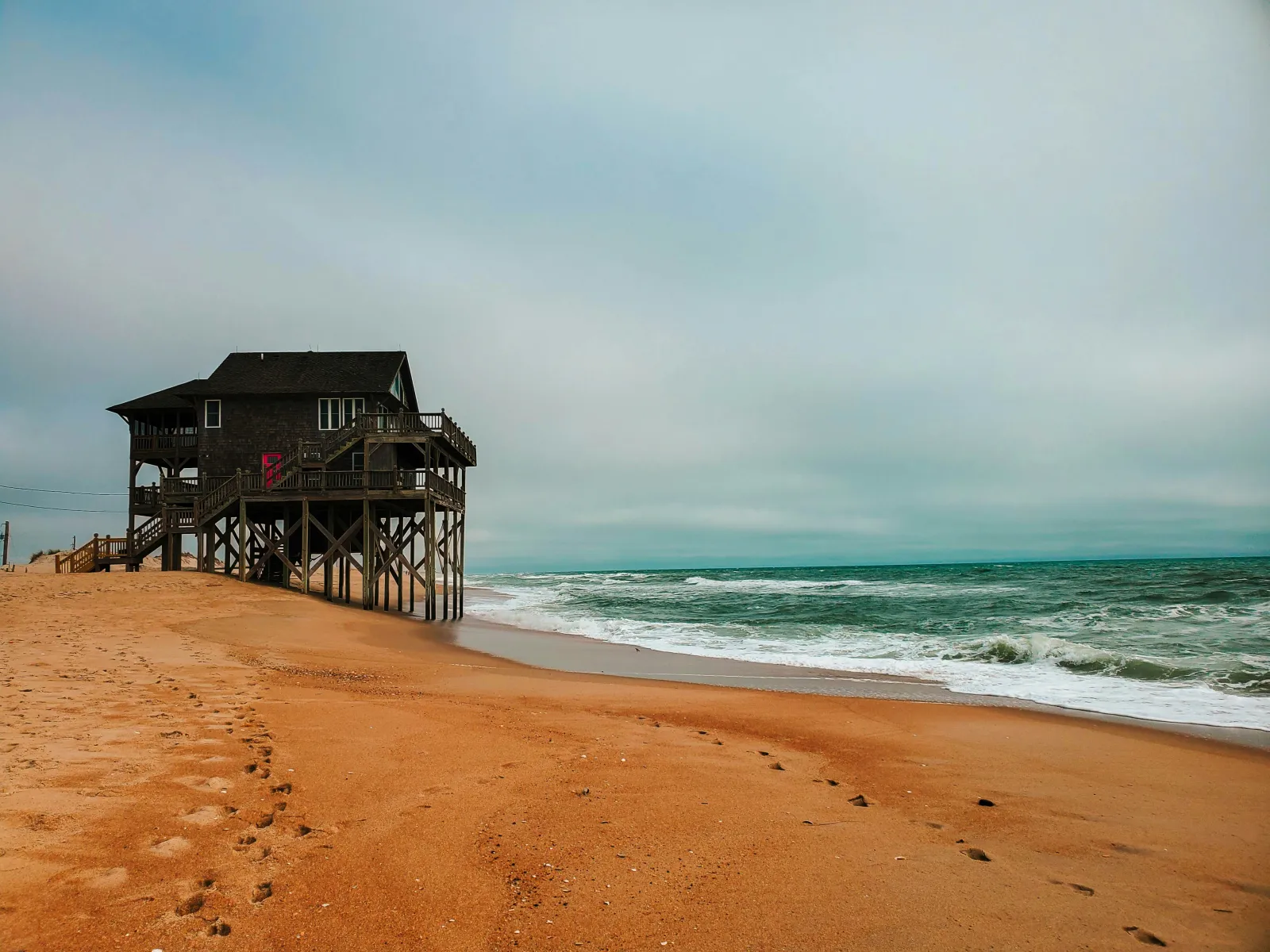
The Outer Banks is the only East Coast vacation market where 8-to-12 bedroom commercial-scale STRs are the dominant inventory category rather than an outlier. A typical Corolla oceanfront rental is built specifically as a commercial vacation business: 4,500-7,500 sqft of conditioned space, sleeping 18-24, with the kitchen, laundry, and bathing infrastructure of a small bed-and-breakfast. The cost segregation math reflects this commercial-scale buildout.
Compare to the typical Smoky Mountains, Joshua Tree, or Tahoe STR: those markets are dominated by 3-4BR cabins or 2-3BR condos at the $500K-$900K range. An OBX equivalent is a 6-8BR oceanfront at $1.2M-$1.8M. The bedroom count alone doubles or triples the FF&E line items: every bedroom needs a complete furniture set, every bathroom needs full linens, and the dining/kitchen/laundry/storage infrastructure scales with occupancy.
Beyond FF&E, OBX properties carry the most extensive 15-year site improvement bucket of any East Coast residential market. The CAMA-permitted dune crossover, the wood-frame pool deck (often 1,500-2,500 sqft on larger oceanfronts), the elevated boardwalk system, the storm-mitigation drainage and dune-stabilization plantings, the multi-vehicle parking pad, and the fenced/gated outdoor entertainment zones routinely add $135K-$180K to the depreciable 15-year basis.
Hurricane-resilient construction adds the third layer. Properties built or rebuilt after 2003 NC Building Code revisions carry storm-window packages, hurricane-rated roofing, and reinforced foundation pilings: line items that produce documented depreciable basis reclassifying into 5-year (storm shutters, monitoring equipment) and 27.5-year (structural piling reinforcement, but ineligible for cost seg acceleration).
With 100% bonus depreciation permanently restored under the One Big Beautiful Bill Act (signed July 2025), every reclassified dollar is deductible in the first year on the federal return. NC does not fully conform, so the NC share is deferred under the state add-back rather than taken in full in Year 1; the federal Year-1 benefit is unaffected. For owner-managed OBX investors who clear material participation under the STR special test, these deductions offset W-2 income directly without REPS qualification.
Who This Example Applies To
- Owner-managed Corolla, Duck, Southern Shores, or Pine Island Reserve oceanfront investors
- Northern Virginia / DC corridor commuter-investors with $400K-$1.2M AGI
- Tidewater VA / Triangle NC investors building portfolio rental holdings
- Multi-property OBX portfolio investors operating under §469(c)(7) REPS election
- Post-Hurricane Florence/Dorian/Idalia rebuild owners with documented reconstruction invoices
- Taxpayers in the 32-37% federal bracket plus 4.5% NC bracket
- Properties with 6+ bedrooms, private pool/hot tub, elevated pool deck, and CAMA-permitted dune crossover
If your property is a smaller (3-4BR) condo or a Manteo cottage rather than a Corolla / Duck oceanfront, the absolute reclassification dollars will be smaller, but the percentage reclassification rate holds up for properly furnished STR-grade rentals. Smaller properties don’t change whether cost seg works; they change the absolute size of the Year-1 deduction. Actual results vary based on bedroom count, FF&E scope, post-storm rebuild history, and Dare/Currituck County construction records.
Compare: OBX Properties at Different Price Points
| Price | Accelerated | Year-1 Fed Savings | Study Cost | ROI |
| $725K KDH oceanfront | $182,000 | $67,340 | $995 | 68x |
| $925K Nags Head 6BR | $235,000 | $86,950 | $995 | 87x |
| $1.25M Corolla 8BR | $305,000 | $112,850 | $1,295 | 87x |
| $1.65M Duck oceanfront | $410,000 | $151,700 | $1,595 | 95x |
| $2.4M Pine Island 10BR | $612,000 | $226,440 | $1,995 | 114x |
| $3.8M 4WD Carova mega-rental | $1,012,000 | $374,440 | $2,495 | 150x |
Compare: $1,250,000 Across Property Types
| Property Type | Accelerated | Year-1 Fed Savings | Study Cost | ROI |
| Corolla 8BR oceanfront STR | $305,000 | $112,850 | $895 | 126x |
| Soundside 6BR LTR/MTR | $245,000 | $90,650 | $895 | 101x |
| Manteo small-MF (duplex) | $238,000 | $88,060 | $995 | 89x |
| Hatteras 5BR semi-soundfront STR | $278,000 | $102,860 | $895 | 115x |
Frequently Asked Questions
How much does a cost segregation study cost in Outer Banks? For a representative $1,250,000 Outer Banks investment property, a Cost Seg Smart study runs $1,295. Full pricing: $495 (under $300K), $895 ($300K–$700K), $995 ($700K–$1M), $1,295 ($1M–$1.5M), $1,595 ($1.5M–$2M), $1,995 ($2M–$3M), $2,495 ($3M–$4M), $3,995 ($4M–$6M), $5,995 ($6M–$8M), $7,995 ($8M–$10M). Commercial studies start at $995 and 5+ unit multifamily at $1,995; 2–4 unit multifamily from $995. Most residential studies are delivered the next business day once your documents are in, and all within two business days, with the CPA-Ready Guarantee: free revisions if your CPA flags a problem, and a refund if the report still can’t be used.
Why does the Outer Banks produce larger absolute reclassifications than other East Coast vacation markets?
Two structural reasons. First, the bedroom count is unusually high: OBX rentals are predominantly 6-12 bedroom commercial-scale STRs rather than the 3-4 bedroom cabin/condo profile that dominates Smoky Mountains, Tahoe, or Joshua Tree. FF&E scales with bedroom count, so a representative Corolla oceanfront carries $115K-$155K in 5-year personal property versus $40K-$65K for a comparable Tahoe STR. Second, the 15-year site improvement bucket is extreme: the CAMA-permitted dune crossover, the wood-frame pool deck, the storm-mitigation drainage, and the multi-vehicle parking pad add $135K-$180K to the depreciable 15-year basis. The federal Year-1 savings on a $1.25M OBX rental routinely clears $112K, at the high end of any East Coast market. NC does not fully conform to federal bonus depreciation, so the NC share is deferred under the state add-back rather than taken in full in Year 1.
How does Dare County’s CAMA permitting affect cost seg on dune crossovers and beach walks?
The Coastal Area Management Act permits and engineering reports for the dune crossover are the foundation of the depreciable-basis documentation. We require the CAMA permit, the engineer-stamped construction drawings, and the contractor’s line-item invoice for every dune crossover we reclassify. The crossover itself reclassifies into 15-year MACRS as an exterior land improvement; the storm-mitigation rebar and concrete-piling work reclassifies into 27.5-year structural; and the elevated-platform handrails, lighting, and signage reclassify into 5-year personal property. The CAMA paper trail is what makes the reclassification defensible — it provides an independent third-party engineering record of the construction scope.
My OBX rental has a Generac whole-house generator and EV charger. Are those depreciable?
Yes, and increasingly common on post-2020 OBX acquisitions. The Generac 22-30kW whole-house generator with automatic transfer switch and propane tank reclassifies into 15-year MACRS as a site improvement tied to the structure. The 240V Level 2 EV charger in the garage or driveway reclassifies into 15-year MACRS as exterior site improvement. On a representative Corolla oceanfront with both, you’re adding $14K-$20K of depreciable 15-year basis above the standard pool/deck/landscape package. We document the equipment make/model, install date, and contractor invoice in every OBX report where these are present.
Learn More About Cost Segregation
- What Is Cost Segregation? — Full explanation of how the study works and what you receive
- How Much Does a Cost Segregation Study Cost? — Pricing breakdown by property type and value
- What Percentage Gets Reclassified? — Representative accelerated depreciation rates by property type
- Form 3115 Lookback Study — Catch up missed depreciation on a property you already own
Ready to See Your Actual Outer Banks Numbers?
Want a number for a specific OBX property? Use the calculator. It’s pre-set with property-type defaults you can adjust to match your basis and tax bracket.
CPA use note: These figures estimate the size of the depreciation deduction. Whether the loss is usable in the current year depends on passive-activity rules, STR material participation, REPS status, entity structure, depreciable basis, and state conformity. Your CPA decides how and when it is applied. Specialty and site components (equipment, casework, docks, pools, arenas, tenant improvements, and similar) are only classified when you own them and they are included in the depreciable basis being studied.
How should Outer Banks, NC investors choose a cost segregation provider?
For an Outer Banks, NC investor buying a property in the $1,250,000 range, the choice of provider is a major controllable variable in the return. The IRS Audit Techniques Guide sets the quality characteristics an engineering-based study should meet — industry-standard construction cost data, MACRS classification, and component-level documentation — but it does not make every provider's work identical; rigor, cost, and turnaround still vary.
Traditional engineering studies often run several thousand dollars and can take several weeks, because they include on-site inspections, sales discovery calls, and scheduling overhead. The IRS Cost Segregation Audit Techniques Guide does not prescribe an on-site inspection as a standalone requirement; it sets out the quality characteristics of an engineering-based study — component-level classification, a documented and supportable cost derivation, and a clear audit trail — and describes how a physical inspection can contribute to meeting them.
Modern automated providers (such as Cost Seg Smart) deliver an engineering-based, IRS ATG-aligned study using property records, documents, photos, and recognized construction-cost data, typically from $495 and often by the next business day. For an Outer Banks, NC investor at a high combined bracket, that cost and speed difference is meaningful. The CPA-Ready Guarantee (free revisions if your CPA flags a problem, and a refund if the report still can't be used) makes the decision essentially risk-free on the report itself.
The automated path is best-fit for owners who can provide closing documents and property photos online (no in-person visit required) and want the report in time to file the current year's return rather than the next one.
All Cost Seg Smart studies include the CPA-Ready Guarantee (free revisions if your CPA flags a problem, and a refund if the report still can't be used). Straightforward residential studies are often delivered the next business day and completed remotely; larger or more complex commercial studies take longer and may include an on-site observation.