Multifamily cost segregation in South Carolina.
Garden-style and suburban apartment communities across the state's growth markets — Charleston, Greenville-Spartanburg, Columbia, Rock Hill and the Grand Strand. When a walkthrough would improve the study, we do it with you on a video call, at no charge, and most studies are delivered within about two weeks.
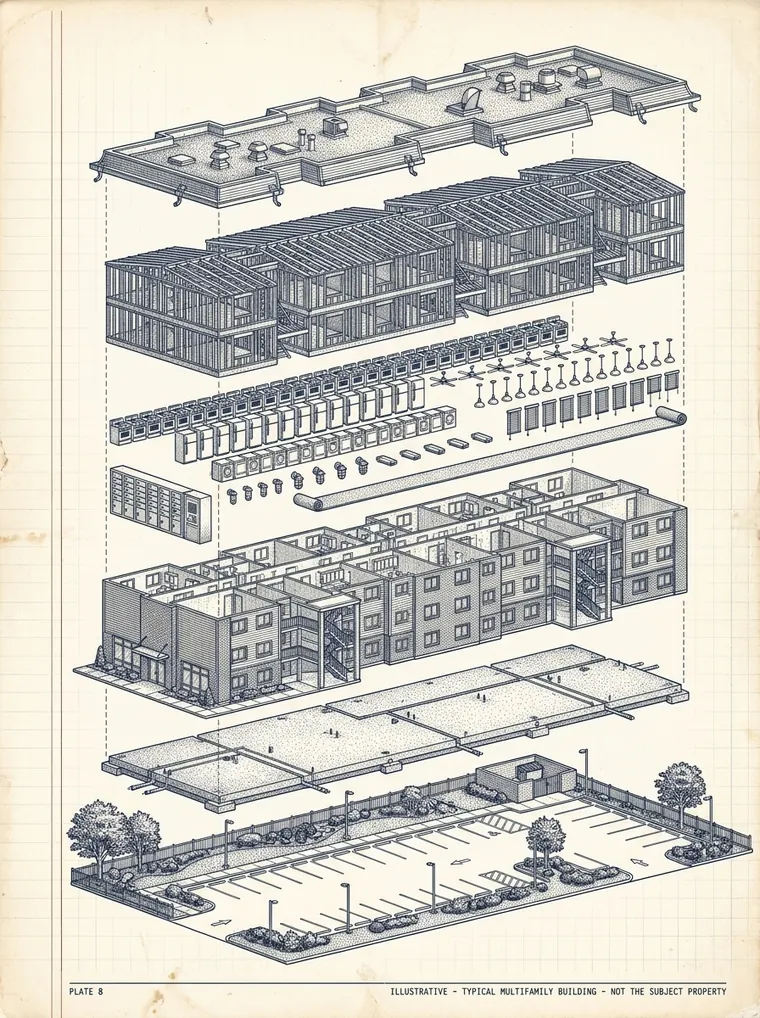
Why so much of a South Carolina apartment is the site
South Carolina apartment owners are often surprised how much of a garden community's value is outside the buildings. The state's fast-growing metros are full of newer, surface-parked, amenity-rich communities — resort pools and decks, cabanas, carports, gated entries, and extensive landscaping and irrigation — components generally treated as 15-year land improvements. Beneath them is a second, less-visible layer that Carolina geography forces onto nearly every project: engineered stormwater retention and drainage, permitted through the SC Department of Environmental Services and heightened on flood-prone coastal parcels. A closing file underweights that whole exterior bucket; on a Carolina community, the pond, the swales and the amenity deck can be a bigger part of the story than the clubhouse.
On a video walkthrough with you, and from your photos and records, our engineering review evaluates unit finishes and common areas and — across the whole parcel — pools and amenity decks, surface parking, landscaping and the required retention, building by building. Where drainage or flood-mitigation work has been done, we document what was replaced and when, so your CPA can weigh a partial asset disposition election and the correct year.
Why apartment communities reward a walkthrough
A South Carolina garden community repeats itself and spreads out. A 100-unit property has 100 sets of flooring, fixtures and appliances, and a site full of pools, decks, parking, landscaping and retention — and the mix is rarely uniform, because units turn and site work is added at different times.
A closing file records a building count and a unit count. It does not record which units were turned, what went into them, or how much site and amenity improvement is actually on the ground. A walkthrough of the parcel, done with you on a video call, is how that becomes a documented record instead of an assumption. Where records already support the components at issue, our remote model applies and costs less.

Unit finishes & fixtures
Flooring, window treatments, appliances, removable kitchen and bath fixtures, closet shelving, and per-unit lighting. On a 100-unit community these repeat many times, so unit-level documentation matters here.

Pools & amenities
Pool shells and pool equipment, amenity decks and cabanas, clubhouse and leasing-office build-out, fitness fixtures, dog parks, and extensive landscaping and irrigation — amenity-rich Carolina sites carry a large share here.

Parking & site improvements
Surface parking, drive aisles, sidewalks, curbing, carports, site lighting, fencing and gated entries — the large 15-year bucket a closing file rarely itemizes.

Retention & drainage
On-site retention or detention ponds, control structures, inlets, piped conveyance and swales the site is required to carry — and, where drainage or flood-mitigation work has occurred, the record of what was replaced and when for your CPA.
One community, three kinds of answer
Illustrative. Actual classifications are made per property, on the facts.
Carpet, vinyl and laminate flooring, appliances, removable kitchen and bath fixtures, closet shelving, ceiling fans, and site improvements such as pools and pool equipment, amenity decks, surface parking, carports, exterior lighting, landscaping, irrigation and retention.
Decorative and special-purpose lighting, cabinetry and countertops, amenity build-outs, drainage and flood-mitigation improvements and what they replaced, and improvements added after acquisition. Cabinetry in particular is fact-sensitive — ordinary permanent casework is generally building property.
Shell, framing, foundation, roofing, exterior walls, windows, general plumbing and electrical rough-in, and building-wide HVAC and fire protection. A five-plus-unit apartment community is residential rental property depreciated over 27.5 years.
How the engagement works
South Carolina stormwater and flood mitigation
If your community was built or improved under South Carolina's stormwater rules — or you have done drainage, retention, regrading or flood-mitigation work — it is worth reading this. Land-disturbing development is permitted through the SC Department of Environmental Services (formerly SCDHEC), and coastal Charleston sites carry heightened flood and stormwater design. Any mitigation or restoration is a capital event where cost segregation and depreciation timing interact. Each row is the question it raises:
A summary of local requirements and a general depreciation framing, not legal or tax advice; stormwater and floodplain compliance is a question for your engineer and counsel, and whether a partial asset disposition election is advisable is your CPA's determination. Sources: SC Department of Environmental Services — Stormwater, IRS partial-disposition practice unit.
South Carolina multifamily submarkets we serve
Related: multifamily cost segregation, the sample multifamily report, our Charleston warehouse coverage, and the South Carolina commercial hub.
Frequently asked
Do you visit apartment communities in South Carolina?
Not in person by default. When a walkthrough would improve the study, we do it with you on a video call, about 30 to 45 minutes, at no charge. You walk the property with your phone while our analyst directs the camera to the components that carry the value. An in-person visit is available by quote. On a garden community the walkthrough is how the site, including pools, parking, landscaping and retention, gets documented across the whole parcel rather than estimated from plans.
How long does a South Carolina multifamily study take?
Most studies are delivered within about two weeks once we have your records, varying with unit count, renovation history and record availability.
How much does a South Carolina apartment study cost?
Engineered multifamily studies start at $1,995 and step with the improvement basis. You get a fixed written fee before any work begins, not a percentage of your deduction — or call us at (213) 444-2776.
We did drainage or flood-mitigation work. Does that matter for the study?
It can matter a great deal. Drainage, regrading, retention or flood-mitigation work is a capital event placed in service in its own year, and the components it replaced may support a partial asset disposition election. We document what was replaced and the dates from your records and the walkthrough; whether the election is advisable is your CPA's determination.
Ready to scope your building?
Tell us the address, basis, and placed-in-service date. We generally return a written scope and quote within one business day — or call the office at (213) 444-2776.