Multifamily cost segregation in Los Angeles.
Engineered studies for apartment buildings across Los Angeles County. Larger engagements include an in-person walkthrough; below that, we walk the property with you by video at no charge, or in person as an add-on. Most studies are delivered within about two weeks. If you are carrying a soft-story retrofit, the timing matters more than usual.
How a soft-story retrofit interacts with cost segregation
Los Angeles apartment owners are often surprised that a soft-story retrofit interacts with cost segregation at all. Roughly 13,500 LA buildings were flagged under the ordinance — overwhelmingly pre-1978 "dingbat" apartments over open ground-floor carports, concentrated in Koreatown, the mid-Wilshire corridor, and Valley neighborhoods like Van Nuys, North Hollywood and Reseda — and the earliest-notified buildings hit their completion deadline in 2026. The retrofit is a capital event: the spend is its own placed-in-service asset, and a partial asset disposition election may apply to what was removed.
On a walkthrough, in person or by video, our engineering review evaluates unit finishes, common areas, and site improvements building-by-building — and where a retrofit has occurred or is planned, flags the disposition and timing questions for your CPA. RSO recovers only part of the retrofit cost over 10–15 years, so getting the depreciation timing right is worth the effort.
Why apartment buildings reward a walkthrough
An apartment building repeats itself. A 24-unit property has 24 sets of flooring, fixtures, window treatments and appliances, and the mix is rarely uniform: units get renovated at different times, in different finishes, by different owners.
A closing file records a building and a unit count. It does not record which units were turned, what went into them, or when. A walkthrough, in person or by video, is how that becomes a documented record instead of an assumption. Where records already support the components at issue, our remote model applies and costs less.

Unit finishes & fixtures
Flooring, window treatments, appliances, removable kitchen and bath fixtures, closet shelving, and per-unit lighting. On a 24-unit building these repeat 24 times, so unit-level documentation matters here.

Cabinetry & surfaces
Casework and countertops are reviewed against their installation and permanence rather than treated as a category. Ordinary permanently-installed cabinetry is generally building property; we document what is actually there.

Common areas & amenities
Lobby, laundry, corridor and amenity finishes, common-area lighting and flooring, low-voltage and access-control wiring, and equipment serving shared spaces.

Site improvements
Walkways and steps, surface parking, drives, retaining walls, exterior lighting, landscaping and irrigation, drainage, fencing and gates, and shared utility infrastructure.
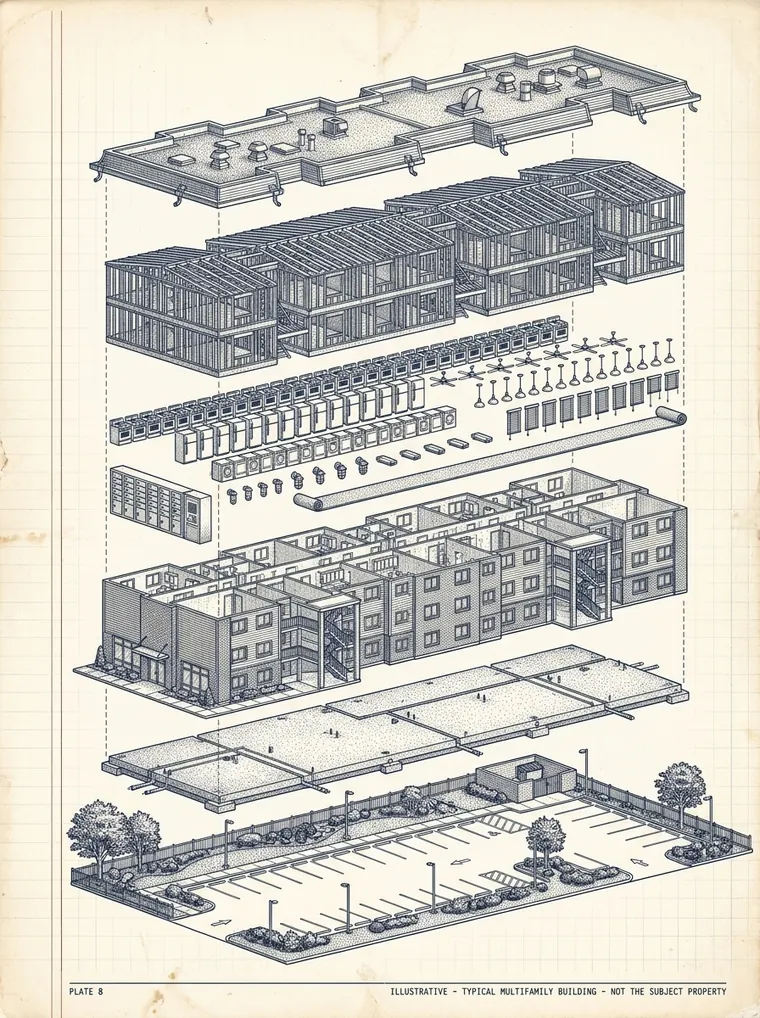
One building, three kinds of answer
Illustrative. Actual classifications are made per property, on the facts.
Carpet, vinyl and laminate flooring, window treatments, appliances, removable kitchen and bath fixtures, closet shelving, ceiling fans, and site improvements such as walkways, surface parking, exterior lighting, landscaping and irrigation.
Decorative and special-purpose lighting, cabinetry and countertops, specialty plumbing serving identified equipment, amenity build-outs, and improvements added after acquisition. Cabinetry in particular is fact-sensitive — ordinary permanent casework is generally building property.
Shell, framing, foundation, roofing, exterior walls, windows, general plumbing and electrical rough-in, and building-wide HVAC and fire protection. A 5-plus-unit apartment building is residential rental property depreciated over 27.5 years.
How the engagement works
The LA soft-story retrofit ordinance
If you own a pre-1978 wood-frame building in the City of Los Angeles with ground-floor open space, this is probably the most consequential thing on this page. Ordinances 183893 / 184081 require seismic retrofit of soft-story buildings of three or more units, on a compliance clock that runs up to seven years from the Order to Comply. A retrofit is a capital event, and capital events are where cost segregation and depreciation timing interact. Each row is the question it raises:
A summary of a local ordinance, not legal or tax advice; retrofit compliance is a building-department question for your engineer and counsel, and whether a partial asset disposition election is advisable is your CPA's determination. Where a retrofit has occurred or is planned, the spend and what it replaced should be separately identified. Sources: LADBS Soft-Story Program, LAHD Seismic Retrofit.
Los Angeles submarkets we serve
Related: multifamily cost segregation, the sample multifamily report, our Los Angeles warehouse coverage, and the Southern California commercial hub.
Frequently asked
Do you visit apartment buildings in Los Angeles?
On commercial engagements of $3 million or more, an in-person walkthrough by our team is included. Below that, an in-person site visit is available as an add-on for $895, travel included; otherwise, when a walkthrough would improve the study, we do it with you on a video call, about 30 to 45 minutes, at no charge. The walkthrough documents unit finishes, common areas, and site improvements, and on an in-person visit we coordinate access so occupied units are not disturbed unnecessarily.
How long does a multifamily cost segregation study take?
Most studies are delivered within about two weeks once we have your records, varying with unit count, the number of distinct unit types, and record availability.
How much does a Los Angeles multifamily study cost?
Engineered multifamily studies start at $1,995 and step with the improvement basis. You get a fixed written fee before any work begins, not a percentage of your deduction — or call us at (213) 444-2776.
What recovery period applies to an apartment building?
A residential rental building with five or more units is residential rental property, depreciated over 27.5 years — not the 39 years that applies to commercial property. A cost segregation study does not change that for the building itself; it identifies components that may properly belong in shorter recovery periods.
I am doing a soft-story retrofit. Does that change anything?
It can, in two directions. The retrofit spend is its own capital improvement with its own placed-in-service date and component detail. Separately, a partial asset disposition election may apply to building elements removed during the work — a timing question worth raising with your CPA before the return is filed. We flag what we observe; the election itself is your CPA's call.
Ready to scope your building?
Tell us the address, basis, and placed-in-service date. We generally return a written scope and quote within one business day — or call the office at (213) 444-2776.