On a Wichita long-term rental, your cost-seg deduction usually can’t hit this year’s W-2 income, and that is fine, because you don’t lose it. A long-term rental is a passive activity under §469, so a big first-year loss generally can’t offset your salary unless you clear the $25,000 special allowance (gone by $150,000 MAGI) or qualify as a real estate professional. But the suspended loss is not wasted: it carries forward and releases against future passive income or, in full, when you sell the property. On a Wichita rental, cost segregation is a bank-it-now, harvest-later play, not a same-April refund.
Want a number for a specific Wichita property? Use the calculator. It is pre-set with property-type defaults you can adjust to match your basis and tax bracket.
Cost Segregation in Wichita, KS
Is my $180K house too cheap to bother?
There is no legal threshold; it is pure economics. Does the modeled tax deferral exceed the study fee with room to spare? Because Cost Seg Smart runs the study remotely, with no travel cost baked in, the break-even basis is lower than the old rule-of-thumb floors traditional on-site firms quote. For a typical Wichita single-family rental around $150,000-plus in depreciable building basis, the reclassified deduction generally clears the residential study fee by a wide multiple, assuming you can use or bank the passive loss. Below roughly $120,000 to $150,000 of building basis the margin narrows and it becomes a judgment call. The numbers here are modeled, not a promise.
Cheap dirt means more depreciable building
Here is the quiet Wichita advantage. Land is never depreciable, and because Wichita dirt is cheap, a larger share of the purchase price is depreciable building rather than land. A $200,000 coastal condo might be 40 to 50% land; a $200,000 Wichita house is often only 15 to 20% land. Same sticker price, more depreciable basis, and more of that basis is exactly the short-life components a study accelerates. Wichita’s older 1970s and 1980s stock with basements and detached garages, plus a hot-and-cold climate that drives dedicated HVAC and site work, tends to carry a healthy short-life share. Components, not the sticker price, are the story.
Kansas follows federal bonus
Kansas follows federal accelerated and bonus depreciation. Kansas individual income tax starts from your federal adjusted gross income and uses rolling conformity, and Kansas conforms to the §168(k) 100% bonus rather than decoupling like California or New Jersey. So the accelerated federal deduction flows into your Kansas return automatically, with no state add-back for rental depreciation, at the state’s two-bracket rate of 5.20% and 5.58%. See bonus depreciation by state, and confirm your treatment with your CPA.
Worked example (modeled)
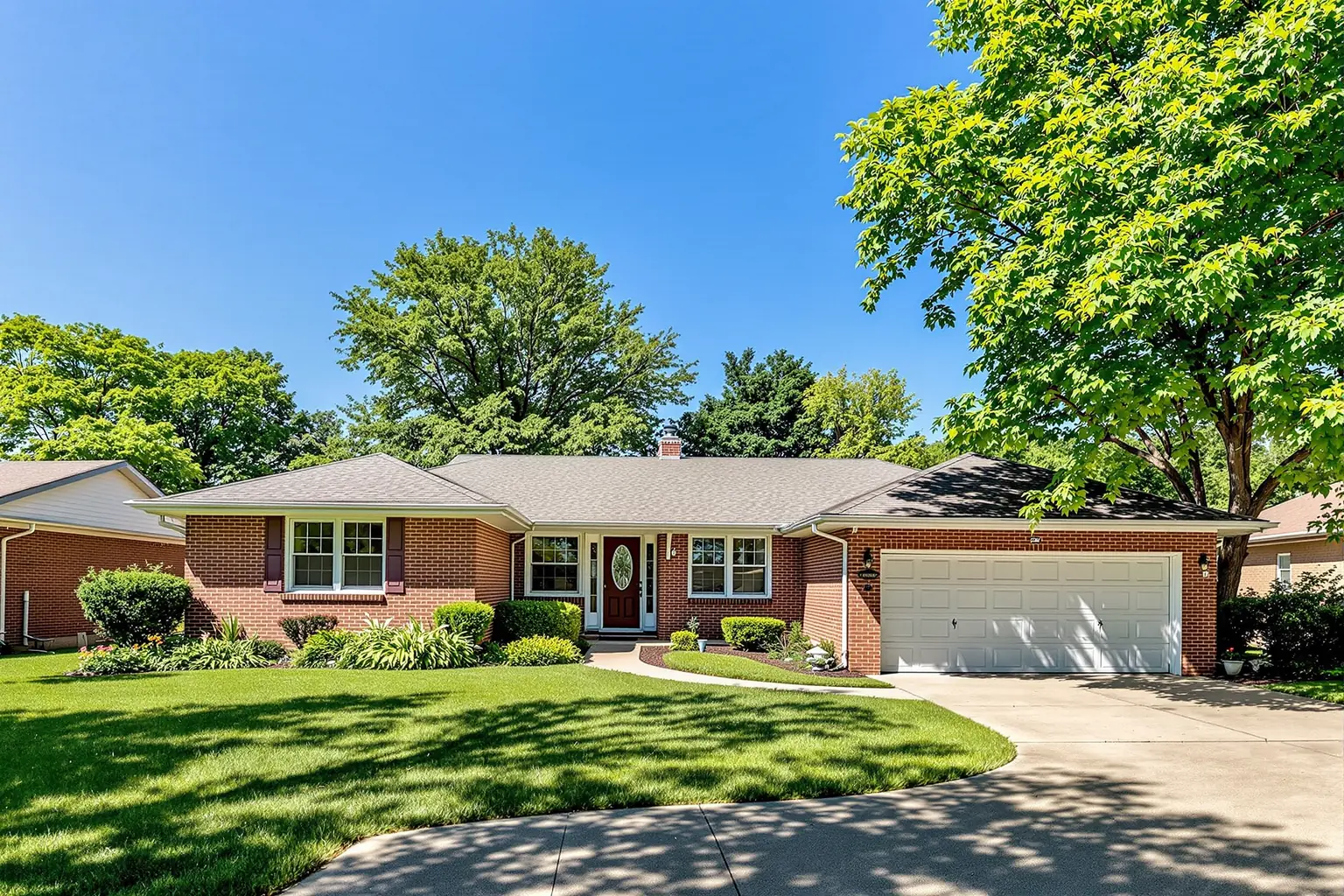
Consider a $180,000 buy-and-hold single-family rental in Wichita, acquired and placed in service in 2025. Every figure here is a modeled illustration, not a measured result or a promise; your study and CPA determine the actual amounts.
Cheap Kansas dirt means a land carve-out of only about 18%, so land comes out first and leaves a depreciable building basis of roughly $147,600. A residential single-family study commonly reclassifies 16–22% of building basis into shorter recovery periods. Modeled at about 22%, that is roughly $32,000 reclassified: on the order of $17,000 of 5-year personal property (flooring, cabinets, appliances) and $13,000 of 15-year land improvements (driveway, detached-garage site work, fencing, landscaping), plus a small 7-year slice.
Under 100% bonus, that reclassified amount is deductible in year one on the federal return, and Kansas conforms. The modeled first-year federal tax reduction is about $9,500, roughly nineteen times a typical residential study fee, subject to the §469 passive-loss rules above. Even at a modest $180,000, the reclassified deduction dwarfs the study fee; the real gating question is whether you can use or bank the loss this year.
Done remotely for most residential properties
The study is engineering-based but conducted remotely from your deed or closing statement, cost and basis records, and interior and exterior photos. For most residential properties there is no on-site visit, which is what lets us serve out-of-state owners of affordable Wichita rentals without a travel fee. We use industry-standard, nationally recognized construction cost data to support the component allocation. See how remote cost segregation works and what a cost segregation study is.
Wichita submarkets
- East Wichita and Andover: newer stock and strong schools, so higher basis and more new-build components, with families as long-term tenants.
- Derby: a fast-growing suburb near the aviation employers, with steady buy-and-hold demand from aerospace-wage renters.
- College Hill and Riverside: historic, well-kept near-central neighborhoods where older character homes carry basement, finish, and site-work opportunity.
- Delano District: a revitalizing area west of downtown with single-family, duplex, and townhome stock for value-add buy-and-hold.
Learn more about cost segregation
- Remote cost segregation: how an engineering-based study is delivered without a site visit
- What is cost segregation?: the full explanation of how the study works and what you receive
- Bonus depreciation by state: how Kansas conformity flows the deduction to your state return
- Material participation for STR owners: passive vs. non-passive losses and the §469 rules
- By property type: single-family rentals, multifamily, short-term rentals, warehouse & industrial
Ready to see your actual Wichita numbers?
Want a number for a specific Wichita property? Use the calculator, or start a preliminary analysis. Figures on this page are modeled illustrations; your study and CPA determine the actual amounts.
CPA use note: These figures estimate the size of the depreciation deduction. Whether the loss is usable in the current year depends on passive-activity rules, STR material participation, REPS status, entity structure, depreciable basis, and state conformity. Your CPA decides how and when it is applied. Specialty and site components (equipment, casework, docks, pools, arenas, tenant improvements, and similar) are only classified when you own them and they are included in the depreciable basis being studied.
How should Wichita, KS investors choose a cost segregation provider?
For a Wichita, KS investor buying a property in the $180,000 range, the choice of provider is a major controllable variable in the return. The IRS Audit Techniques Guide sets the quality characteristics an engineering-based study should meet — industry-standard construction cost data, MACRS classification, and component-level documentation — but it does not make every provider's work identical; rigor, cost, and turnaround still vary.
Traditional engineering studies often run several thousand dollars and can take several weeks, because they include on-site inspections, sales discovery calls, and scheduling overhead. The IRS Cost Segregation Audit Techniques Guide does not prescribe an on-site inspection as a standalone requirement; it sets out the quality characteristics of an engineering-based study — component-level classification, a documented and supportable cost derivation, and a clear audit trail — and describes how a physical inspection can contribute to meeting them.
Modern automated providers (such as Cost Seg Smart) deliver an engineering-based, IRS ATG-aligned study using property records, documents, photos, and recognized construction-cost data, typically from $495 and often the same day. For a Wichita, KS investor at a high combined bracket, that cost and speed difference is meaningful. The CPA-Ready Guarantee (full refund if the report can't be used by your CPA) plus the 60-day money-back policy makes the decision essentially risk-free on the report itself.
The automated path is best-fit for owners who can provide closing documents and property photos online (no in-person visit required) and want the report in time to file the current year's return rather than the next one.
All Cost Seg Smart studies include the CPA-Ready Guarantee (full refund if your CPA can't use the report) plus a 60-day money-back policy. Straightforward residential studies are often delivered the same day and completed remotely; larger or more complex commercial studies take longer and may include an on-site observation.