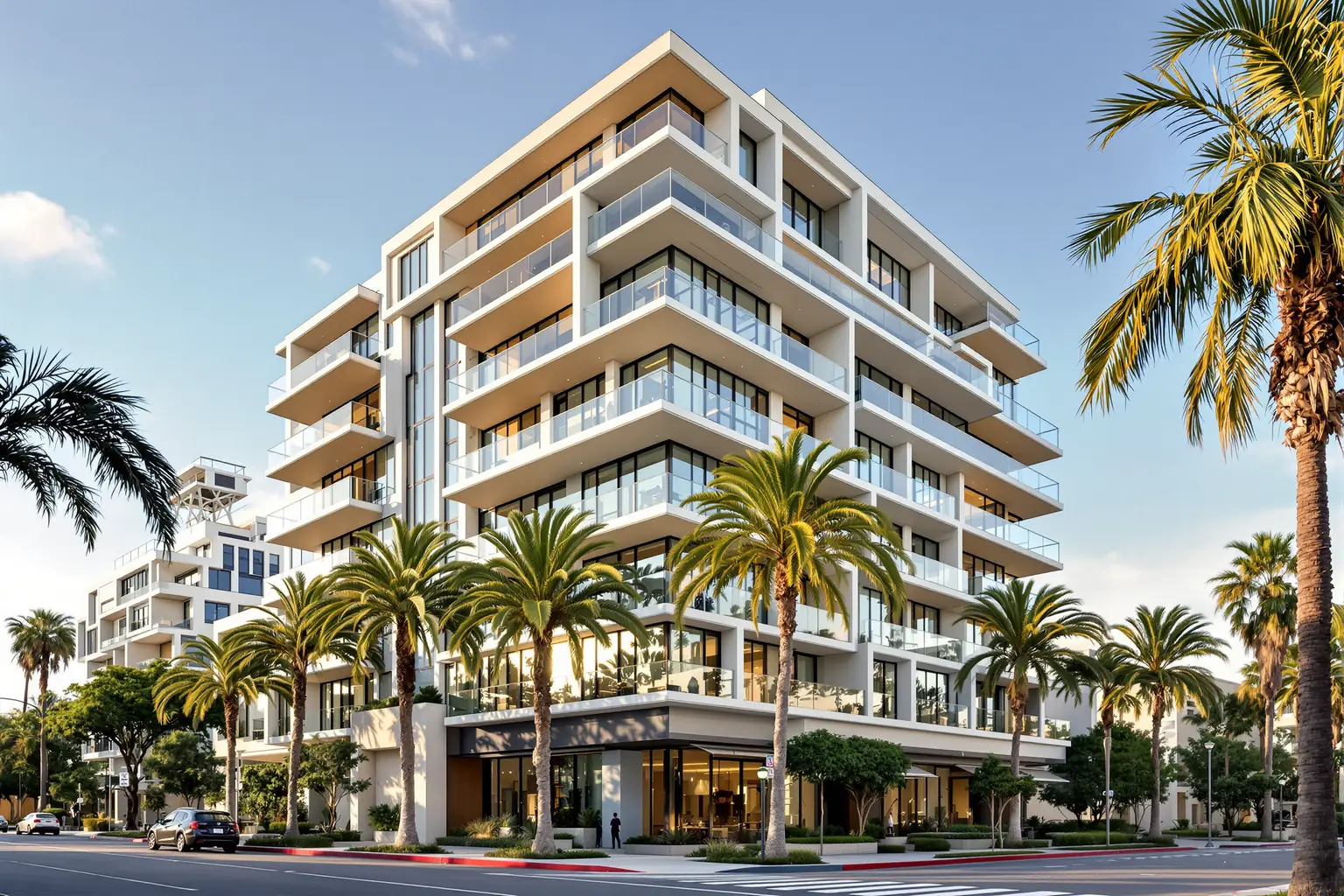
A West Hollywood apartment building reclassifies a higher share of its basis than a single house of the same value, and the reason is simple arithmetic. A house has one kitchen, one or two baths, and one appliance set. A twelve-unit WeHo building has twelve kitchens, twelve to twenty-four baths, twelve appliance sets, and twelve sets of unit finishes and dedicated circuits, plus shared amenities (pool, garage, EV charging, deck, landscaping) a house does not have at all. The repeating per-unit personal property and the building-scale site work are exactly what a national template built for a house leaves in the 27.5-year shell.
Want a number for a specific West Hollywood property? Use the calculator. It is pre-set with property-type defaults you can adjust to match your basis and tax bracket.
Cost Segregation in West Hollywood, CA
Why an apartment building beats a house
The reclassification opportunity scales with unit count and amenity density, both high in WeHo mid-rises. An engineering study evaluates the per-unit §1245 finishes (appliances, dedicated kitchen and laundry equipment circuits, carpet and removable floor coverings, specialty lighting) and the building-scale §1250 site work (courtyard hardscape, decorative walls and fences, fountains, specimen landscaping and irrigation, surface and structured parking, exterior lighting, amenity decks, retaining walls, drainage). Newer buildings add subterranean parking, elevators, pools and spas, and EV charging equipment.
We keep it honest and conservative. WeHo’s stock is dominated by residential rental property, and the leading adverse authority is an apartment case: in AmeriSouth, the Tax Court rejected 5-year treatment for cabinets, sinks, vent hoods, and decorative millwork, holding them structural. So the hook is “components multiply,” not “we will strip your cabinets to 5-year.” The defensible multiplier lives in genuine equipment and site improvements; contested finishes stay conservative and CPA-gated.
Two eras of West Hollywood stock
WeHo’s rental stock splits into two very different construction eras, and a study reads each differently. The 1920s to 1940s courtyard, Spanish, and walk-up apartments carry their reclassifiable value in site and land-improvement work: courtyard hardscape, decorative tile paths, fountains, perimeter walls and wrought-iron, mature landscaping and irrigation, drainage, and exterior stair and walkway lighting. The newer luxury condo and apartment mid-rises are amenity-dense, where §1245 equipment and §1250 site work multiply: subterranean parking with ramps, ventilation, EV charging and access control, pools and amenity decks, and rich common-area landscaping. The engineering emphasis shifts by building age, which is why a component-level study beats a flat percentage.
California does not conform to federal bonus
California does not conform to federal §168(k) bonus depreciation, and it did not adopt the 2025 federal law that restored 100% bonus. SB 711, signed in October 2025, moved California’s conformity date to January 1, 2025, which predates and excludes that change, so federal bonus is added back on the California return. California also caps §179 at $25,000. One study produces two schedules: federally, the reclassified 5-, 7-, and 15-year property is eligible for 100% bonus; for California, the same property is depreciated on accelerated MACRS over its shorter lives. California still benefits, as a timing acceleration versus straight-line, just not an immediate full write-off. See bonus depreciation by state, and route the mechanics to your CPA.
Worked example (modeled)
Consider a twelve-unit West Hollywood apartment building, newer construction with subterranean parking and a small amenity deck, acquired for $4,800,000. Every figure here is a modeled illustration, not a measured result or a promise; your study and CPA determine the actual amounts.
Dense Los Angeles land carries a high land ratio, so land comes out first (the exact percentage is property-specific, set from the assessor split or an appraisal, never assumed). That leaves a depreciable building basis of roughly $3,120,000. Multifamily reclassifies higher than a house because unit fixtures multiply; an engineering-based study commonly reclassifies 14–26% of building basis on a 5-plus-unit apartment. Modeled at about 26%, that is roughly $810,000 reclassified: on the order of $460,000 of 5-year personal property (per-unit appliances, floor coverings, and EV and amenity equipment), $330,000 of 15-year land improvements (site paving, hardscape, and landscaping; the subterranean parking structure itself stays in the building class), and a small 7-year slice.
Under 100% bonus, that reclassified amount is deductible in year one on the federal return. At a 37% bracket the modeled first-year federal tax reduction is about $300,000. For California it is added back and depreciated on accelerated MACRS, and if the loss is passive it suspends under §469 and releases at a fully taxable sale. Treat it as a timing benefit, not a permanent elimination of tax.
Rent stabilization and STR limits do not shrink the opportunity
West Hollywood has strong rent stabilization, in effect since 1985 and covering much of the pre-1979 apartment stock, and it prohibits most short-term rentals. Neither changes cost segregation. Rent stabilization caps revenue growth but has no effect on depreciation, so tax timing becomes one of the few owner-controlled levers left, which makes a study more valuable in a stabilized market. And because the income here comes from long-term tenancy, cost segregation applies squarely, regardless of short-term-rental rules.
Done remotely for most residential properties
The study is engineering-based but conducted remotely from your closing statement, cost records, rent roll, and photos. For most residential properties there is no on-site visit. We use industry-standard, nationally recognized construction cost data to support the component allocation. See how remote cost segregation works and what a cost segregation study is.
West Hollywood submarkets
- Sunset Strip: modern high-end apartment and condo mid-rises, amenity-dense with pools, decks, subterranean parking, and EV, so the highest equipment and site-improvement yield.
- East WeHo and the Norma Triangle perimeter: older courtyard and Spanish apartment stock, often pre-1979 and rent-stabilized, where 15-year site and land-improvement work is the story.
- West Hollywood West and the Design District edge: design-forward buildings and higher-end small multifamily with elevated finishes and mixed amenity components.
Learn more about cost segregation
- Remote cost segregation: how an engineering-based study is delivered without a site visit
- What is cost segregation?: the full explanation of how the study works and what you receive
- Bonus depreciation by state: how California non-conformity affects timing
- Material participation for STR owners: passive vs. non-passive losses and the §469 rules
- By property type: multifamily, short-term rentals, single-family rentals, warehouse & industrial
Ready to see your actual West Hollywood numbers?
Want a number for a specific West Hollywood property? Use the calculator, or start a preliminary analysis. Figures on this page are modeled illustrations; your study and CPA determine the actual amounts.
CPA use note: These figures estimate the size of the depreciation deduction. Whether the loss is usable in the current year depends on passive-activity rules, STR material participation, REPS status, entity structure, depreciable basis, and state conformity. Your CPA decides how and when it is applied. Specialty and site components (equipment, casework, docks, pools, arenas, tenant improvements, and similar) are only classified when you own them and they are included in the depreciable basis being studied.
How should West Hollywood, CA investors choose a cost segregation provider?
For a West Hollywood, CA investor buying a property in the $4,800,000 range, the choice of provider is a major controllable variable in the return. The IRS Audit Techniques Guide sets the quality characteristics an engineering-based study should meet — industry-standard construction cost data, MACRS classification, and component-level documentation — but it does not make every provider's work identical; rigor, cost, and turnaround still vary.
Traditional engineering studies often run several thousand dollars and can take several weeks, because they include on-site inspections, sales discovery calls, and scheduling overhead. The IRS Cost Segregation Audit Techniques Guide does not prescribe an on-site inspection as a standalone requirement; it sets out the quality characteristics of an engineering-based study — component-level classification, a documented and supportable cost derivation, and a clear audit trail — and describes how a physical inspection can contribute to meeting them.
Modern automated providers (such as Cost Seg Smart) deliver an engineering-based, IRS ATG-aligned study using property records, documents, photos, and recognized construction-cost data, typically from $495 and often within 1–2 business days. For a West Hollywood, CA investor at a high combined bracket, that cost and speed difference is meaningful. The CPA-Ready Guarantee (free revisions if your CPA flags a problem, and a refund if the report still can't be used) makes the decision essentially risk-free on the report itself.
The automated path is best-fit for owners who can provide closing documents and property photos online (no in-person visit required) and want the report in time to file the current year's return rather than the next one.
All Cost Seg Smart studies include the CPA-Ready Guarantee (free revisions if your CPA flags a problem, and a refund if the report still can't be used). Straightforward residential studies are often delivered in 1–2 business days and completed remotely; larger or more complex commercial studies take longer and may include an on-site observation.