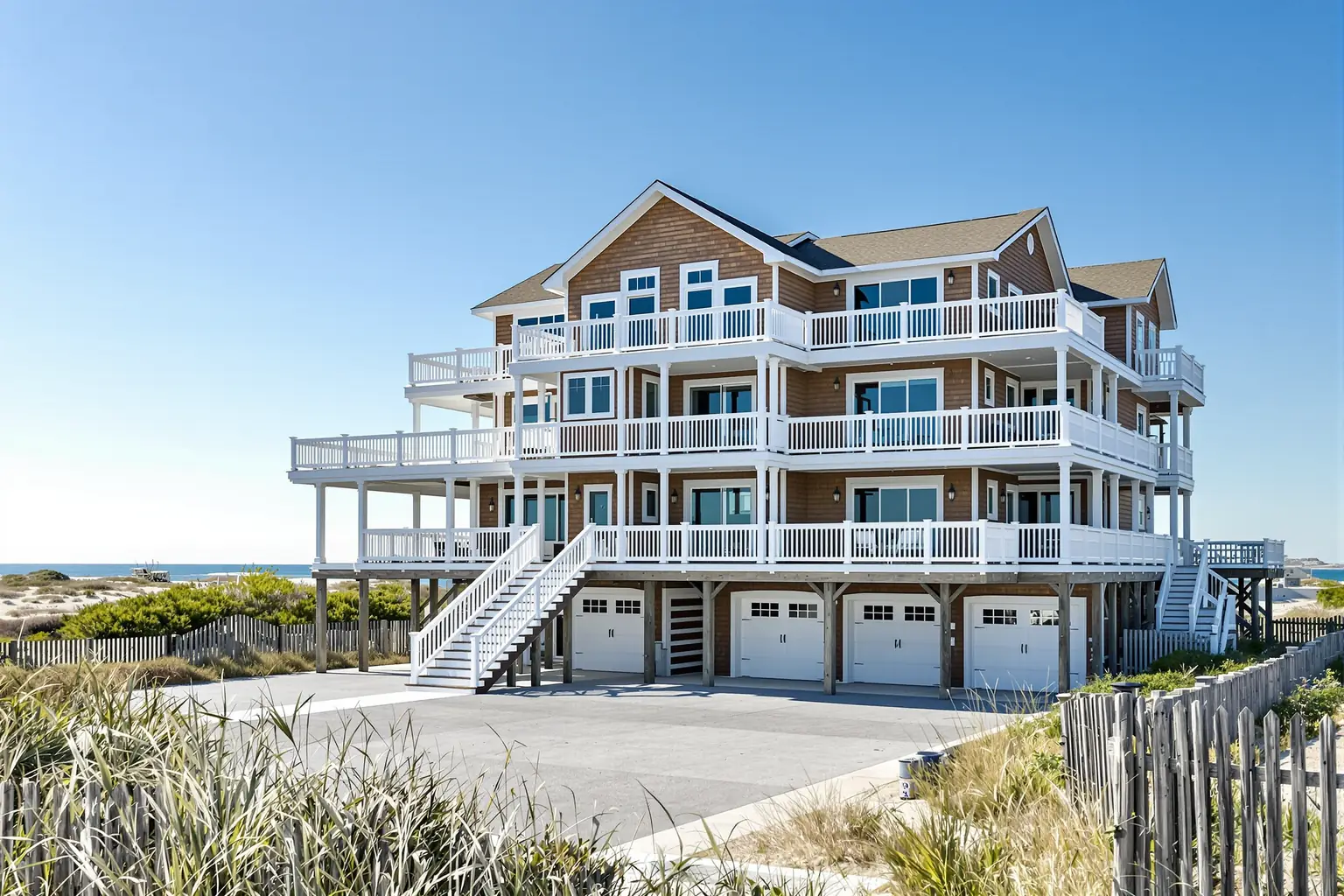
Owners on Seven Mile Island keep hearing that 100% bonus depreciation is permanent again, and they assume the whole benefit flows through on both returns. On a New Jersey return it does not. New Jersey decoupled from federal bonus depreciation years ago and never rejoined, so the bonus is added back on the state return and the same reclassified basis is recovered over its normal life instead. The federal timing benefit is as large as ever, and an engineering study is what captures it correctly and keeps your two schedules straight.
Want a number for a specific Avalon property? Use the calculator. It is pre-set with property-type defaults you can adjust to match your basis and tax bracket.
Cost Segregation in Avalon, NJ
What New Jersey does with your bonus depreciation
New Jersey has not conformed to federal §168(k) bonus depreciation, and the 2025 federal law that restored 100% bonus did not change that. NJ requires a full add-back of the federal bonus, for both the Gross Income Tax (individuals) and the Corporation Business Tax. You add the bonus back, recompute New Jersey depreciation without it, and carry a separate NJ schedule. Because the reclassified basis is still recovered for NJ over the assets’ normal lives, the effect is a timing difference between the federal and state returns, not a permanent loss. New Jersey also uses a much lower §179 allowance than the current federal limit, and its top Gross Income Tax rate is 10.75%, so the state math is worth getting right.
The honest, defensible read: a study accelerates your federal depreciation sharply; on your New Jersey return the bonus is added back and the same basis is recovered over its normal life, so the study still helps NJ, just as timing rather than a first-year windfall. Your CPA runs both schedules. See bonus depreciation by state for how conformity affects timing.
You do not need the Airbnb loophole
A lot of Avalon owners assume the tax angle only works for nightly Airbnb operators. It does not. Cost segregation applies to any income-producing property, and the depreciation benefit does not depend on qualifying as a short-term rental or on the under-7-day material-participation test. A weekly summer rental and a monthly seasonal lease both qualify to depreciate. What the short-term-rental question actually affects is whether the resulting losses are passive or non-passive under §469, which is a CPA determination, not something a study or this page should promise.
What a barrier-island beach house is made of
An Avalon beach house is not the slab-on-grade suburban home a national cost-seg template assumes, and the differences concentrate value in exactly the short-life classes a template under-captures. An engineering study evaluates components like these:
- Elevated pile and pier foundations. Homes in the coastal high-hazard flood zones sit on open piling foundations elevated above base flood elevation, with breakaway walls and elevated utilities. That structure, site work, and the enclosed-versus-open lower level all change how the property is characterized from the first line.
- Bayside bulkheads, docks, and boat lifts. On lagoon and canal lots, the bulkhead, dock, and lift infrastructure is dense 15-year land-improvement value a template built for an inland house never itemizes.
- Decks, walkovers, pools, spas, and outdoor showers. Near-universal at the shore, these are 15-year land improvements alongside pavers, driveways, irrigation, and landscape lighting.
- Elevators and pilings. Passenger elevators and the structural piling foundation are common on three-story Avalon beach houses, and both generally remain building property; a study reviews only genuinely separable equipment.
- FF&E and salt-environment mechanical. Luxury seasonal rentals are furnished and amenity-dense, and coastal HVAC is often upgraded and corrosion-rated; the study evaluates which portions are building system versus equipment-serving components.
Name the components, not the market: barrier-island, flood-driven, salt-environment construction puts an unusually large share of basis into non-structural and site components.
Worked example (modeled)
Consider a furnished beach-block Avalon rental acquired for $3,200,000. Every figure here is a modeled illustration, not a measured result or a promise; your study and CPA determine the actual amounts.
Barrier-island land is a very high share of value on prime blocks, so land comes out first (the exact percentage is property-specific and set by the study, never assumed). That leaves a depreciable building basis of roughly $1,440,000. An engineering-based study commonly reclassifies 19–39% of building basis into shorter recovery periods on residential work. Modeled at about 24%, that is roughly $345,000 reclassified: on the order of $155,000 of 5-year personal property (FF&E, elevator and pool equipment), $10,000 of 7-year property, and $180,000 of 15-year land improvements (decks, bulkhead, dock, pool, and site work).
Under 100% bonus, that reclassified amount is deductible in year one on the federal return. At a 37% bracket the modeled first-year federal tax reduction is about $128,000, roughly 51 times a typical study fee. On the New Jersey return the bonus is added back and the same basis is recovered over its normal life. Treat the federal figure as a timing benefit, not a permanent elimination of tax.
Done remotely for most residential properties
The study is engineering-based but conducted remotely from your closing statement, plans or appraisal, and photos. For most residential properties there is no on-site visit, which is what lets us serve owners who are rarely at the shore. We use industry-standard, nationally recognized construction cost data to support the component allocation. See how remote cost segregation works and what a cost segregation study is.
Avalon and Seven Mile Island submarkets
- Avalon beach blocks (oceanfront): the highest land share on the island, so the land carve-out discipline matters most here, on top of decks, dune walkovers, pools, and elevators.
- Bayside and lagoon lots: bulkheads, docks, and boat lifts make these a distinct 15-year land-improvement story a template routinely under-captures.
- Stone Harbor: the quieter south end of Seven Mile Island, same elevated, component-rich construction profile.
- Seven Mile Island generally: island-wide elevated and piling construction concentrates 5- and 15-year value across the market.
Learn more about cost segregation
- Remote cost segregation: how an engineering-based study is delivered without a site visit
- What is cost segregation?: the full explanation of how the study works and what you receive
- Bonus depreciation by state: how New Jersey’s decoupling affects timing
- Material participation for STR owners: the 7-day rule and passive vs. non-passive losses
- By property type: short-term rentals, multifamily, single-family rentals, warehouse & industrial
Ready to see your actual Avalon numbers?
Want a number for a specific Avalon property? Use the calculator, or start a preliminary analysis. Figures on this page are modeled illustrations; your study and CPA determine the actual amounts.
CPA use note: These figures estimate the size of the depreciation deduction. Whether the loss is usable in the current year depends on passive-activity rules, STR material participation, REPS status, entity structure, depreciable basis, and state conformity. Your CPA decides how and when it is applied. Specialty and site components (equipment, casework, docks, pools, arenas, tenant improvements, and similar) are only classified when you own them and they are included in the depreciable basis being studied.
How should Avalon, NJ investors choose a cost segregation provider?
For an Avalon, NJ investor buying a property in the $3,200,000 range, the choice of provider is a major controllable variable in the return. The IRS Audit Techniques Guide sets the quality characteristics an engineering-based study should meet — industry-standard construction cost data, MACRS classification, and component-level documentation — but it does not make every provider's work identical; rigor, cost, and turnaround still vary.
Traditional engineering studies often run several thousand dollars and can take several weeks, because they include on-site inspections, sales discovery calls, and scheduling overhead. The IRS Cost Segregation Audit Techniques Guide does not prescribe an on-site inspection as a standalone requirement; it sets out the quality characteristics of an engineering-based study — component-level classification, a documented and supportable cost derivation, and a clear audit trail — and describes how a physical inspection can contribute to meeting them.
Modern automated providers (such as Cost Seg Smart) deliver an engineering-based, IRS ATG-aligned study using property records, documents, photos, and recognized construction-cost data, typically from $495 and often within 1–2 business days. For an Avalon, NJ investor at a high combined bracket, that cost and speed difference is meaningful. The CPA-Ready Guarantee (free revisions if your CPA flags a problem, and a refund if the report still can't be used) makes the decision essentially risk-free on the report itself.
The automated path is best-fit for owners who can provide closing documents and property photos online (no in-person visit required) and want the report in time to file the current year's return rather than the next one.
All Cost Seg Smart studies include the CPA-Ready Guarantee (free revisions if your CPA flags a problem, and a refund if the report still can't be used). Straightforward residential studies are often delivered in 1–2 business days and completed remotely; larger or more complex commercial studies take longer and may include an on-site observation.