Cost Segregation If You Plan to Sell Soon: Worth It?
You deduct at 37% and recapture at 25%. That 12-point spread is permanent arbitrage. Even on a 2-3 year hold, a $600K STR nets $36K after recapture.

You deduct at 37% and recapture at 25%. That 12-point spread is permanent arbitrage. Even on a 2-3 year hold, a $600K STR nets $36K after recapture.
Bottom Line
- Depreciation recapture is taxed at a maximum 25% rate; the deduction saves you up to 37%. That 12-point spread is a permanent tax arbitrage, not a deferral.
- A $600K STR with a 3-year hold produces roughly $36,000 in net benefit after recapture—before counting time value of money
- A 1031 exchange at sale defers recapture entirely, turning cost segregation into pure upside
- Short holds under 12 months rarely justify the study. Holds of 2–5 years almost always do.
The most common hesitation we hear from investors considering cost segregation: “I might sell in a few years. Won’t I just have to pay it all back?”
It depends on your numbers, but often yes—cost segregation is still worth it, even with a 2–3 year holding period. The reason comes down to a tax rate arbitrage that most investors (and some CPAs) overlook. You deduct at your ordinary income rate. You repay at the recapture rate. Those two rates are not the same.
Here’s how to think about it, with actual math.
The Recapture Concern, Explained
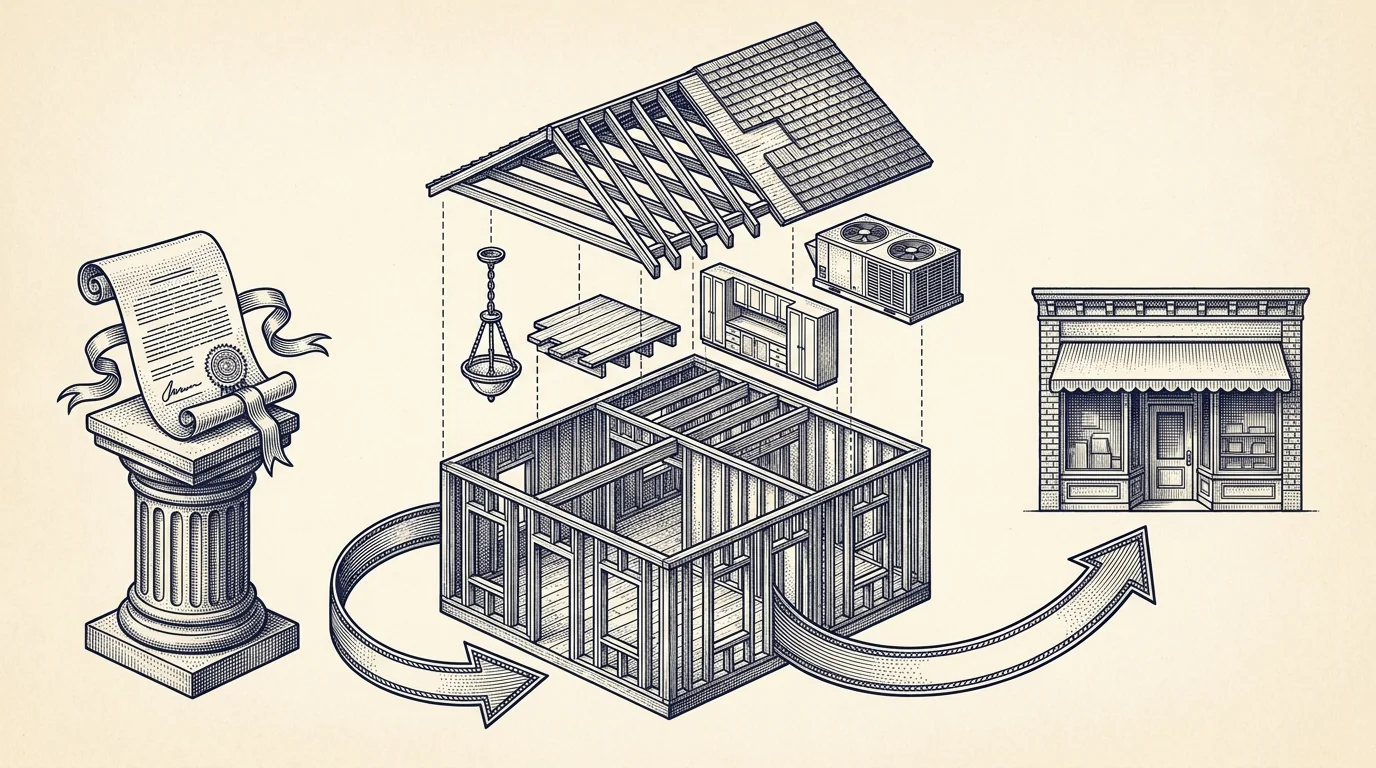
When you sell a property, the IRS requires you to “recapture” depreciation you’ve claimed. This applies to all depreciation—not just accelerated depreciation from a cost segregation study. If you own a rental property, you’re claiming depreciation whether you do a cost seg study or not. The study doesn’t create recapture exposure; it changes the timing.
Under IRC §1250, depreciation recapture on real property is taxed at a maximum rate of 25%. This is often called “unrecaptured Section 1250 gain.” It applies to the total depreciation claimed over the holding period, regardless of whether it was straight-line or accelerated. For a detailed breakdown of how recapture works, see our depreciation recapture guide.
The critical point: that 25% recapture rate is lower than the rate at which the deduction saved you money. If you’re in the 37% federal bracket (taxable income above $609,350 in 2026), every dollar of accelerated depreciation saved you $0.37 in Year 1. At sale, you owe $0.25 on that same dollar. The difference—$0.12 per dollar—is not a temporary benefit. It’s a permanent tax rate arbitrage.
The Math That Still Works
The net benefit of cost segregation with a short hold comes from three sources: the rate spread, the timing benefit, and any exit strategy that defers recapture. The rate spread alone makes the case for most investors.
| Your Federal Bracket | Year-1 Savings Rate | Recapture Rate at Sale | Net Rate Spread |
|---|---|---|---|
| 37% | 37% | 25% | 12 points |
| 35% | 35% | 25% | 10 points |
| 32% | 32% | 25% | 7 points |
| 24% | 24% | 24% | 0 points |
| 22% | 22% | 22% | 0 points |
Notice what happens below the 25% bracket: the rate spread disappears. If you’re in the 24% bracket, you save $0.24 on the deduction and owe at most $0.24 in recapture. The benefit shrinks to time value of money only. At the 22% bracket, the recapture rate equals your ordinary rate—no arbitrage at all.
This is why tax bracket matters. Cost segregation with a short hold is most powerful for high-income investors (32%+ bracket) and least compelling for those in the 22–24% range. For more on situations where cost seg may not pencil, see when not to do cost segregation.
The time value of money adds another layer. A dollar saved in Year 1 and repaid in Year 3 is worth more than a dollar repaid immediately. At a conservative 5% discount rate, $48,100 received today is worth approximately $2,400 more than $48,100 paid in 3 years. Over a 5-year hold, that time-value benefit grows further. It’s not the primary driver, but it compounds the rate-spread advantage.

Worked Example: $600K STR, 3-Year Hold
Let’s walk through a specific scenario. A furnished short-term rental purchased for $600,000 in a mountain market. The investor plans to hold for 3 years, then sell at roughly the same price. Year 1 — Purchase and Cost Seg Study Purchase price: $600,000. Land allocation: 20% ($120,000). Depreciable basis: $480,000. Cost seg reclassifies 32% of basis ($153,600) into 5/7/15-year property. With 100% bonus depreciation, the entire $153,600 is deducted in Year 1. Year 1 — Tax Savings At a 37% federal rate, that $153,600 deduction produces $56,832 in federal tax savings. Plus standard 27.5-year depreciation on the remaining basis ($326,400 / 27.5 = $11,869/year). Total Year-1 depreciation: ~$165,469. But we’ll focus on the accelerated portion since that’s what cost seg adds. Year 3 — Sale Sell for $600,000. Total depreciation claimed over 3 years: $153,600 (accelerated) + $35,607 (3 years of straight-line on remaining basis) = $189,207. Recapture tax on $189,207 at 25% = $47,302. Net Benefit: Cost Seg vs. No Cost Seg (3-Year Hold) Year-1 accelerated deduction $153,600 Year-1 federal tax savings (37%) $56,832 Recapture on accelerated portion at sale (25%) ($38,400) Rate-spread benefit (37% − 25% = 12%) $18,432 Time value of money (3 years at 5%) ~$2,800 Study cost ($895) Net benefit after recapture ~$20,337
That’s a net benefit of roughly $20,000 on an $895 study—even with a 3-year hold and a taxable sale. And this is the conservative case: no appreciation, no state tax benefit, and no 1031 exchange.
The 1031 Exchange Workaround
If you’re planning to sell and buy another investment property, a 1031 exchange changes the calculus entirely. Under IRC §1031, when you exchange one investment property for another of equal or greater value, all capital gains and depreciation recapture are deferred. Not reduced—deferred. You pay nothing at the time of exchange.
This means cost segregation with a 1031 exit is pure upside: you take the full Year-1 deduction, and the recapture tax never comes due (at least not on this transaction). The deferred recapture rolls into the replacement property’s adjusted basis and only triggers if you eventually sell outright without exchanging.
Many investors chain 1031 exchanges across multiple properties over decades. At death, heirs receive a stepped-up basis under IRC §1014, which eliminates all deferred depreciation recapture and capital gains permanently. This is sometimes called the “swap till you drop” strategy. Cost segregation makes it significantly more powerful.
If a 1031 exchange is part of your exit plan, the holding period concern essentially disappears. Even a 2-year hold produces a full Year-1 accelerated deduction with zero recapture at exit.

Think carefully if: You’re in the 24–32% bracket with a 1–2 year hold and no 1031 planned. The math still works, but the net benefit may be modest relative to the study cost. Run the numbers on the calculator to see your property-specific estimate, then order your study → once it pencils.
Skip it if: You’re in the 22% bracket or below, holding for under a year, or the property has a depreciable basis under $200,000. The economics don’t justify the study cost or the added complexity on your return.
Frequently Asked Questions Do I have to pay back all my depreciation when I sell?
You pay back depreciation you’ve claimed, but at a lower rate than you saved. Depreciation recapture on real property is taxed at a maximum 25% under IRC §1250, while the deduction likely saved you 32–37% in the year you claimed it. The net difference is a permanent tax arbitrage. And you only pay recapture on what you actually claimed—standard straight-line depreciation triggers the same recapture whether you did a cost seg study or not. Can I avoid depreciation recapture with a 1031 exchange?
Yes. A 1031 exchange defers all capital gains and depreciation recapture when you sell one investment property and buy another of equal or greater value. The recapture is rolled into the replacement property’s adjusted basis and only comes due if you eventually sell without exchanging. Many investors chain exchanges indefinitely, and the step-up in basis at death eliminates the deferred recapture permanently. What’s the minimum holding period for cost segregation to make sense?
There’s no IRS-mandated minimum. The economics depend on your tax bracket, the property’s reclassification rate, and your exit strategy. For investors in the 32–37% bracket, holds of 2 years or more produce a clear net benefit after recapture. Holds under 1 year rarely make sense because the time-value advantage is minimal. If you plan a 1031 exchange, even a 1-year hold works because recapture is deferred entirely.
Related Reading
- The Real ROI of a Cost Segregation Study: Breaking Down the Numbers
- What Percentage Should You Actually Expect From a Cost Segregation Study? (Real Data, Not Marketing)
See How Short-Hold Cost Seg Works for Your Property
Free preliminary depreciation estimate — property summary, basis allocation, five-year schedule. We do the work; you get the PDF.
See my estimated Year-1 savings →Related Reading [

Tax Mechanics
Depreciation Recapture and Cost Segregation: What You Actually Owe
How Section 1250 recapture works, what triggers it, and why the math still favors accelerated depreciation. 9 min read ](cost-segregation-depreciation-recapture) [

Exit Strategy
Cost Segregation and 1031 Exchanges: How They Work Together
Defer recapture entirely by pairing cost seg with a like-kind exchange at sale. 8 min read ](cost-segregation-1031-exchange) [

Analysis
When Not to Do Cost Segregation
Cost seg isn’t right for every property. Here’s how to know if the economics work for yours. 10 min read ](when-not-to-do-cost-segregation)
Frequently asked
Do I have to pay back all my depreciation when I sell?
You pay back depreciation you've claimed, but at a lower rate than you saved. Depreciation recapture on real property is taxed at a maximum 25% under IRC §1250, while the deduction likely saved you 32-37% in the year you claimed it. The net difference is a permanent tax arbitrage. And you only pay recapture on what you actually claimed — standard straight-line depreciation triggers the same recapture whether you did a cost seg study or not.
Can I avoid depreciation recapture with a 1031 exchange?
Yes. A 1031 exchange defers all capital gains and depreciation recapture when you sell one investment property and buy another of equal or greater value. The recapture is rolled into the replacement property's adjusted basis and only comes due if you eventually sell without exchanging. Many investors chain exchanges indefinitely, and the step-up in basis at death eliminates the deferred recapture permanently.
What's the minimum holding period for cost segregation to make sense?
There's no IRS-mandated minimum. The economics depend on your tax bracket, the property's reclassification rate, and your exit strategy. For investors in the 32-37% bracket, holds of 2 years or more produce a clear net benefit after recapture. Holds under 1 year rarely make sense because the time-value advantage is minimal. If you plan a 1031 exchange, even a 1-year hold works because recapture is deferred entirely.