Form 3115 Catch-Up Depreciation: §481(a) Worksheet (2026)
Line-by-line worksheet for computing missed depreciation you can catch up with Form 3115 — basis, asset class, and the §481(a) adjustment, step by step.
Line-by-line worksheet for computing missed depreciation you can catch up with Form 3115 — basis, asset class, and the §481(a) adjustment, step by step.
Form 3115 (Application for Change in Accounting Method) is the IRS form that lets you switch from one depreciation method to another and claim a one-time catch-up deduction for the difference — without filing amended returns for prior years. The catch-up is the §481(a) adjustment: the cumulative dollar amount of depreciation you should have taken under the new method, minus what you actually took under the old one. For real estate investors who didn’t do a cost segregation study at acquisition, Form 3115 is the way to claim every dollar of missed accelerated depreciation in the current tax year. This article walks through the three methods for computing the adjustment, the line-by-line worksheet, and the OBBBA bonus-depreciation interaction.
Key Takeaways
- §481(a) is a one-time catch-up deduction, not a multi-year smoothing. You claim the full cumulative adjustment in the year of change, no amended returns needed (IRC §481(a)).
- No lookback time limit on Form 3115. A property placed in service in 1995, 2010, or 2024 is equally eligible if you’ve been using a wrong or sub-optimal depreciation method.
- Cost segregation is the most-common reason to file 3115 for real estate — switching from straight-line 27.5/39-year depreciation to engineered MACRS reclassification with 5/7/15-year buckets.
- The adjustment respects prior-year bonus depreciation rates, not the current year’s rate. Property placed in service in 2022 gets 100% bonus on reclassified assets in its §481(a); property placed in 2024 gets 60% bonus on reclassified assets; property placed in 2025+ gets 100% bonus per OBBBA.
- Three methods to compute the §481(a): full engineered cost seg study (most defensible, starting at $495), Industry-standard cost data + IRS asset class lookup (DIY, requires careful documentation), or IRS reasonable-estimate framework (highest audit risk).
- DCN 7 is the most-common automatic-consent change code for cost segregation — depreciation method change without IRS pre-approval. The §481(a) adjustment computed under DCN 7 doesn’t require IRS sign-off before filing.
- A negative §481(a) means you over-depreciated in prior years and owe income recognition. Positive §481(a) means you under-depreciated and get a deduction. Real estate cost seg almost always produces positive (deductible) adjustments.
§481(a) adjustment vs. amended returns — which path applies
Two paths exist for correcting prior-year depreciation. They are NOT interchangeable.
| Path | When it applies | Lookback limit | IRS approval |
|---|---|---|---|
| Form 3115 §481(a) adjustment | Changing depreciation method (e.g., straight-line → cost seg). Treated as a method change, not an error. | No time limit — captures missed depreciation back to placed-in-service date. | Automatic consent for most depreciation changes (DCN 7 + others). File with return. |
| Form 1040X amended return | Correcting a mathematical or factual error in a prior year’s depreciation calculation. Used when the method itself was correct but a number was wrong. | Three years from the original return filing date (IRC §6511(a)). | No pre-approval needed — file amended return for each affected year. |
The practical rule: if you’ve been using straight-line 27.5/39-year depreciation and want to switch to engineered cost segregation with MACRS class reclassification, that’s a method change — Form 3115 with §481(a) adjustment, no time limit. If you used cost seg but miscalculated a basis allocation, that’s an error correction — Form 1040X, three-year limit.
When to file Form 3115 for real estate
Scenario 1 — missed cost seg at acquisition
The most common case. You bought a rental property in a prior year (residential or commercial), depreciated it straight-line over 27.5 or 39 years, and never did a cost segregation study. In the current year you decide to do one. The §481(a) adjustment captures every dollar of accelerated depreciation you should have taken from the placed-in-service date through the end of the current year. Filed with the current-year return as Form 3115 with DCN 7.
Scenario 2 — changing from an incorrect MACRS class
Less common but mechanically the same. You initially classified an asset into a wrong recovery period (e.g., depreciated land improvements over 27.5 years instead of 15 years) and want to correct. Form 3115 with DCN 7. The §481(a) adjustment is the cumulative depreciation difference between the wrong class and the correct class through the year of change.
Scenario 3 — applying bonus depreciation retroactively
You bought a property in 2020 (when bonus depreciation was 100%) and didn’t apply bonus to qualifying components. The §481(a) adjustment captures the missed bonus depreciation at the 2020 rate. Same DCN 7 framework.
Scenario 4 — §263A capitalization recalculation
Applies to property used in a producing trade or business (rare for pure rental). UNICAP rules under §263A may require capitalizing costs that were initially expensed. Separate DCN codes apply (DCN 27 for most §263A method changes). Outside the scope of typical cost-seg lookback work.
Three methods to compute the §481(a) adjustment
| Method | Approach | Cost | Audit risk |
|---|---|---|---|
| 1. Engineered cost segregation study | industry-standard 2026 construction cost data, engineering-based component allocation, IRS Cost Segregation Audit Techniques Guide (Pub 5653) framework | From $495 | Lowest — produces a 40+ page engineering-based report |
| 2. Industry-standard cost data + IRS asset class lookup (DIY) | Manual research using Pub 946 Table B for asset-class lives and industry-standard cost data for component costs. Document your methodology and component allocation rationale. | Time only (~20–40 hours) | Medium — depends entirely on documentation quality |
| 3. IRS reasonable-estimate framework | Building-permit-based allocation, comparable-property benchmarking, or simplified percentage methods. Acceptable for small dollar amounts. | Time only (~5–10 hours) | Highest — most likely to draw examination on §481(a) adjustments >$25K |
For residential rentals where the §481(a) adjustment is likely $20K–$80K, an engineered study at $495–$1,595 has overwhelming cost-benefit. For commercial properties where the adjustment can run $200K–$2M+, the $1,995–$3,295 commercial study is essentially mandatory — the document trail is what defends the adjustment in examination. Compare your specific numbers in the calculator — the catchupdepreciation.com worksheet runs the §481(a) computation interactively.
The worksheet — line by line
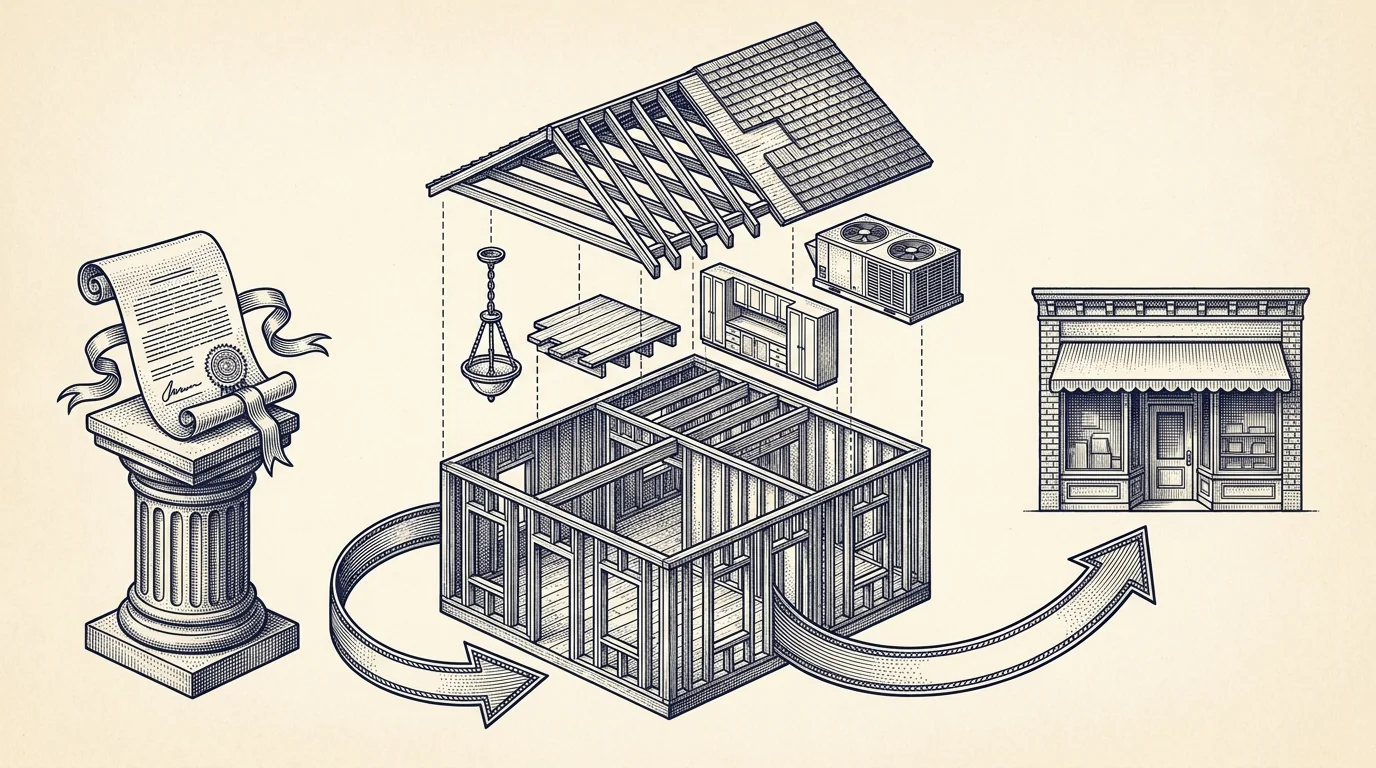
The worksheet captures the components of the §481(a) adjustment. Each row is one asset class identified by the cost segregation study; the totals at the bottom are what flows to Form 3115 Part IV.
| Line | Component / asset class | Recovery period | What goes here |
|---|---|---|---|
| 1 | Total acquisition cost (depreciable basis) | — | Purchase price + capitalized closing costs + capital improvements — land allocation. Pull from Form 4562 or original closing statement. |
| 2 | Placed-in-service date | — | Original PIS date. Drives the number of years of catch-up included in the §481(a). |
| 3a | 5-year property (personal property, FF&E, certain decorative components) | 5 years | Reclassified basis from cost seg study. Includes appliances, carpet, decorative lighting, removable wall coverings. |
| 3b | 7-year property (office furniture, certain machinery) | 7 years | Rare in residential; common in restaurant/retail. Specific asset classes per Pub 946 Table B. |
| 3c | 15-year property (land improvements, qualified improvement property) | 15 years | Site work, exterior lighting, fencing, parking, landscaping, signage. QIP since 2017 also lands here. |
| 3d | 27.5- or 39-year property (residual structural shell) | 27.5 (residential) or 39 (commercial) | Acquisition basis minus reclassified amounts. The shell. |
| 4 | Bonus depreciation rate(s) by placed-in-service year | — | For each prior year, the bonus rate at the time: 2017 (50%), 2018–2022 (100%), 2023 (80%), 2024 (60%), 2025+ (100% per OBBBA). |
| 5 | Year-by-year depreciation under new method | — | Compute the corrected depreciation for each year from PIS through current year using MACRS schedules + the bonus rate from line 4 for the PIS year. |
| 6 | Year-by-year depreciation under old method | — | Pull from Form 4562s filed in prior years. Typically straight-line 27.5/39 across the full basis. |
| 7 | §481(a) adjustment | — | Line 5 cumulative — Line 6 cumulative. Positive = deductible in year of change; negative = recognized as income in year of change. |
The output (line 7) is what flows to Form 3115 Part IV, line 25. The detail rows are kept in the cost segregation study’s supporting workpapers and attached to the filed Form 3115.
Bonus depreciation + §481(a) interaction
Under the One Big Beautiful Bill Act (OBBBA, signed July 2025), bonus depreciation is permanently 100% for property placed in service after January 19, 2025. The §481(a) adjustment respects the bonus rate in effect at the PIS date, not the current year — so the catch-up amount on a 2020-placed property includes the 100% bonus rate that applied in 2020, even though you’re filing in 2026.
The historical bonus depreciation schedule that drives §481(a) computations:
| PIS year | Bonus depreciation rate | Effect on §481(a) for reclassified 5/7/15-yr property |
|---|---|---|
| Pre-2008 | 0% (no bonus) | Only standard MACRS acceleration captured |
| 2008–2009 | 50% | 50% of reclassified basis as Year-1 bonus |
| 2010 | 50% (later raised to 100% retroactively for some property) | 50% baseline, 100% for qualifying assets |
| 2011 | 100% | Full Year-1 bonus on reclassified property |
| 2012–2017 | 50% | 50% Year-1 bonus |
| 2018–2022 (TCJA) | 100% | Full Year-1 bonus — peak catch-up years |
| 2023 | 80% (TCJA phase-down) | 80% Year-1 bonus |
| 2024 | 60% | 60% Year-1 bonus |
| 2025+ (OBBBA) | 100% (permanent) | Full Year-1 bonus restored |
Properties placed in service 2018–2022 carry the highest §481(a) potential because the 100% bonus applied to all reclassified components. A $1M residential rental placed in 2020 with 24% reclassification yields ~$240K of reclassified basis × 100% bonus = $240K of missed Year-1 depreciation, which (less the small amount of straight-line already taken) becomes the §481(a) adjustment in 2026. For the 2026 bonus depreciation rules and worked examples, see the standalone analysis.
Documentation and audit defense
The IRS examines Form 3115 filings with §481(a) adjustments above $25K more frequently than below. Four components defend the filing:
- Engineered cost segregation study (or a documented DIY methodology). The report’s component-by-component breakdown is the basis for the asset class allocation in line 3a–3d of the worksheet.
- Original Form 4562 filings for each prior year. Establishes the “old method” depreciation amounts (line 6).
- Closing disclosure / settlement statement from acquisition. Establishes original basis allocation between land and improvements (line 1).
- MACRS recovery period documentation per IRS Pub 946 Table B. Justifies the asset-class assignments on each reclassified component.
The standard automatic-consent change code for depreciation method changes is DCN 7 (change from impermissible to permissible method of accounting for depreciation, or from one permissible method to another). DCN 7 means no IRS pre-approval — file Form 3115 with the return, attach the §481(a) computation, and the change is effective. The IRS has 90 days to challenge; in practice, properly documented DCN 7 filings rarely draw examination.
Frequently asked
Each FAQ on this page is also embedded as FAQPage schema for AI extraction. The four answers above cover the most-common pre-filing questions. For interactive computation of your specific §481(a) catch-up, see catchupdepreciation.com — the worksheet calculator that runs the full §481(a) computation against your property’s basis, PIS date, and reclassification percentages.
Sources
- 26 U.S.C. § 481 — Adjustments required by changes in method of accounting
- 26 U.S.C. § 168 — Accelerated Cost Recovery System
- 26 U.S.C. § 168(k) — Bonus depreciation
- Form 3115 (IRS) — Application for Change in Accounting Method
- Rev. Proc. 2015-13 — Automatic consent procedures for accounting method changes
- IRS Publication 946 — How to Depreciate Property (with Table B asset-class lookup)
- IRS Cost Segregation Audit Techniques Guide — Publication 5653
Run the §481(a) computation on your property. The catch-up depreciation calculator runs the worksheet line-by-line for a specific property’s basis, placed-in-service date, and reclassification percentages — interactive, no signup. To get an engineered cost-seg study that produces the supporting workpapers attached to Form 3115, order a study (delivered in under 1 hour, from $495). For the parallel REPS framework that lets you actually use the §481(a) deduction against W-2 income, see REPS hour log + 750-hour test. For 2026 bonus-depreciation context, see bonus depreciation 2026.
Frequently asked
What is a §481(a) adjustment?
A §481(a) adjustment is the one-time catch-up deduction you claim when you file Form 3115 (Application for Change in Accounting Method) to switch from one depreciation method to another. If you bought a property in 2022 and used straight-line 27.5-year depreciation through 2025, then decide to do a cost segregation study in 2026, the §481(a) adjustment computes the difference between what you actually deducted (straight-line) and what you should have deducted under the new method (cost seg + bonus depreciation) — and lets you claim that entire cumulative difference in the year of change. Under IRC §481(a), the IRS treats this as a one-time recognition event rather than requiring amended returns for each prior year.
Do I need a cost segregation study to file Form 3115?
Not strictly — but in practice, yes. Form 3115 requires you to compute the §481(a) adjustment using a reasonable methodology, and the IRS Cost Segregation Audit Techniques Guide (Pub 5653) is the most-defensible framework. You can self-estimate using industry-standard construction cost data and IRS asset-class lives, but if the §481(a) adjustment is material (say, more than $50K), a formal engineering-based study is the cheapest insurance against examination. An engineered study starts at $495 for residential and $1,995 for commercial; the §481(a) adjustment it generates often runs $50K–$500K+, so the cost-benefit is overwhelming.
What if I placed the property in service more than 3 years ago?
Form 3115 has no lookback time limit — that limit only applies to amended returns. You can file Form 3115 in 2026 to change the depreciation method on a property placed in service in 2018, 2010, or 1995. The §481(a) adjustment captures the full cumulative depreciation difference from the placed-in-service date forward. The only practical floor is whether the catch-up is large enough to justify the cost of the study (typically $50K+ in catch-up makes the math pencil).
Can I combine §481(a) catch-up with 100% bonus depreciation?
Yes, and the OBBBA permanent restoration of 100% bonus depreciation makes the combination especially powerful for 2025+ filings. The §481(a) adjustment captures missed accelerated depreciation from prior years — including bonus depreciation that would have applied if the assets had been correctly classified into 5/7/15-year buckets at placed-in-service. For a property placed in service in 2022 (when bonus was 100%), the §481(a) adjustment includes the full bonus on the reclassified assets, even though you're claiming it in 2026. For property placed in service in 2024 (when bonus was 60%), the bonus portion of the §481(a) is at the 2024 rate, not the 2026 rate — the §481(a) calculation respects the rates that were in effect for each prior year.