Warehouse and logistics cost segregation in Houston.
Distribution and industrial property across greater Houston — the Port, the Grand Parkway (TX-99), and the US-59, US-290 and I-45 corridors. When a walkthrough would improve the study, we do it with you on a video call, at no charge, and most studies are delivered within about two weeks.
What makes Houston warehouses different for cost seg
Houston owners often expect the accelerated value to sit inside the building, when a large share of it is outside — and more so here than in most metros. After Hurricane Harvey, the region adopted NOAA Atlas 14 rainfall data and raised on-site stormwater detention requirements, so a Houston distribution site is engineered to hold its own rainwater: detention basins, storm drainage, truck courts and extensive paving — components generally treated as 15-year land improvements. Add the Port of Houston distribution engine, cheap land under a no-zoning regime, and tilt-wall construction, and the outdoor land-improvement bucket tends to be larger than a closing file suggests.
On a video walkthrough with you, and from your site plan, photos and records, our engineering review documents the detention basin and drainage, the truck court and trailer yard, dock positions and equipment, and heavy service and yard lighting. That is the land-improvement and §1245 value that Houston's stormwater rules and distribution scale tend to enlarge, and the components a closing file is least able to show.
Why distribution property rewards a walkthrough
A Houston distribution building carries much of its value outside the walls. Detention and drainage, paving area and section, dock equipment counts, and the heavy electrical service that feeds equipment are the largest reclassification lines, and they are the ones least visible in a closing file.
A walkthrough with you on a video call, checked against the site plan, is how the detention, the yard, the equipment and the service become a documented record instead of an estimate. Where records already support the components at issue, our remote model applies and costs less.

Detention & storm drainage
We document the detention basin (footprint, slopes and outfall) plus inlets, area drains, piping and water-quality features. Houston sites carry more of this than metros without comparable detention rules, and it is generally 15-year land improvement rather than building.

Truck court & dock equipment
Paved truck court and trailer yard (heavy-duty concrete vs. asphalt, dimensions, striping), dock positions, levelers, seals, shelters and bumpers, and any cross-dock configuration — documented as quantities and named §1245 equipment.

Heavy service & yard power
Panel and switchgear capacity, transformers, dedicated equipment feeds, and yard light poles and fixtures — separating equipment-serving 5-year power and 15-year site lighting from the 39-year shell.

Site & structure
Curbs, elevated loading pads, fencing and gates, and confirmation of the tilt-wall shell and the (typically lower) Houston land ratio that leaves more depreciable improvement basis.
One building, three kinds of answer
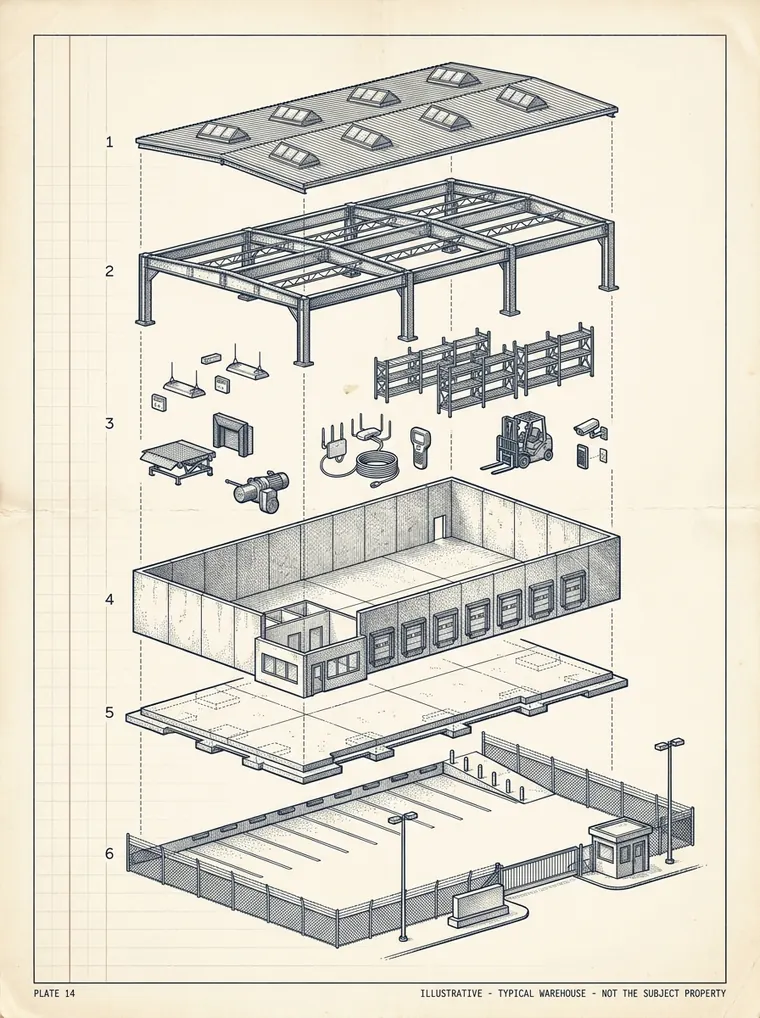
Illustrative. Actual classifications are made per property, on the facts.
Detention basins and storm drainage, truck court and trailer-yard paving, dock levelers and equipment, yard light poles and fixtures, dedicated equipment power, fencing and gates, and site landscaping — land improvements and §1245 equipment.
Heavy-duty slab and equipment pads, cold-storage refrigeration and insulated panels, water-quality and retention features, and tenant build-out of uncertain vintage — turning on how each installation functions and what the records show.
Shell, structural frame (including tilt-wall panels), foundation and floor slab, exterior walls, roofing, general-purpose lighting, and building-wide HVAC, plumbing and fire protection — nonresidential real property depreciated over 39 years.
How the engagement works
Houston distribution submarkets we serve
Related: our Energy Corridor industrial coverage, industrial cost segregation, the sample manufacturing report, and our Houston commercial hub.
Frequently asked
Do you visit warehouses in Houston?
Not in person by default. When a walkthrough would improve the study, we do it with you on a video call, about 30 to 45 minutes, at no charge. You walk the property with your phone while our analyst directs the camera to the components that carry the value. An in-person visit is available by quote. On distribution property the walkthrough is where the truck court, detention and drainage, and equipment get documented rather than assumed.
How long does a Houston industrial study take?
Most commercial studies are delivered within about two weeks once we have your records, varying with site complexity and record availability.
How much does a Houston warehouse study cost?
Engineered commercial and industrial studies start at $2,495 and step with the improvement basis. You get a fixed written fee before any work begins, not a percentage of your deduction — or call us at (213) 444-2776.
Why does the detention pond matter for cost segregation?
Because it is usually a land improvement, not building. Detention basins, storm drainage, truck courts and paving are generally treated as 15-year land improvements, and Houston sites carry more of that infrastructure than metros without comparable stormwater detention requirements. Documenting it on the walkthrough and from the site plan is how it gets separated from the 39-year shell.
Ready to scope your building?
Tell us the address, basis, and placed-in-service date. We generally return a written scope and quote within one business day — or call the office at (213) 444-2776.