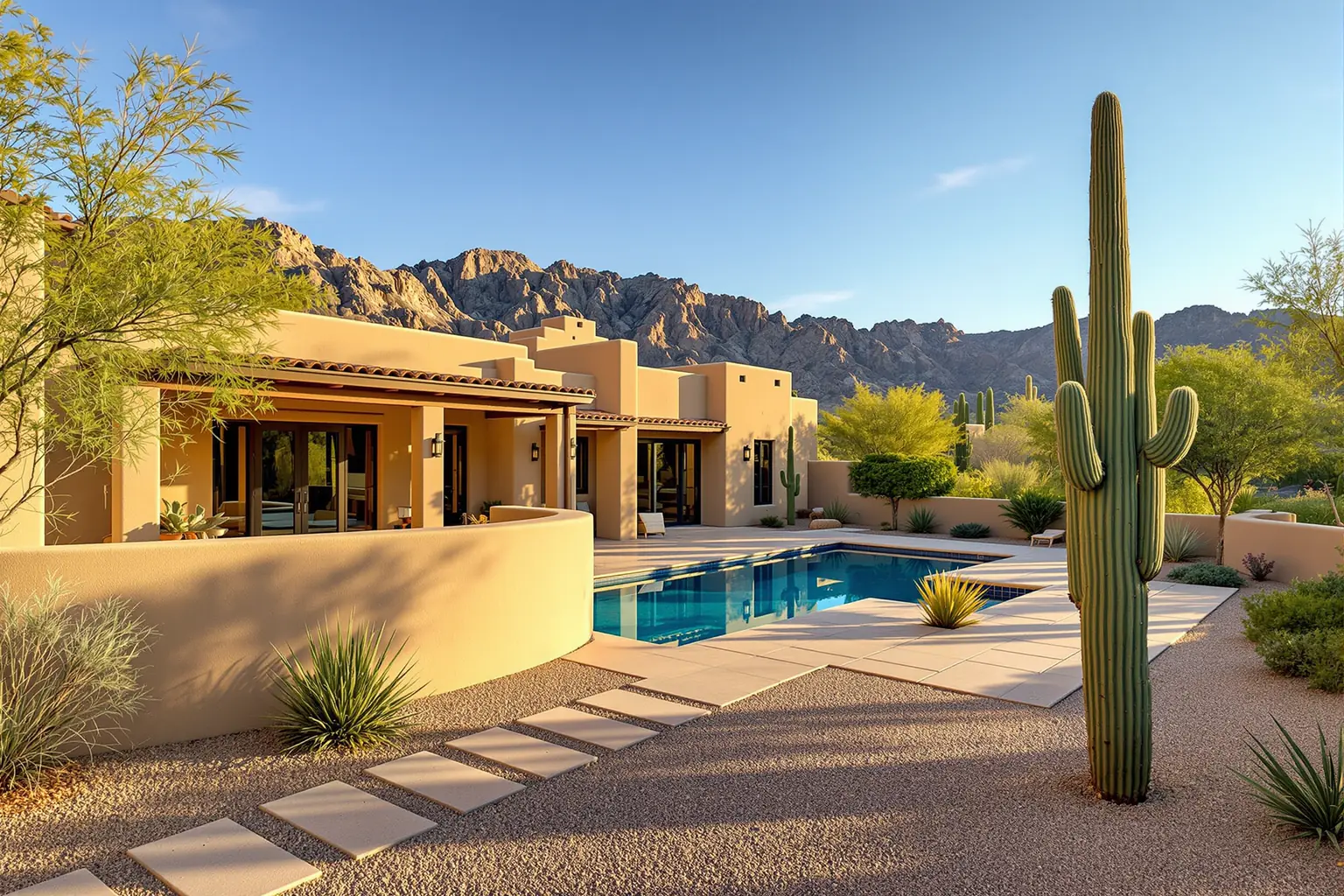
On a walled Tucson desert property with a pool, the biggest accelerated-depreciation bucket is often the site and outdoor living space, not the stucco box itself. The pool and spa, block privacy walls, pavers, ramada, outdoor kitchen, and decomposed-granite xeriscape are 15-year land improvements, and a generic study that treats the home like a suburban Midwest duplex leaves that value stranded on the 27.5- or 39-year schedule. In Tucson, most of your depreciation is in the yard.
Want a number for a specific Tucson property? Use the calculator. It is pre-set with property-type defaults you can adjust to match your basis and tax bracket.
Cost Segregation in Tucson, AZ
The desert yard is the story
Tucson builds concentrate depreciable value outside the building envelope to a degree a national template under-captures. An engineering study evaluates named desert components like these:
- Pool and spa, where the excavation itself is expensive because of caliche, the concrete-hard soil layer that has to be jackhammered on rocky foothill lots, plus the decking, plumbing, pumps, and controls.
- Block privacy walls, gated courtyards, pavers, ramadas, outdoor kitchens, fire features, and drip irrigation, which on a walled desert estate can rival a whole lawn-and-driveway package elsewhere.
- Foothill site work: rock excavation, engineered retaining walls, and grading, the portions of which tied to land improvements a study separates from the building.
- Specialty cooling and solar: evaporative coolers, mini-splits, dedicated pool and spa equipment, and near-universal rooftop solar, each with its own treatment.
We name the components rather than carve a percentage of a system, and because these are visible in listing photos, pool-build invoices, and landscape contracts, they document cleanly for a remote study. Decorative lighting and cabinetry as 5-year property is contested (AmeriSouth) and CPA-gated, so we keep those conservative.
Arizona decouples from federal bonus
Here is the myth-buster most cost-seg ads skip. Arizona decouples from federal §168(k) bonus depreciation. You add the federal bonus back on your Arizona return, then depreciate on regular MACRS and subtract the difference over later years until the add-back is recovered. It is a timing difference that self-corrects over the asset’s life, and it requires a separate Arizona basis per asset. The surprise resolves favorably: the federal acceleration is still large, the reclassification still helps Arizona because 5- and 15-year property depreciates faster than 27.5 or 39 years even under plain MACRS, and at Arizona’s flat 2.5% rate the state piece was always the smaller stake. Arizona’s conformity date moved to January 1, 2026 under HB 4168, still decoupling bonus. See bonus depreciation by state, and route the add-back mechanics to your CPA.
Arizona protects your right to operate
The regulatory story here cuts in the owner’s favor. Under Arizona’s 2016 preemption law, cities and counties cannot ban short-term rentals or regulate them based solely on use or occupancy; a 2022 law lets them require a permit but caps the fee by statute and requires a decision within 7 business days. One nuance worth checking: much of the Catalina Foothills is unincorporated Pima County, while Oro Valley and Marana are separate incorporated towns, so the correct permitting body depends on your parcel. None of it changes cost segregation, which applies to any income-producing property regardless of short-term-rental status.
Worked example (modeled)
Consider a Catalina Foothills desert casita, stucco-over-block with a walled courtyard, heated pool and spa, ramada, xeriscape, and rooftop solar, used as a seasonal short-term rental and acquired for $850,000. Every figure here is a modeled illustration, not a measured result or a promise; your study and CPA determine the actual amounts.
Foothill lots carry meaningful land value, so land comes out first (property-specific, set from an appraisal, never assumed). That leaves a depreciable building basis of roughly $637,500. An engineering-based study commonly reclassifies 20–28% of building basis into shorter recovery periods, and Tucson’s pool-and-hardscape stock weights it toward the upper end and toward the 15-year class. Modeled at about 26%, that is roughly $166,000 reclassified: on the order of $95,000 of 15-year land improvements (pool, spa, block walls, pavers, ramada, xeriscape), $66,000 of 5-year personal property (cooling and pool equipment, solar, furnishings), and a small 7-year slice.
Under 100% bonus, that reclassified amount is deductible in year one on the federal return. At a 32% bracket the modeled first-year federal tax reduction is about $53,000, roughly 53 times a typical study fee. For Arizona it is added back and recovered over time. Treat the federal figure as a timing benefit, not a permanent elimination of tax.
Done remotely for most residential properties
The study is engineering-based but conducted remotely from your closing statement, appraisal, pool and landscape invoices, and photos. For most residential properties there is no on-site visit. We use industry-standard, nationally recognized construction cost data to support the component allocation. See how remote cost segregation works and what a cost segregation study is.
Tucson submarkets
- Catalina Foothills: the flagship luxury and second-home market, custom estates on view lots where pools and hardscape are near-universal, so the richest yard-heavy reclassifications. Mostly unincorporated Pima County.
- Ventana Canyon, Oro Valley, and Marana / Dove Mountain: gated and resort-adjacent luxury rentals, each town with its own permitting posture.
- Downtown and University: smaller-footprint, game-day rentals with lower basis and a different component mix.
Learn more about cost segregation
- Remote cost segregation: how an engineering-based study is delivered without a site visit
- What is cost segregation?: the full explanation of how the study works and what you receive
- Bonus depreciation by state: how Arizona decoupling affects timing
- Material participation for STR owners: the 7-day rule and passive vs. non-passive losses
- By property type: short-term rentals, single-family rentals, multifamily, warehouse & industrial
Ready to see your actual Tucson numbers?
Want a number for a specific Tucson property? Use the calculator, or start a preliminary analysis. Figures on this page are modeled illustrations; your study and CPA determine the actual amounts.
CPA use note: These figures estimate the size of the depreciation deduction. Whether the loss is usable in the current year depends on passive-activity rules, STR material participation, REPS status, entity structure, depreciable basis, and state conformity. Your CPA decides how and when it is applied. Specialty and site components (equipment, casework, docks, pools, arenas, tenant improvements, and similar) are only classified when you own them and they are included in the depreciable basis being studied.
How should Tucson, AZ investors choose a cost segregation provider?
For a Tucson, AZ investor buying a property in the $850,000 range, the choice of provider is a major controllable variable in the return. The IRS Audit Techniques Guide sets the quality characteristics an engineering-based study should meet — industry-standard construction cost data, MACRS classification, and component-level documentation — but it does not make every provider's work identical; rigor, cost, and turnaround still vary.
Traditional engineering studies often run several thousand dollars and can take several weeks, because they include on-site inspections, sales discovery calls, and scheduling overhead. The IRS Cost Segregation Audit Techniques Guide does not prescribe an on-site inspection as a standalone requirement; it sets out the quality characteristics of an engineering-based study — component-level classification, a documented and supportable cost derivation, and a clear audit trail — and describes how a physical inspection can contribute to meeting them.
Modern automated providers (such as Cost Seg Smart) deliver an engineering-based, IRS ATG-aligned study using property records, documents, photos, and recognized construction-cost data, typically from $495 and often the same day. For a Tucson, AZ investor at a high combined bracket, that cost and speed difference is meaningful. The CPA-Ready Guarantee (full refund if the report can't be used by your CPA) plus the 60-day money-back policy makes the decision essentially risk-free on the report itself.
The automated path is best-fit for owners who can provide closing documents and property photos online (no in-person visit required) and want the report in time to file the current year's return rather than the next one.
All Cost Seg Smart studies include the CPA-Ready Guarantee (full refund if your CPA can't use the report) plus a 60-day money-back policy. Straightforward residential studies are often delivered the same day and completed remotely; larger or more complex commercial studies take longer and may include an on-site observation.