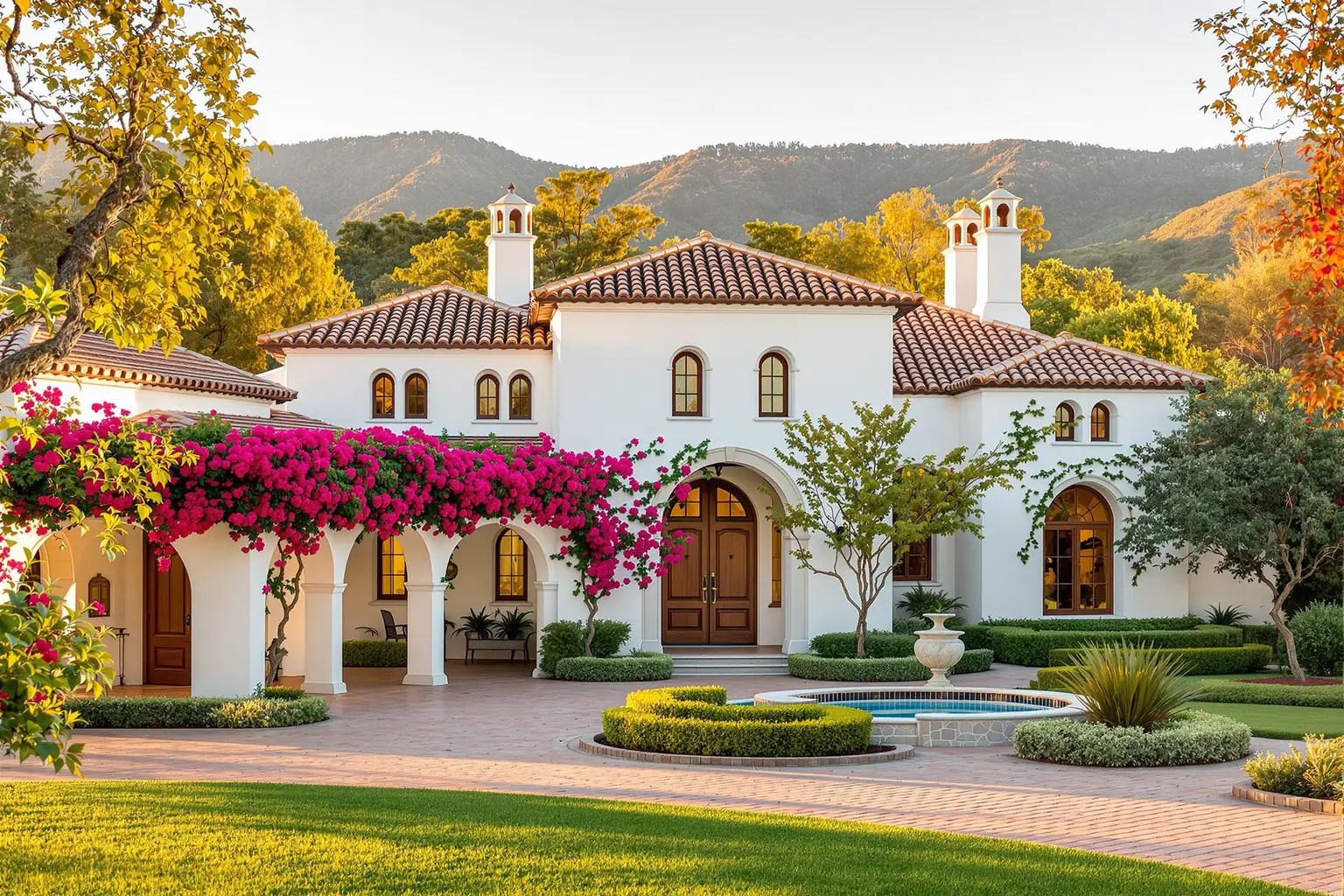
A $3.5M Montecito estate looks like the wrong property for cost segregation. So much of the price is dirt, the thinking goes, that there is little building left to depreciate. The opposite is true, and the reason is the single most valuable insight for a high-end Santa Barbara owner: the walls, courtyards, driveways, pools, and mature landscaping that make these estates worth what they are worth are 15-year depreciable site improvements, not land. Without a study, those improvements sit in the long-life building bucket, depreciating over 27.5 or 39 years; an engineering study carves them out into 15-year property. The more elaborate the grounds, the more a routine allocation leaves on the slow schedule.
Want a number for a specific Santa Barbara property? Use the calculator. It is pre-set with property-type defaults you can adjust to match your basis and tax bracket.
Cost Segregation in Santa Barbara, CA
A worked example: the $3.5M Montecito estate
Take a $3.5M estate in unincorporated coastal Montecito, held as an income-producing rental. Every figure here is a modeled illustration of the method, not a measured result or a promise; the actual split is set by the engineering study, your basis, and your tax profile.
On a lot like this, land is a large share of value, so it comes out first. Model land at roughly 45% (the exact percentage is property-specific and determined by the study, never assumed), and about $1,925,000 of depreciable basis remains. An engineering-based study commonly reclassifies 19–39% of building basis into shorter recovery periods on high-value residential work. Modeled near the top of that band, that is about $540,000 reclassified: roughly $385,000 of 15-year site improvements (the hardscape, walls, driveways, pools, and irrigated landscaping), about $150,000 of 5-year personal property (kept deliberately conservative on the contested residential finishes), and a small 7-year slice.
Under 100% bonus depreciation, that $540,000 is deductible in year one on the federal return. At a 37% bracket the modeled first-year federal tax reduction is about $200,000, roughly 80 times a typical study fee. Treat it as a timing benefit (a deferral), not a permanent elimination of tax.
Why the land-heavy estate is the best candidate, not the worst
The paradox is worth stating plainly, because it is where owners and even some CPAs get it backwards. Raw land never depreciates. But an estate’s grounds are not raw land. Perimeter and privacy walls, motor courts, cobbled and paver driveways, stone terraces and patios, pools and spas with their decking and filtration, fountains, retaining walls, drainage, site lighting, and mature specimen landscaping with its irrigation are all land improvements in the 15-year MACRS class. A simple 80/20 or assessor-ratio land/building split does not break these out, so they stay on the long-life building schedule instead of their proper 15-year life until a study separates them.
On Santa Barbara’s hardscape-dense estates that carve-out is unusually large. Add the guest house or ADU that so many of these properties carry, and the depreciable improvement base grows again. This is the ownable point for the market: the more you spent on the grounds, the more a proper engineering study recovers that a shortcut split throws away.
California does not follow the federal bonus rule
Get this exactly right, because national competitor pages tend to headline the big federal number and skip it. California does not conform to federal bonus depreciation, and it did not adopt the 2025 federal law that restored 100% bonus. Even after the conformity date moved to January 1, 2025 under SB 711, the state still excludes bonus depreciation and caps §179 expensing at $25,000.
For an owner that means two schedules from one study. Federally, the reclassified 5-, 7-, and 15-year property is written off immediately under 100% bonus. For California, you add the bonus back and depreciate that same property over its normal MACRS life. The study still helps the California return, because reclassifying 27.5-year building basis into 5/7/15-year property front-loads the California deduction through faster MACRS, rather than an immediate write-off. The California benefit is acceleration and timing, not instant expensing, and federal and California basis converge over time. One engineering study feeds both sets of books. See bonus depreciation by state for how conformity affects timing, and route the California mechanics to your CPA.
Where the Santa Barbara audience actually is
Short-term-rental rules here are a city-versus-county, coastal-versus-inland maze, and they are actively changing, so the cost-seg audience follows the parts of the map where income use is cleanest:
- Montecito: mostly unincorporated county, trophy estates with the largest hardscape and guest-house component. Coastal short-term rental is currently unregulated here, which is why it anchors the worked example above.
- Hope Ranch: unincorporated gated estates with extensive, often equestrian, grounds, so a heavy 15-year improvement base.
- Summerland: an unincorporated coastal enclave; the coastal-zone short-term rental status is currently unregulated.
- Riviera and The Mesa: inside city limits, where residential short-term rental is effectively banned, so the angle is mid-term and long-term income property.
- Carpinteria: a more attainable entry point; verify city-of-Carpinteria versus unincorporated-county jurisdiction separately.
The city, inside its limits, effectively bans residential short-term rentals and has enforced that since 2023; a further ordinance is proposed for late 2026 but is not yet adopted. Cost segregation does not depend on short-term eligibility, since it applies to any property held for income production, including mid-term and long-term rentals. It does not apply to a pure personal residence. Verify your specific parcel’s jurisdiction and zone before assuming a use.
Done remotely for most residential properties
The study is engineering-based but conducted remotely from your closing statement, appraisal, site and landscape plans, permits, and photos of the hardscape, pools, courtyards, and finishes. For most residential properties there is no on-site visit, which is what lets busy owners (including those who rarely visit the property) get a study delivered quickly. We use industry-standard, nationally recognized construction cost data to support the component allocation. See how remote cost segregation works and what a cost segregation study is.
Learn more about cost segregation
- Remote cost segregation: how an engineering-based study is delivered without a site visit
- What is cost segregation?: the full explanation of how the study works and what you receive
- Bonus depreciation by state: how California non-conformity affects timing
- Material participation for STR owners: the 7-day rule and how the deductions offset active income
- By property type: short-term rentals, multifamily, single-family rentals, warehouse & industrial
- Related California destination markets: Palm Springs, Joshua Tree, Lake Tahoe
Ready to see your actual Santa Barbara numbers?
Want a number for a specific Santa Barbara property? Use the calculator, or start a preliminary analysis. Figures on this page are modeled illustrations; your study and CPA determine the actual amounts.
CPA use note: These figures estimate the size of the depreciation deduction. Whether the loss is usable in the current year depends on passive-activity rules, STR material participation, REPS status, entity structure, depreciable basis, and state conformity. Your CPA decides how and when it is applied. Specialty and site components (equipment, casework, docks, pools, arenas, tenant improvements, and similar) are only classified when you own them and they are included in the depreciable basis being studied.
How should Santa Barbara, CA investors choose a cost segregation provider?
For a Santa Barbara, CA investor buying a property in the $3,500,000 range, the choice of provider is a major controllable variable in the return. The IRS Audit Techniques Guide sets the quality characteristics an engineering-based study should meet — industry-standard construction cost data, MACRS classification, and component-level documentation — but it does not make every provider's work identical; rigor, cost, and turnaround still vary.
Traditional engineering studies often run several thousand dollars and can take several weeks, because they include on-site inspections, sales discovery calls, and scheduling overhead. The IRS Cost Segregation Audit Techniques Guide does not prescribe an on-site inspection as a standalone requirement; it sets out the quality characteristics of an engineering-based study — component-level classification, a documented and supportable cost derivation, and a clear audit trail — and describes how a physical inspection can contribute to meeting them.
Modern automated providers (such as Cost Seg Smart) deliver an engineering-based, IRS ATG-aligned study using property records, documents, photos, and recognized construction-cost data, typically from $495 and often within 1–2 business days. For a Santa Barbara, CA investor at a high combined bracket, that cost and speed difference is meaningful. The CPA-Ready Guarantee (free revisions if your CPA flags a problem, and a refund if the report still can't be used) makes the decision essentially risk-free on the report itself.
The automated path is best-fit for owners who can provide closing documents and property photos online (no in-person visit required) and want the report in time to file the current year's return rather than the next one.
All Cost Seg Smart studies include the CPA-Ready Guarantee (free revisions if your CPA flags a problem, and a refund if the report still can't be used). Straightforward residential studies are often delivered in 1–2 business days and completed remotely; larger or more complex commercial studies take longer and may include an on-site observation.