Most Portland owners, and several competitor pages, assume Maine simply follows the federal bonus deduction. It does not, and getting this right is the most valuable thing this page can tell you. Maine decouples from federal §168(k) bonus depreciation and requires you to add the bonus back on the Maine return. Maine used to soften that with the Maine Capital Investment Credit, but that credit is repealed for tax years beginning on or after January 1, 2025, so a 2025 study gives you zero state credit against the add-back. The honest hook: do not let “Maine doesn’t conform” talk you out of a study. You still capture the full federal acceleration, and the Maine piece is a timing difference we will show you plainly, not a reason to skip it.
Want a number for a specific Portland property? Use the calculator. It is pre-set with property-type defaults you can adjust to match your basis and tax bracket.
Cost Segregation in Portland, ME
What Maine does with your bonus depreciation
Federally, the reclassified 5-, 7-, and 15-year property is eligible for 100% bonus in year one. For Maine, you complete a pro forma federal depreciation calculation as if no bonus was claimed and add back the difference, then recover that basis over the asset’s regular MACRS life through subtraction modifications in later years. So the deduction is not lost at the state level; it is a deferral, not a forfeiture, and the overwhelming majority of a study’s dollar value is federal, where 100% bonus is fully available on qualifying property. Maine does conform to the increased §179 limits, a separate lever that is not the primary cost-seg driver for real property. See bonus depreciation by state, and route the Maine specifics to your CPA.
What a historic Portland building is made of
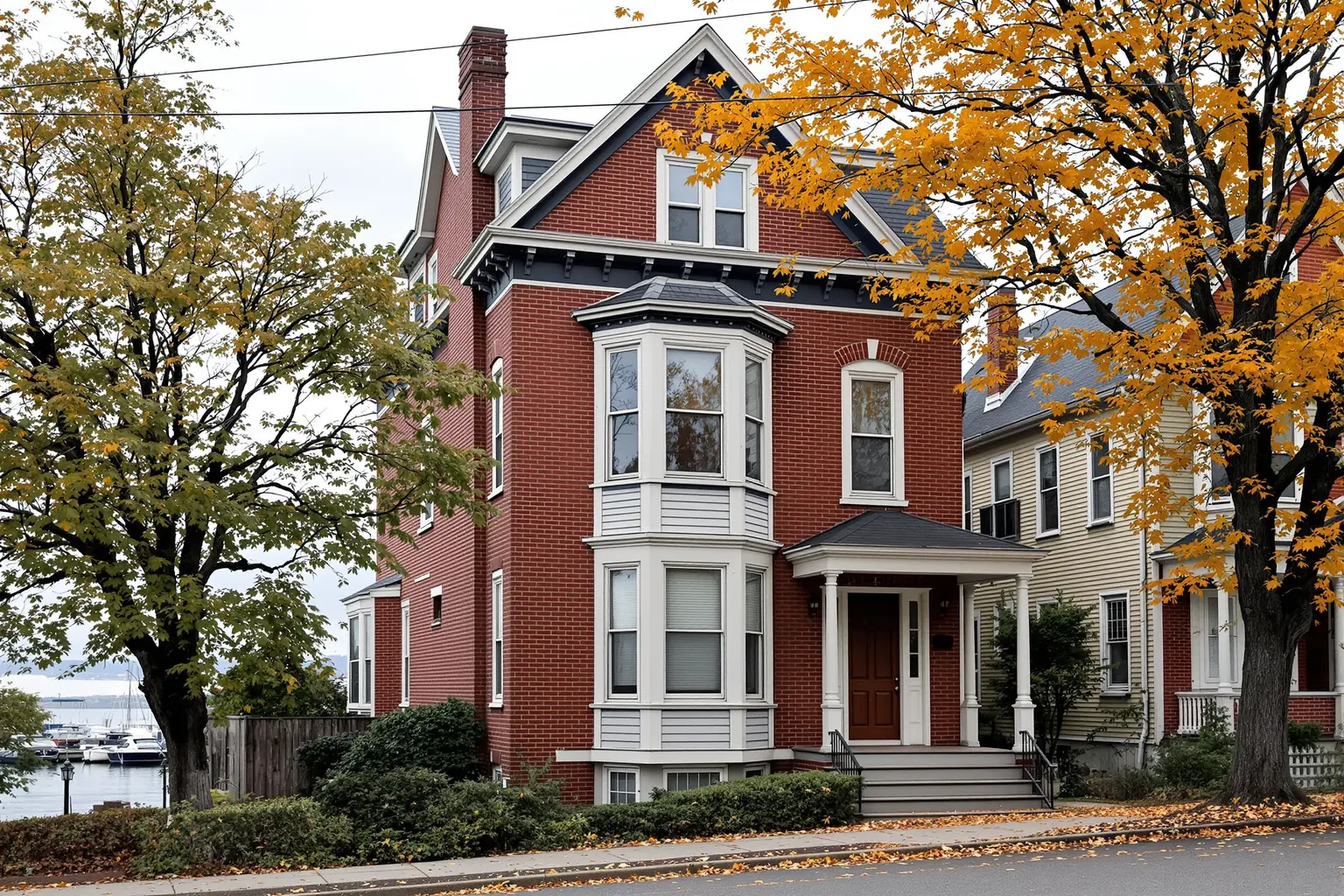
Portland’s peninsula housing stock is old, dense, and masonry-heavy, and it runs on cold-climate mechanical systems. Both facts change what a study can reclassify versus a Sunbelt new build. An engineering study evaluates components like these:
- Furnished short-term-rental contents: appliances, in-unit laundry, furniture packages, window treatments, and non-permanent floor coverings, the 5-year layer where acceleration concentrates on older stock. Heating that serves the building generally, including boilers and mini-split heat pumps, stays in the building class; only genuinely separable or dedicated equipment is evaluated.
- Cold-climate mechanical systems: boilers, baseboard and hydronic heat, and the ductless mini-split heat pumps common in Maine retrofits, where equipment serving specific loads is evaluated component by component, never as a percentage of the whole HVAC system.
- Limited but real site work: exterior stairs, walkways, retaining walls, and parking, which are thinner on tight peninsula lots and larger in South Portland and Westbrook.
Honesty for older masonry stock: a 19th-century brick multiunit yields a lower 5-year share than a modern furnished new build, because so much value sits in long-life masonry and original hardwood. The furnishing layer of a short-term rental is where the acceleration lives. Decorative lighting and cabinetry as 5-year property is contested (AmeriSouth) and CPA-gated, so we keep those conservative and mark every range as modeled until the review is done.
Portland’s short-term-rental caps
Portland runs one of New England’s most restrictive short-term-rental regimes. Non-owner-occupied mainland licenses are capped at roughly 293 for the 2026 program year, a formula set at 1.5% of the prior year’s registered long-term rentals, and effectively unavailable to new entrants unless an existing operator fails to renew. Peaks Island carries a separate 40-unit cap, and no new tenant-occupied short-term rentals are permitted for 2026. That scarcity makes an existing license a capitalized asset held for years, which is the multi-year horizon a study’s accelerated deductions play out over. None of it changes cost segregation, which applies to any income-producing property, including the long-term-rental units in a mixed building.
Worked example (modeled)
Consider a Munjoy Hill three-unit wood-frame building, one unit run as a furnished short-term rental under a grandfathered license and two long-term units, acquired for $650,000. Every figure here is a modeled illustration, not a measured result or a promise; your study and CPA determine the actual amounts.
Portland peninsula land is a meaningful share of value, so land comes out first (property-specific, never assumed), leaving a depreciable building basis of roughly $468,000. A small-multifamily study commonly reclassifies 22–26% of building basis into shorter recovery periods, though older masonry sits at the lower end. Modeled at about 22%, that is roughly $103,000 reclassified: on the order of $48,000 of 5-year personal property (furnishings and finishes in the rental unit), $50,000 of 15-year land improvements, and a small 7-year slice.
Under 100% bonus, that reclassified amount is deductible in year one on the federal return. At a 32% bracket the modeled first-year federal tax reduction is about $33,000. On the Maine return the bonus is added back and recovered over the asset’s life, with no state credit to offset it for 2025. Treat the federal figure as a timing benefit, not a permanent elimination of tax.
Done remotely for most residential properties
The study is engineering-based but conducted remotely from your closing documents, cost records, and photos. For most residential properties there is no on-site visit, which lets us serve owners of Portland’s older masonry and multiunit stock without a travel fee. We use industry-standard, nationally recognized construction cost data to support the component allocation. See how remote cost segregation works and what a cost segregation study is.
Portland submarkets
- Old Port and West End: historic brick and Victorian stock, premium short-term-rental and condo-conversion demand, with thin private site work on tight lots.
- Munjoy Hill and the East End: dense wood-frame multiunit with harbor views, strong small-multifamily activity, and the best example-property fit.
- Bayside and Peaks Island: transitional multifamily near downtown, and seasonal island cottages under a separate 40-unit cap.
- South Portland and Westbrook: newer stock on larger lots with better building-to-land and 15-year ratios, though separate municipalities with their own rules.
Learn more about cost segregation
- Remote cost segregation: how an engineering-based study is delivered without a site visit
- What is cost segregation?: the full explanation of how the study works and what you receive
- Bonus depreciation by state: how Maine decoupling affects timing
- Material participation for STR owners: the 7-day rule and passive vs. non-passive losses
- By property type: multifamily, short-term rentals, single-family rentals, warehouse & industrial
Ready to see your actual Portland numbers?
Want a number for a specific Portland property? Use the calculator, or start a preliminary analysis. Figures on this page are modeled illustrations; your study and CPA determine the actual amounts.
CPA use note: These figures estimate the size of the depreciation deduction. Whether the loss is usable in the current year depends on passive-activity rules, STR material participation, REPS status, entity structure, depreciable basis, and state conformity. Your CPA decides how and when it is applied. Specialty and site components (equipment, casework, docks, pools, arenas, tenant improvements, and similar) are only classified when you own them and they are included in the depreciable basis being studied.
How should Portland, ME investors choose a cost segregation provider?
For a Portland, ME investor buying a property in the $650,000 range, the choice of provider is a major controllable variable in the return. The IRS Audit Techniques Guide sets the quality characteristics an engineering-based study should meet — industry-standard construction cost data, MACRS classification, and component-level documentation — but it does not make every provider's work identical; rigor, cost, and turnaround still vary.
Traditional engineering studies often run several thousand dollars and can take several weeks, because they include on-site inspections, sales discovery calls, and scheduling overhead. The IRS Cost Segregation Audit Techniques Guide does not prescribe an on-site inspection as a standalone requirement; it sets out the quality characteristics of an engineering-based study — component-level classification, a documented and supportable cost derivation, and a clear audit trail — and describes how a physical inspection can contribute to meeting them.
Modern automated providers (such as Cost Seg Smart) deliver an engineering-based, IRS ATG-aligned study using property records, documents, photos, and recognized construction-cost data, typically from $495 and often the same day. For a Portland, ME investor at a high combined bracket, that cost and speed difference is meaningful. The CPA-Ready Guarantee (full refund if the report can't be used by your CPA) plus the 60-day money-back policy makes the decision essentially risk-free on the report itself.
The automated path is best-fit for owners who can provide closing documents and property photos online (no in-person visit required) and want the report in time to file the current year's return rather than the next one.
All Cost Seg Smart studies include the CPA-Ready Guarantee (full refund if your CPA can't use the report) plus a 60-day money-back policy. Straightforward residential studies are often delivered the same day and completed remotely; larger or more complex commercial studies take longer and may include an on-site observation.