Louisiana quietly changed how your New Orleans rental depreciates on your state return, and most owners have not noticed. For tax years beginning on or after January 1, 2025, Louisiana decoupled from federal §168(k) bonus depreciation and replaced automatic pass-through with its own elective regime under R.S. 47:297.25. The federal acceleration from a cost segregation study is as large as ever. The Louisiana piece is now a separate election you have to make on purpose, and a study is what lets you claim it correctly on both returns.
- $101,000 Accelerated Depreciation (modeled)
- $32,000 Est. Year-1 Federal Deduction Value
- 36x Return on Study Cost
Want a number for a specific New Orleans property? Use the calculator. It is pre-set with property-type defaults you can adjust to match your basis and tax bracket.
Cost Segregation in New Orleans, LA
What changed on your Louisiana return in 2025
Through 2024, Louisiana conformed to federal depreciation, so bonus flowed to the state return with no extra step. That assumption broke on January 1, 2025. Under R.S. 47:297.25, qualified property placed in service on or after that date gets bonus on the Louisiana return only if the taxpayer affirmatively elects it, with an add-back mechanism so the same deduction is not double-counted across years. Louisiana also moved to a flat 3% individual income tax rate for 2025, replacing the old bracket structure.
The practical read for an owner: the federal deduction is still the dominant dollar driver, and it is unchanged. The Louisiana benefit is smaller (3% flat) and now opt-in. Nearly every competitor page ranking for this market is a national template that never mentions the 2025 decoupling, so owners who rely on that stock advice quietly leave the state election unmade. Coordinate the federal study with the Louisiana election, and route the state-side specifics to your CPA. See bonus depreciation by state for how conformity affects timing.
The New Orleans short-term-rental permit reality
Orleans Parish runs one of the strictest, most block-specific STR regimes in the country, and it shapes who actually benefits from a study here. Residential permits are capped at one per city square (block), awarded by lottery when more than one owner on a square applies. The city stopped accepting new commercial STR applications on June 8, 2023, closing that pipeline to new entrants. Residential permits are tied to an on-site operator requirement; the older owner-occupancy and homestead rules have been litigated and rewritten, so confirm the current status with the City rather than relying on a blog from 2021.
Some districts are off-limits or restricted. The French Quarter (Vieux Carré) broadly prohibits residential STRs outside a narrow commercial corridor, and parts of the Garden District are banned block-by-block. Marigny and Bywater carry additional neighborhood-specific density limits beyond the citywide rule. None of that changes the depreciation math: cost segregation applies to income-producing property whether it is rented short-term, long-term, or as a mixed-use holding. The permit scarcity simply means most New Orleans STR owners are single-property residential operators who won a hard-to-replace permit and have real reason to maximize after-tax cash flow.
The parts of a New Orleans house that depreciate fastest
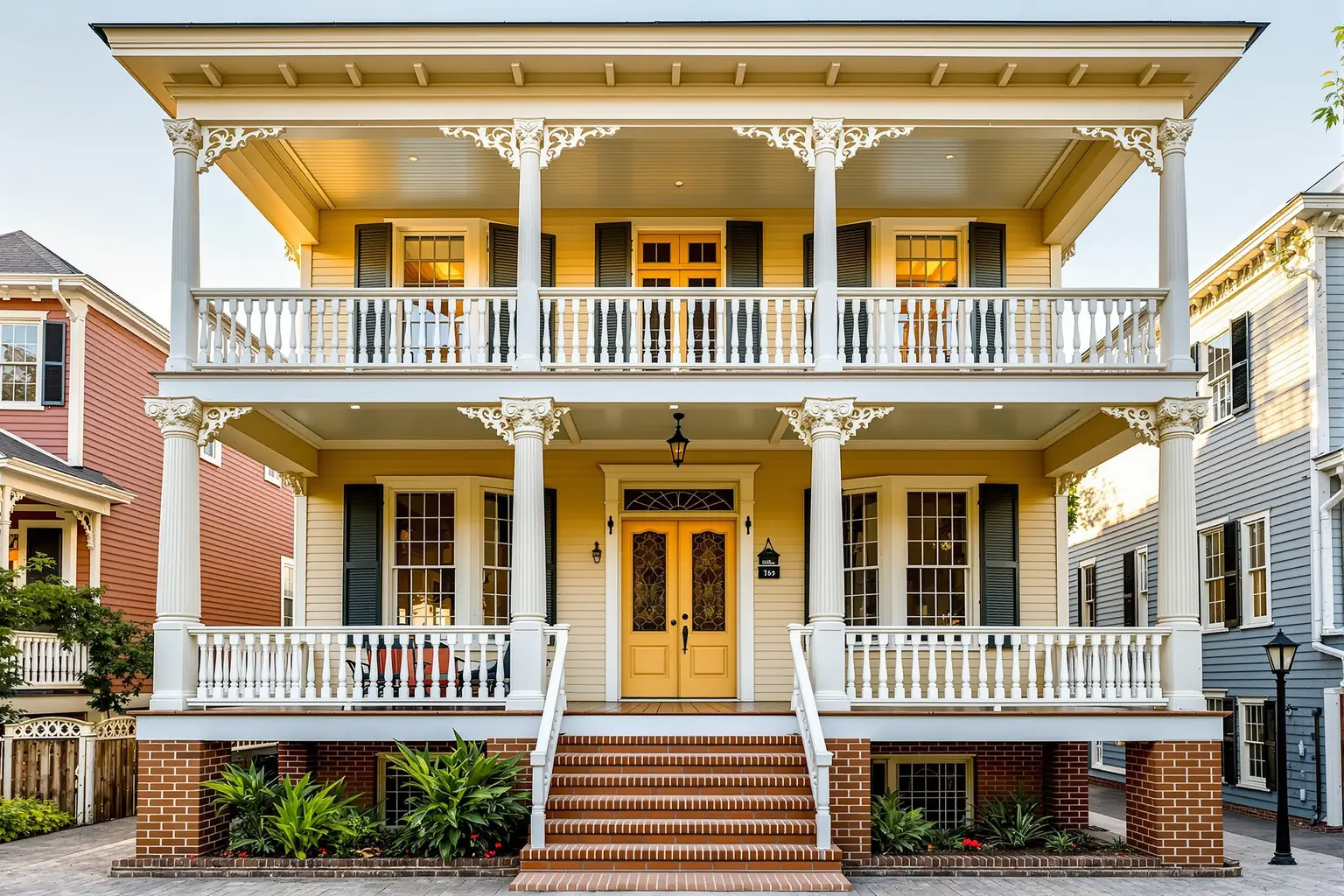
Generic cost-seg models are tuned for slab-on-grade suburban rentals. New Orleans stock is nothing like that, and the differences concentrate basis in exactly the 5-year (§1245 personal property) and 15-year (land improvement) classes a national template under-captures. An engineering-based study evaluates components like these for reclassification:
- Raised piers and elevated foundations. Shotguns, Creole cottages, and raised-basement houses sit on brick or masonry piers above grade. The elevation work, sub-structure access, and exterior stairs and ramps that come with it are dense 15-year site-work territory a slab-home template ignores.
- Galleries, porches, and balconies. Deep front galleries and side porches are near-universal, and their decorative, non-structural elements are candidates for shorter recovery periods rather than 27.5-year shell.
- Ornamental millwork. Victorian and Italianate stock carries turned, bracketed, and pierced decorative trim and built-ins, classic non-structural finish components an engineering study evaluates.
- Courtyards and historic-lot site improvements. Brick paving, iron fencing and gates, cisterns, drainage, and landscaping typical of New Orleans lots are 15-year land improvements.
- Flood-mitigation and specialty systems. Elevated mechanical and electrical service, sump and drainage systems, and elevated HVAC condensers and ductwork are the kind of component detail a generic model never itemizes.
Name the components, not the market: this raised, gallery-heavy, site-work-dense, ornament-rich stock puts an unusually large share of a renovated property’s basis into non-structural and site components.
Worked example (modeled)
Consider a renovated raised double-shotgun in Bywater or Marigny, operated as a permitted residential STR, acquired for $500,000. Every figure here is a modeled illustration, not a measured result; your study and your CPA determine the actual amounts.
New Orleans historic lots carry meaningful land value, so land is carved out first (land percentage is property-specific and should not be assumed). That leaves a depreciable building basis of roughly $390,000. An engineering-based study commonly reclassifies 19–39% of building basis into 5- and 15-year property on residential work, and this city’s site-work-, gallery-, and millwork-heavy stock tends to support the upper part of that band. Modeled at about 26%, that is roughly $101,000 reclassified: on the order of $52,000 of 5-year FF&E and finishes, $4,000 of 7-year property, and $45,000 of 15-year land improvements (the piers, gallery, courtyard, iron, and drainage work).
Under 100% bonus depreciation, that reclassified amount is deductible in year one on the federal return. At a 32% federal bracket the modeled first-year federal tax reduction is about $32,000, roughly 36 times a typical study fee. The Louisiana benefit is separate and smaller: at the flat 3% rate, and only if the R.S. 47:297.25 election is made. The federal number is the story; the state number is a coordinated add-on your CPA elects.
Done remotely for most residential properties
Our studies are engineering-based but conducted remotely from your closing statement, cost and renovation records, and photos. For most residential properties there is no on-site visit or in-person measurement, which is what lets us serve New Orleans owners (including out-of-state investors) without a travel fee inflating the cost. We use industry-standard, nationally recognized construction cost data to support the component allocation. See how remote cost segregation works and what a cost segregation study is.
New Orleans submarkets we see
- Bywater and Marigny (Faubourg Marigny): renovated Creole doubles and shotguns are the core residential-STR profile, subject to extra density limits.
- Uptown and Carrollton: large historic residential base, a mix of long-term and permitted short-term rentals.
- Mid-City, Treme, and the 7th Ward: historic stock at more attainable basis; the permit and component angles both land.
- Garden District: grand historic homes with a rich component narrative, even in sections where STR is restricted and owners run them as long-term rentals.
- French Quarter (Vieux Carré): recognizable as the “you cannot STR here” anchor, not a target market.
Learn more about cost segregation
- Remote cost segregation: how an engineering-based study is delivered without a site visit
- What is cost segregation?: the full explanation of how the study works and what you receive
- Bonus depreciation by state: how Louisiana’s 2025 decoupling affects timing
- Material participation for STR owners: the 7-day rule and how the deductions offset active income
- By property type: short-term rentals, multifamily, single-family rentals, warehouse & industrial
- Related historic-market pages: Savannah, GA, Charleston, SC, Nashville, TN
Ready to see your actual New Orleans numbers?
Want a number for a specific New Orleans property? Use the calculator, or start a preliminary analysis. Figures on this page are modeled illustrations; your study and CPA determine the actual amounts.
CPA use note: These figures estimate the size of the depreciation deduction. Whether the loss is usable in the current year depends on passive-activity rules, STR material participation, REPS status, entity structure, depreciable basis, and state conformity. Your CPA decides how and when it is applied. Specialty and site components (equipment, casework, docks, pools, arenas, tenant improvements, and similar) are only classified when you own them and they are included in the depreciable basis being studied.
How should New Orleans, LA investors choose a cost segregation provider?
For a New Orleans, LA investor buying a property in the $500,000 range, the choice of provider is a major controllable variable in the return. The IRS Audit Techniques Guide sets the quality characteristics an engineering-based study should meet — industry-standard construction cost data, MACRS classification, and component-level documentation — but it does not make every provider's work identical; rigor, cost, and turnaround still vary.
Traditional engineering studies often run several thousand dollars and can take several weeks, because they include on-site inspections, sales discovery calls, and scheduling overhead. The IRS Cost Segregation Audit Techniques Guide does not prescribe an on-site inspection as a standalone requirement; it sets out the quality characteristics of an engineering-based study — component-level classification, a documented and supportable cost derivation, and a clear audit trail — and describes how a physical inspection can contribute to meeting them.
Modern automated providers (such as Cost Seg Smart) deliver an engineering-based, IRS ATG-aligned study using property records, documents, photos, and recognized construction-cost data, typically from $495 and often within 1–2 business days. For a New Orleans, LA investor at a high combined bracket, that cost and speed difference is meaningful. The CPA-Ready Guarantee (free revisions if your CPA flags a problem, and a refund if the report still can't be used) makes the decision essentially risk-free on the report itself.
The automated path is best-fit for owners who can provide closing documents and property photos online (no in-person visit required) and want the report in time to file the current year's return rather than the next one.
All Cost Seg Smart studies include the CPA-Ready Guarantee (free revisions if your CPA flags a problem, and a refund if the report still can't be used). Straightforward residential studies are often delivered in 1–2 business days and completed remotely; larger or more complex commercial studies take longer and may include an on-site observation.