Cost segregation study for rental property
A cost segregation study splits your rental's purchase price into the parts the tax code depreciates over 5, 7 and 15 years instead of 27.5, so far more of it can be deducted in the first year. Ours start at $495, and most residential studies are delivered in 1–2 business days.
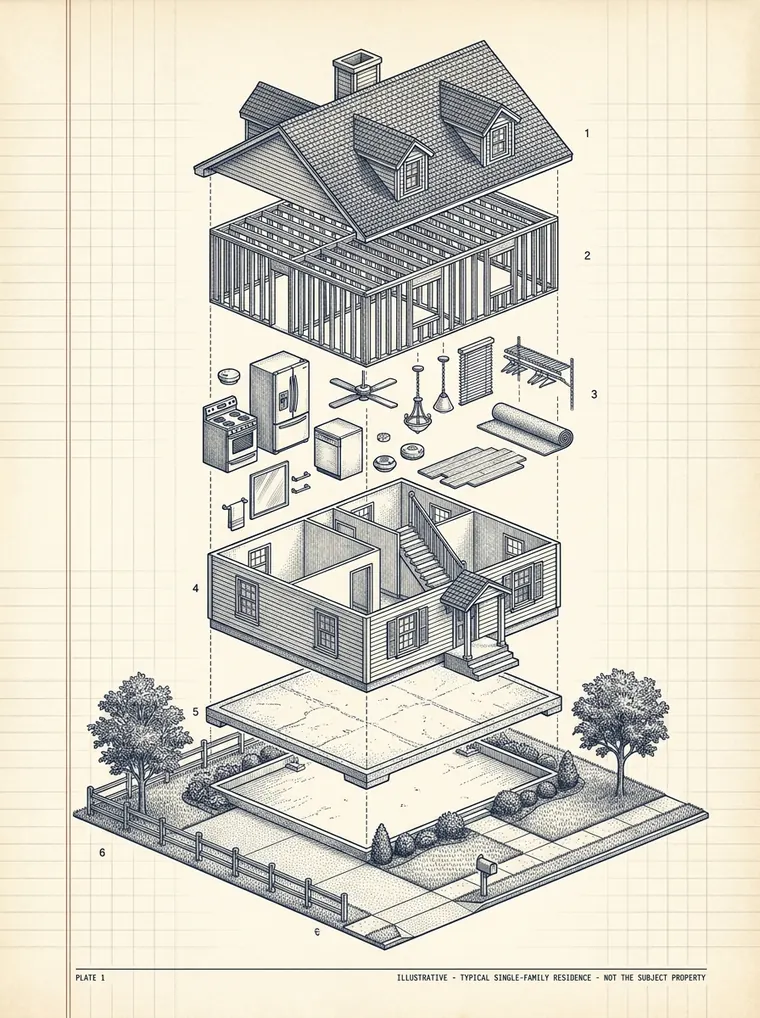
Without a study, a rental building is depreciated as one 27.5-year asset. A study identifies the appliances, flooring, cabinets, fixtures, furnishings (5-year) and the driveway, fencing and landscaping (15-year), which qualify for bonus depreciation. Total depreciation over the life of the property does not change; the study moves it forward. Whether you can use the larger deduction this year depends on the passive activity rules, covered below.
Which rentals we study
One order form covers every kind of rental. Each type has its own page with the method, a sample report and the reclassification band we publish, measured from our delivered studies where we have enough of a type.

Long-term rentals of one house. Appliances, flooring, cabinets, fencing and the driveway reclassify.

Your unit's interior finishes plus your share of the site work, with condo-specific land treatment.

Furnished Airbnb and VRBO homes carry the most 5-year property, because the furnishings come with it.

Two kitchens, two sets of baths and often two HVAC systems on one lot.

Three units of repeated fixtures, with shared parking and site work.

Four sets of kitchens, baths and HVAC on one lot, priced on the same 2–4 unit ladder.
Mixed 2–4 unit buildings, including separately metered units.

Per-unit fixtures plus parking, lighting and amenity areas.

Bought with the house: priced on its share of the purchase. Built it yourself: priced on the build cost, from $995.
Reclassification is the share of depreciable basis (purchase price less land) moved into 5-, 7- and 15-year property. Your study can land anywhere in the band, or outside it. Not sure which type you own? Pick the closest on the order form and we confirm it from county records.
Worked example: a $500,000 long-term rental
A single-family rental bought for $500,000, 20% allocated to land (our residential default; your county assessor's ratio replaces it), placed in service in July 2026, acquired after January 19, 2025, so the reclassified property takes 100% bonus depreciation. We use the single-family rental's most common reclassification share, 15%.
| Without a study | With a study | |
|---|---|---|
| Depreciable basis | $400,000 | $400,000 |
| Reclassified to 5- and 15-year | $0 | $60,000 |
| Year-1 depreciation | $6,667 | $65,667 |
| Extra Year-1 deduction | — | $59,000 |
| Study fee | — | $895 |
Without a study, July placement gives 1.667% of the basis in year one under the mid-month convention. With one, the reclassified slice is deducted in full and the rest of the building follows the same 27.5-year schedule. At a 32% federal bracket the extra deduction is worth about $18,880 of tax, if you can use the loss this year.
Can you use the loss? The passive activity rules
- Long-term rental losses are generally passive under IRC §469. They offset passive income, such as profit from your other rentals.
- The $25,000 allowance. If you actively participate, up to $25,000 of rental loss can offset wages and other income. It phases out between $100,000 and $150,000 of modified adjusted gross income and is gone above that.
- Real estate professional status. With REPS (750+ hours and more than half your working time in real estate) and material participation, the loss is not passive.
- Otherwise it carries forward. A suspended loss is not lost: it offsets future passive income, and any balance is released when you sell the property in a taxable sale.
- Short-term rentals are different. With an average guest stay of seven days or less and material participation, the loss can offset W-2 income. See the short-term rental loophole and our short-term rental study page.
An estimate for planning, not tax advice. Property acquired on or before January 19, 2025 stays on the prior bonus phase-down. Plug in your own numbers with the rental property depreciation calculator.
What you get
A CPA-ready report
A PDF with the component schedule, each item's MACRS recovery period and cost, the land methodology and the depreciation tables your CPA enters on Form 4562. See a sample rental report.
Quality-checked before delivery
Every study runs through basis reconciliation and automated quality checks before it ships, and our team reviews any study a check flags.
Form 3115 for prior-year rentals
When a prior-year lookback applies, your report includes the §481(a) catch-up schedule and supporting workpapers, and your CPA prepares, signs, and files Form 3115 with your return. Preparing and signing the form itself is available as a separately engaged, separately priced add-on; filing it, and deciding whether a method change is appropriate, stays with your CPA either way.
Audit support
Lifetime audit support, included: written answers to your CPA's technical questions about our methodology, for the life of the study — no expiry. It does not include IRS representation. Scope.
Your CPA, included
CPA coordination included. We answer your accountant's technical questions in writing, provide supporting schedules, and get on a call or meeting with your CPA when either of you asks.
Renovations
Renovation costs under $100,000 are analyzed inside your study at no extra charge. From $100,000 to $1 million we add Renovation Cost Segregation ($595), and above that we quote the work.
Pricing by property value
One flat fee, set by purchase price. You see it on the order form before you pay.
| Purchase price | Single-family, condo, townhome, STR | Duplex, triplex, fourplex |
|---|---|---|
| <$300K | $495 | $995 |
| $300K–$700K | $895 | $1,295 |
| $700K–$1M | $995 | $1,495 |
| $1M–$1.5M | $1,295 | $1,795 |
| $1.5M–$2M | $1,595 | $2,195 |
| $2M–$3M | $1,995 | $2,595 |
| $3M–$4M | $2,495 | $2,995 |
Higher values, apartments of 5+ units and add-ons are on the full pricing page. An ADU you built yourself is priced on its documented build cost.
When a study is not worth it
- The building is a small part of the price. When land is most of the value, the depreciable basis, and the deduction with it, is small next to the fee.
- You will sell soon. Depreciation on reclassified personal property is recaptured as ordinary income under §1245 when you sell, unless a §1031 exchange defers it.
- You cannot use the loss for years. With no passive income, no allowance and no REPS, the deduction waits. It is not lost, but its value shrinks the longer it waits.
- Little or no taxable income. A deduction at a low bracket saves little tax.
- It is your home. Personal-use property is not depreciable; only the rented part of a property is.
The full decision, with the numbers by property type: is cost segregation worth it for a rental property?
Rental property cost segregation FAQ
How much does a cost segregation study for a rental property cost?
Our fee is set by property type and purchase price. Single-family rentals, condos, townhomes and short-term rentals start at $495; duplexes, triplexes and fourplexes start at $995. A $500,000 single-family rental is $895. The full table is on our pricing page, and the order form shows your exact fee before you pay.
Is a cost segregation study worth it for a long-term rental?
Often, when you can use the deduction. Studies of single-family rentals typically reclassify 8–32% of the depreciable basis into 5- and 15-year property, which qualifies for bonus depreciation. The catch is that long-term rental losses are generally passive, so the benefit lands this year only if you have passive income, qualify for the $25,000 allowance, or qualify as a real estate professional. Otherwise the deduction carries forward.
Can I use the rental loss against my W-2 income?
Usually not in full. Long-term rental losses are passive under IRC §469. If you actively participate, up to $25,000 of rental loss can offset other income, but that allowance phases out between $100,000 and $150,000 of modified adjusted gross income. Real estate professional status removes the limit if you also materially participate. A short-term rental with an average stay of seven days or less is not a rental activity under the passive rules, so with material participation its loss can offset other income.
I bought my rental years ago. Can I still get a study?
Yes. When a prior-year lookback applies, your report includes the §481(a) catch-up schedule and supporting workpapers, and your CPA prepares, signs, and files Form 3115 with your return. Preparing and signing the form itself is available as a separately engaged, separately priced add-on; filing it, and deciding whether a method change is appropriate, stays with your CPA either way. The catch-up deduction for the depreciation you missed is taken in the current year, without amending past returns.
What do you need from me?
The property address, your closing statement (or the purchase price and closing date), the date the property was first available to rent, and any photos you have. Invoices for improvements help if you made any. We pull county and assessor records and aerial data ourselves.
How long does a rental property study take?
Most residential studies are delivered in 1–2 business days once your documents are in. Portfolios take one to two business days per property, scheduled with you. Studies with an on-site observation take about a week. You get a CPA-ready PDF by email, quality-checked before delivery.
Figures on this page are estimates for planning only, not tax advice. Confirm your basis, land allocation, placed-in-service date and passive activity position with your tax professional.