Car wash cost segregation in Southern California.
Express and full-service washes across Los Angeles, Orange County, the Inland Empire, San Diego and Ventura. A wash is one of the most equipment-dense properties anyone buys, and almost none of that equipment is legible from a closing file. Larger engagements include an in-person walkthrough; below that, we walk the property with you by video at no charge, or in person as an add-on.
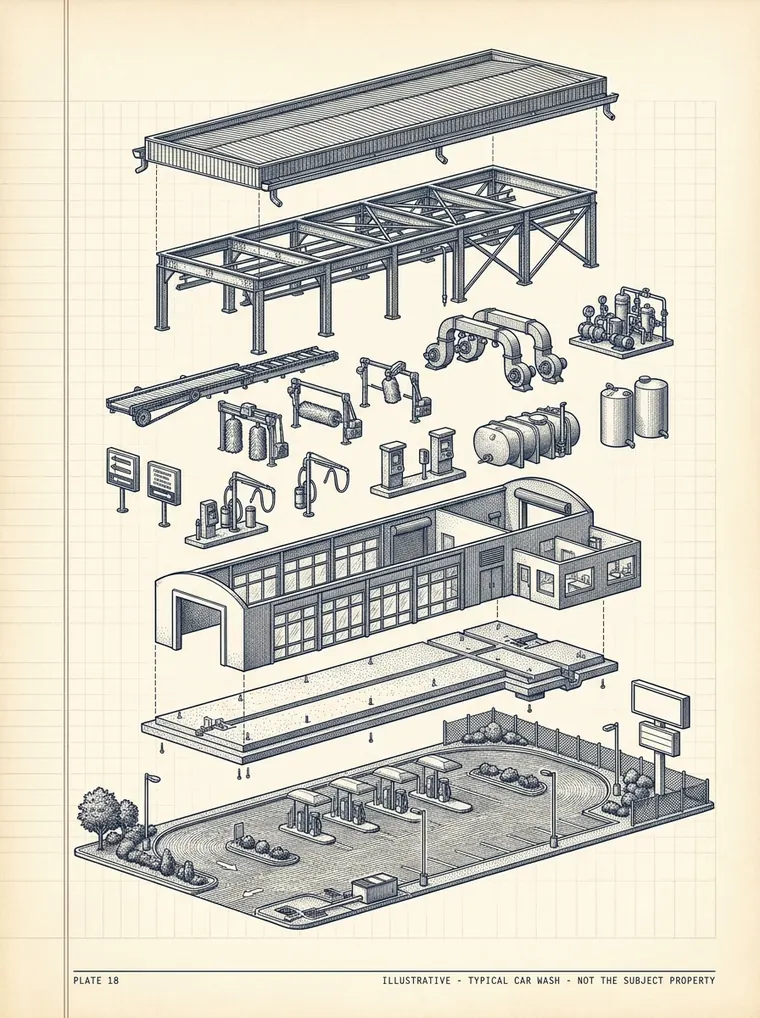
What makes a car wash different for cost seg
Car wash buyers often underestimate how much of an express tunnel is tangible personal property rather than building. Southern California is a consolidation epicenter — membership-model operators are actively acquiring independents from Fontana to Lawndale — and modern Southern California express tunnels almost always include sophisticated water reclaim and treatment systems because of California's regulatory environment and local water-conservation requirements. That reclaim system, plus the tunnel conveyor, dryers, vacuums and controls, is where the equipment-dense basis lives.
On a walkthrough, in person or by video, our engineering review inspects the tunnel conveyor and arches, dryers and blowers, vacuum systems, pay stations, controls, and the water reclaim and treatment system directly — the §1245 equipment that carries most of a car wash's accelerated value, none of which is legible from a closing file.
Why a car wash rewards a walkthrough
A wash is equipment first and building second. The tunnel conveyor and arches, dryers and blowers, vacuum systems, pay stations, chemical delivery and controls, and the water reclamation system carry most of the value — and none of it is described in a purchase agreement or a listing photo.
A walkthrough, in person or by video, is how the equipment inventory, the queue-lane and vacuum-plaza paving, and the reclamation system become a documented record instead of an assumption. Where records already support the components at issue, our remote model applies and costs less.

Tunnel & wash equipment
Conveyor and correlator, wash arches, dryers and blowers, chemical delivery, and tunnel controls — documented by configuration and count, with the dedicated power that serves them.

Vacuum & water reclamation
Vacuum systems and stalls, and the water recycling and treatment system — filtration, holding tanks, reclaim pumps — documented as installed systems and evaluated on what they serve.

Queue lanes & site work
Stacking and queue-lane paving, vacuum-plaza concrete and islands, canopies, drainage and oil-water separators, site lighting, landscaping and fencing.

Pay stations & signage
Pay stations and POS, illuminated signage and wayfinding, and office / restroom interior finishes — documented on the walkthrough, not inferred from a listing.
One site, three kinds of answer
Illustrative. Actual classifications are made per property, on the facts.
Tunnel conveyor and arches, dryers and blowers, vacuum systems, pay stations and controls, chemical delivery, and the water reclamation system; plus queue-lane and vacuum-plaza paving, canopies, and site lighting.
Dedicated versus general electrical distribution, specialty plumbing, signage, and finishes — evaluated on how each installation functions and what the records show.
The tunnel building shell, structural frame, foundation and slab, exterior walls, roofing, and building-wide systems — nonresidential real property depreciated over 39 years, which on an express wash is a comparatively small share.
How the engagement works
Where we cover Southern California car washes
Related: our express car wash portfolio coverage, the sample car wash report, our car wash cost segregation guide, and the Southern California commercial hub.
Frequently asked
Do you visit car washes in Southern California?
On commercial engagements of $3 million or more, an in-person walkthrough by our team is included. Below that, an in-person site visit is available as an add-on for $895, travel included; otherwise, when a walkthrough would improve the study, we do it with you on a video call, about 30 to 45 minutes, at no charge. The walkthrough documents tunnel equipment, vacuum plazas, water reclamation, canopies, and the site work that carries them.
How long does a car wash cost segregation study take?
Most commercial studies are delivered within about two weeks once we have your records, varying with equipment complexity and record availability.
How much does a car wash study cost?
Engineered car wash studies start at $2,995 and step with the improvement basis. You get a fixed written fee before any work begins, not a percentage of your deduction — or call us at (213) 444-2776.
Why does a car wash accelerate so much more than other property?
A car wash is one of the most equipment-dense properties anyone buys. The tunnel conveyor and wash arches, dryers and blowers, vacuum systems, pay stations, chemical delivery and controls, and the water reclamation system are all tangible personal property, and the queue-lane paving and canopies are land improvements. On an express tunnel that leaves comparatively little value in the 39-year shell — which is exactly why the modeled share is high. The result still depends entirely on the property, its basis, and its equipment.
Is the water reclamation system separately identifiable?
Typically yes. Water recycling and treatment equipment — filtration, holding tanks, reclaim pumps — is documented as an installed system and evaluated on what it serves. California water rules make reclamation near-universal on newer Southern California washes, and it is one of the clearer 5-year cases when the facts support it.
Ready to scope your building?
Tell us the address, basis, and placed-in-service date. We generally return a written scope and quote within one business day — or call the office at (213) 444-2776.