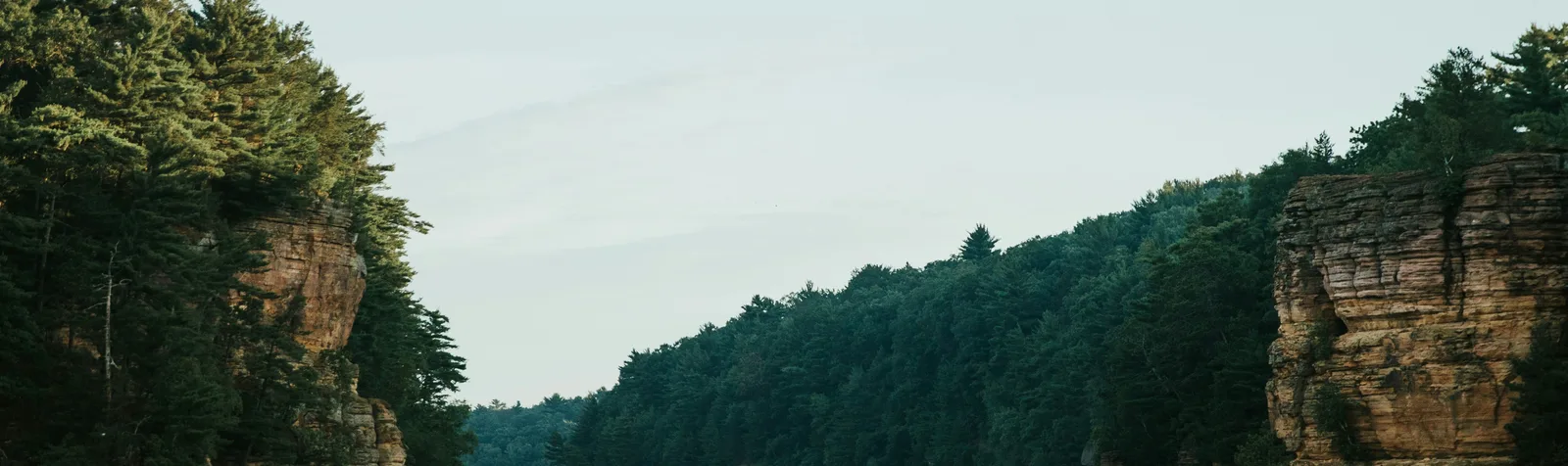
Wisconsin Dells calls itself the waterpark capital of the world and the claim is defensible: Kalahari, Wilderness, Mt. Olympus, Chula Vista and Great Wolf between them run more indoor waterpark surface than anywhere else in the country. That infrastructure is the reason this market behaves unlike any other northern vacation destination — January is rentable here. A family drives two hours from Chicago or an hour from Madison in the middle of winter, and the weather is irrelevant because the water is indoors.
Underneath the waterparks is an older and quieter market: the Wisconsin River gorge itself, the sandstone formations the Dells is named for, Devil’s Lake State Park at Baraboo, and the Lake Delton and Lake Wisconsin shorelines.
For cost segregation the year-round occupancy is the interesting fact. A property renting fifty-two weeks a year turns over more, wears faster, and replaces furnishings and floor coverings on a shorter cycle than a seasonal rental — and those are 5-year categories. Combined with a low 20% land share, the modelled example reclassifies 24.0% of depreciable basis.
- $134,362 accelerated into 5-, 7- and 15-year property
- $130,494 additional Year-1 depreciation
- $48,283 estimated Year-1 federal tax at the 37% bracket
Want a number for a specific Dells property? Use the calculator. It is pre-set with property-type defaults you can adjust to match your basis and bracket.
Cost Segregation in Wisconsin Dells, WI
Wisconsin Dells Investment Snapshot
- Representative price range $175K–$325K (resort condo or 2BR); $350K–$750K (4–6BR family rental); $800K–$2M (large group house, river or lake frontage)
- Season genuinely year-round, with summer peak, a strong winter waterpark trade, and an autumn shoulder
- Common property types waterpark-corridor family rental, resort condo, river-corridor house, Lake Delton property, Baraboo-area house
- Wisconsin income tax graduated to a 7.65% top rate
- Bonus depreciation Wisconsin does not conform to federal §168(k)
- Lodging tax municipal room tax on short-term stays plus state sales tax
- Typical land share 15–25% of price
- Representative Year-1 federal benefit $14,000–$140,000 depending on basis and finish
The Wisconsin Dells Market
Lake Delton is the resort core. Kalahari, Mt. Olympus and Chula Vista sit here, along with the densest concentration of rental condos and family houses. This is where the year-round occupancy is strongest and where most investors buy.
Downtown Dells and Broadway hold the older tourist strip — the Ducks, the boat tours through the gorge, the arcades. Property here is a mix of small hotels, converted buildings and in-town houses.
The Wisconsin River corridor upstream and downstream of town is the quieter, more scenic market: sandstone bluffs, river frontage, and houses that rent on scenery rather than waterparks.
Baraboo, fifteen minutes south, brings Devil’s Lake State Park — the most-visited state park in Wisconsin — plus the Circus World Museum and a genuine small-town economy. Prices are lower and the guest profile is more outdoors-oriented.
Lake Wisconsin and Merrimac to the south add a lake-house product with docks and shoreline structures.
The market’s structural feature worth understanding is the resort condo. A large share of Dells rental inventory is condominium units inside resort complexes, and the waterpark, pools, restaurants, parking structures and grounds belong to the association or the resort operator. You depreciate what you own. A resort condo will reclassify at a lower percentage than a detached family house at the same price, and that is correct rather than disappointing — the waterpark is not on your schedule.
Why Cost Segregation Hits Different in the Dells
Year-round occupancy accelerates the 5-year cycle. This is the market’s distinctive tax feature. A seasonal lake rental turns over perhaps sixteen weeks a year. A Dells family house turns over close to fifty-two. Carpet, luxury vinyl plank, mattresses, upholstered furniture, appliances and small equipment all wear at roughly three times the rate — and every one of those is 5-year property. Owners here replace furnishings on a genuinely short cycle, and each replacement is a new depreciable asset.
Land is cheap, which lifts the percentage. At 15–25% of price, more of what you paid is depreciable improvements. Compare the Oregon coast at 30–45%.
The houses are conventionally built. Framed, drywalled, ordinary finishes — the construction profile a study is designed for, unlike the timber cabins of the Ozarks or North Georgia.
Family-group equipment is a real 5-year category. Dells rentals compete on capacity and in-house entertainment: bunk rooms, game rooms, theatre setups, oversized kitchens with doubled appliances. All 5-year, all frequently absorbed into one furnishings line.
The 15-year bucket is moderate. Flat to gently rolling terrain, short drives, municipal utilities in the resort corridor. River and lake properties are the exception, carrying bank stairs, dock structures and shoreline work.
Worked Example — Wisconsin Dells
A 5-bedroom family rental in the waterpark corridor, roughly 3,000 square feet, built in 2008, acquired for $700,000 and placed in service in March 2026. Land is taken at 20% of price. Depreciable basis lands at $560,000.
Running that property through our engine produces $134,362 of reclassified property, or 24.0% of depreciable basis:
| Class | Amount | What it is |
|---|---|---|
| 5-year | $103,440 | Furnishings, appliances, floor coverings, decorative lighting, hot tub equipment, window treatments |
| 7-year | $2,529 | Built-in casework and fixed storage |
| 15-year | $28,393 | Drive and walks, deck, landscape, exterior lighting, site drainage |
| Total | $134,362 |
Under 100% bonus depreciation the additional Year-1 deduction is $130,494 — the Year-1 deduction with the study minus the Year-1 deduction without it. At a 37% federal bracket that is $48,283 in Year-1 federal tax.
A note on what happens after Year 1 in this market specifically. Because Dells properties turn over year-round, the furnishings you place in service today will be replaced sooner than in a seasonal market. Each replacement is a new asset with its own depreciation, and the disposal of the old one has its own treatment. That makes this a market where the conversation with your CPA is usefully about a multi-year pattern rather than a single Year-1 number.
What is real and what is assumed. The split is a real engine run. The inputs are a representative waterpark-corridor house, not a specific address. A resort condo will reclassify lower because the amenities are common property.
Who Is Doing This in Wisconsin Dells
The Chicago buyer is the largest cohort — under three hours, and the Dells has been Chicago’s family destination for generations.
The Madison and Milwaukee buyer is closer still, an hour and two hours respectively, and correspondingly more likely to use the property personally, which brings §280A into play.
The Twin Cities buyer comes from farther out and rents harder.
The multi-property operator running four to fifteen units across Lake Delton is well represented here, and this is the cohort where a portfolio of studies plus the Form 3115 lookback tends to be the largest single opportunity.
WI Tax Considerations
Wisconsin levies a graduated income tax reaching 7.65% at the top bracket.
Wisconsin does not conform to federal bonus depreciation under §168(k). Wisconsin computes depreciation under federal rules in effect on a fixed prior date, which excludes current bonus. The full federal Year-1 deduction is available; the Wisconsin deduction follows a regular schedule, so the state benefit is spread across the recovery period rather than taken up front. Deferred, not lost. The Year-1 figure on this page is a federal number and should not be grossed up by 7.65%.
Dells-area municipalities levy room tax on short-term lodging alongside state sales tax, collected from the guest and remitted.
The Wisconsin point worth repeating from our Door County page, because it applies here too: state law limits how far a municipality can restrict short-term rental, but permits licensing and, in defined circumstances, regulation of rentals shorter than seven consecutive days. If your §469 analysis depends on an average guest stay of seven days or fewer, and a local ordinance pushes you toward seven-night minimums, those two things interact directly. Check the municipality rather than assuming.
Common Wisconsin Dells Investment Properties
- The 4–6BR waterpark-corridor family house, $350K–$750K, the market’s core rental product
- The resort condo, $175K–$325K, lowest entry, lower reclassification percentage
- The large group house, 8–12BR, bunk rooms and game rooms, heaviest 5-year equipment
- The Wisconsin River frontage house, scenery-driven, bank and shoreline site work
- The Baraboo or Devil’s Lake area house, outdoors guest profile, lower entry
Depreciable Features We Commonly See in the Dells
Full furniture packages sized to sleeping capacity, replaced on a short cycle because of year-round turnover. Bunk-room build-outs. Kitchen appliance packages, frequently doubled for family-group capacity. Floor coverings replaced far more often than in a seasonal market. Hot tubs on dedicated electrical. Game-room equipment — pool tables, arcade cabinets, air hockey, foosball — 5-year and routinely under-counted. Home-theatre systems and seating. Decorative and exterior lighting. Decks, patios and fire pits. Concrete drives. Fencing. Landscape and irrigation. On river and lake properties, bank stairs, dock cribbing and shoreline protection. Detached garages and storage buildings.
What People Worry About (and What Actually Happens)
“My condo is inside a resort with a waterpark.” The resort or association owns the waterpark, the pools and the parking structure. Your schedule covers your unit. Expect a lower percentage than a detached house.
“Wisconsin doesn’t conform. Is it still worth it?” Yes. The federal deduction is the larger one and is unaffected. Non-conformity defers the 7.65% state portion.
“I replace furniture constantly.” That is this market’s normal, and it is a feature rather than a problem — each replacement is a new depreciable asset. It also means the multi-year picture is the right frame here.
Why Cost Segregation Works for Dells Family Rentals
Dells rentals run on two- and three-night family stays year-round, which puts average guest stay comfortably under seven days and places a property inside the short-term rental exception under §469 — not automatically a passive rental activity, so an owner who materially participates may be able to apply losses against non-passive income. Whether your participation clears the test, and whether a local seven-night rule affects your average stay, are both questions for your CPA.
Who This Example Applies To
The worked example assumes a 37% federal bracket, 100% bonus depreciation, a March 2026 placed-in-service date, and a 20% land share. At a 32% bracket, scale the Year-1 federal figure by roughly 0.86. For a resort condo, expect a lower percentage. For a large group house with a full game room, expect a higher 5-year figure.
Compare: Wisconsin Dells Properties at Different Price Points
| Price | Typical property | Rough basis at 20% land | Indicative Year-1 federal at 37% |
| $285,000 | 2BR resort condo | $228,000 | $14,000–$17,000 |
| $700,000 | 5BR waterpark-corridor house | $560,000 | $48,283 (modelled above) |
| $1,400,000 | 10BR group house with game room | $1,120,000 | $92,000–$105,000 |
Rows other than the modelled one are indicative ranges scaled from that run, not separate engine runs.
Frequently Asked Questions
Does Wisconsin conform to federal bonus depreciation? No. Wisconsin computes depreciation under federal rules in effect on a fixed prior date, which excludes current bonus, so the state benefit is spread across the recovery period rather than taken in Year 1.
Can I depreciate the resort’s waterpark? No. The resort or association owns it. You depreciate your unit and what belongs to it.
Why does year-round occupancy matter for depreciation? It does not change classification, but it does change turnover. Furnishings and floor coverings — 5-year property — are replaced roughly three times as often as in a sixteen-week seasonal market, and each replacement is a new depreciable asset.
Is a bunk room built-in depreciable? Built-in casework generally falls in the 7-year class rather than 5-year, and it is a real line on family-capacity rentals. A study should separate it from loose furniture.
Does a local seven-night minimum affect me? It does not affect the study. It may affect whether the §469 short-term rental exception applies, which changes how the losses can be used.
Learn More About Cost Segregation
- How cost segregation works
- Bonus depreciation by state
- The Form 3115 lookback
- Cost segregation calculator
Ready to See Your Actual Wisconsin Dells Numbers?
Studies start at $495 and most residential studies are delivered the next business day, with the CPA-Ready Guarantee: if your CPA flags a problem we revise the report free, and if it still can’t be used you get a full refund. Start a study or run your numbers first.
CPA use note: These figures estimate the size of the depreciation deduction. Whether the loss is usable in the current year depends on passive-activity rules, STR material participation, REPS status, entity structure, depreciable basis, and state conformity. Your CPA decides how and when it is applied. Specialty and site components (equipment, casework, docks, pools, arenas, tenant improvements, and similar) are only classified when you own them and they are included in the depreciable basis being studied.
How should Wisconsin Dells, WI investors choose a cost segregation provider?
For a Wisconsin Dells, WI investor buying a property in the $700,000 range, the choice of provider is a major controllable variable in the return. The IRS Audit Techniques Guide sets the quality characteristics an engineering-based study should meet — industry-standard construction cost data, MACRS classification, and component-level documentation — but it does not make every provider's work identical; rigor, cost, and turnaround still vary.
Traditional engineering studies often run several thousand dollars and can take several weeks, because they include on-site inspections, sales discovery calls, and scheduling overhead. The IRS Cost Segregation Audit Techniques Guide does not prescribe an on-site inspection as a standalone requirement; it sets out the quality characteristics of an engineering-based study — component-level classification, a documented and supportable cost derivation, and a clear audit trail — and describes how a physical inspection can contribute to meeting them.
Modern automated providers (such as Cost Seg Smart) deliver an engineering-based, IRS ATG-aligned study using property records, documents, photos, and recognized construction-cost data, typically from $495 and often by the next business day. For a Wisconsin Dells, WI investor at a high combined bracket, that cost and speed difference is meaningful. The CPA-Ready Guarantee (free revisions if your CPA flags a problem, and a refund if the report still can't be used) makes the decision essentially risk-free on the report itself.
The automated path is best-fit for owners who can provide closing documents and property photos online (no in-person visit required) and want the report in time to file the current year's return rather than the next one.
All Cost Seg Smart studies include the CPA-Ready Guarantee (free revisions if your CPA flags a problem, and a refund if the report still can't be used). Straightforward residential studies are often delivered the next business day and completed remotely; larger or more complex commercial studies take longer and may include an on-site observation.