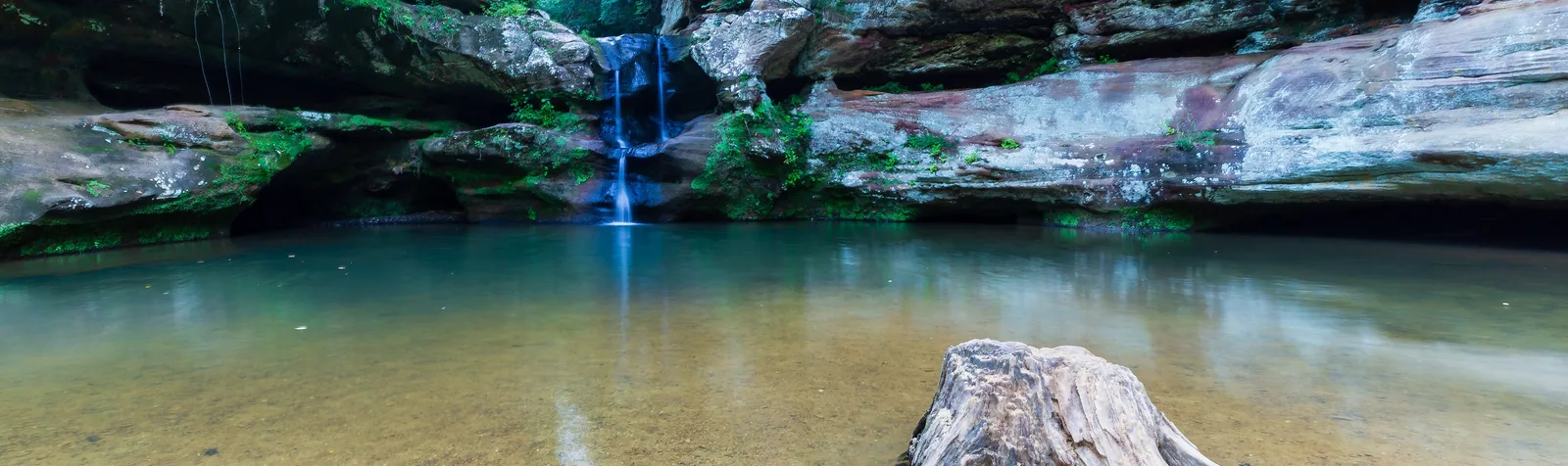
Hocking Hills is a sandstone gorge system in southeastern Ohio — Old Man’s Cave, Ash Cave, Cedar Falls, Conkle’s Hollow — and the rental economy around it is one of the densest cabin markets in the Midwest. Columbus is the next business day in most cases away, Cincinnati and Cleveland under three, and the product is a two-to-four-bedroom cabin or A-frame on a wooded lot with a hot tub, a fire pit and no neighbours in sight.
The tax picture follows from that product. Cabins reclassify low, and the modelled example here comes in at 16.0% of depreciable basis — the second-lowest of the sixteen destination markets we have modelled. The reason is the same as in North Georgia: in a log or timber cabin the structure is also the finish, so a larger share of cost sits in 27.5-year structural property and less in the interior components a study can move.
What partly offsets it is unusual and specific to this terrain. Look at the split below: $24,958 of 15-year property against $34,662 of 5-year. That is a 42% share in the 15-year bucket, far above what a flat-lot rental produces. Building on a wooded ravine lot means long gravel access, culverts, retaining, engineered septic, a drilled well, and decks stepping down grade — all land improvements, all 15-year.
- $59,620 accelerated into 5- and 15-year property
- $57,904 additional Year-1 depreciation
- $21,424 estimated Year-1 federal tax at the 37% bracket
Want a number for a specific cabin? Use the calculator. It is pre-set with property-type defaults you can adjust to match your basis and bracket.
Cost Segregation in Hocking Hills, OH
Hocking Hills Investment Snapshot
- Representative price range $225K–$375K (1–2BR cabin or A-frame); $375K–$650K (3–4BR with hot tub and view); $700K–$1.4M (large group lodge, multi-cabin parcel)
- Season year-round, with an October peak that is the strongest month by a wide margin and a real winter cabin trade
- Common property types log cabin, A-frame, geodesic dome, container and modern-cabin builds, multi-cabin parcels under one owner
- Ohio income tax graduated to a 3.5% top rate, among the lowest in the country
- Bonus depreciation Ohio requires an add-back of a portion of federal bonus, recovered over subsequent years
- Lodging tax county lodging excise on short-term stays plus state and local sales tax
- Typical land share 15–25% of price
- Representative Year-1 federal benefit $11,000–$55,000 depending on basis and finish
The Hocking Hills Market
Logan is the county seat and the practical centre of the market — services, the hospital, the grocery, and the base from which most cabins are managed. In-town property is cheap and rents modestly; the value is in being close to everything.
The Old Man’s Cave corridor along State Route 664 is the highest-demand zone, minutes from the park’s most-visited trailhead and the visitor centre. Cabins here command the strongest rates and the tightest occupancy.
Ash Cave and South Bloomingville to the south are quieter and more remote, with larger parcels and lower prices, and are where the multi-cabin operators tend to assemble.
Nelsonville, toward Athens, brings a college-town economy and Hocking College into the mix, along with the Hocking Valley Scenic Railway.
Rockbridge and Laurelville to the north are the closest submarkets to Columbus and the most convenient for a weekend owner, which makes them popular and also makes the personal-use question sharpest.
The distinctive thing about this market is product experimentation. Hocking Hills has more geodesic domes, container builds, treehouses, glass-walled modern cabins and other novelty structures than any market its size, because the guest is booking an experience rather than a house. That has a real tax consequence: an unusual structure does not reclassify unusually. A geodesic dome is still a shell, and the study will find the same categories of reclassifiable property it finds anywhere — furnishings, appliances, floor coverings, site work. The novelty is in the marketing, not in the depreciation schedule.
Why Cost Segregation Hits Different in the Hocking Valley
Cabin construction pushes the percentage down. A log or heavy-timber shell serves as both structure and interior finish, so there is simply less drywall, trim, cabinetry and finish carpentry for a study to reclassify. At 16.0% the modelled example is honest about that. Anyone quoting 30% on a Hocking Hills cabin has not modelled a cabin.
Ravine-lot site work pushes it back up, and this is the market’s real story. Cabins here are deliberately sited for privacy on wooded, sloped, often deeply cut parcels. Getting a buildable pad and a driveable approach means gravel or chip-and-seal access roads of real length, culverts and low-water crossings, retaining and erosion control, and stormwater management on grade. Add an engineered septic system for a 3- or 4-bedroom rental and a drilled well, and the 15-year bucket carries far more weight than in a subdivision. On this archetype it is 42% of the reclassified total.
Hot tubs are the market’s defining amenity and appear on essentially every listing. Self-contained hot tubs are 5-year personal property; the pad, the dedicated electrical run and the surrounding deck are separate items. A study that lumps them together is leaving detail on the table.
Multi-cabin parcels are common and are frequently mishandled. A single owner with three cabins on one deed is not one building, and a study should treat the structures, the shared access road, the shared septic or well, and the individual site work distinctly. This is one of the more common places we see a purchase-price-driven analysis go wrong here.
Worked Example — Hocking Hills
A 3-bedroom guest cabin near Logan, roughly 2,000 square feet, built in 2012, acquired for $465,000 and placed in service in March 2026. Land is taken at 20% of price. Depreciable basis lands at $372,000.
Running that property through our engine produces $59,620 of reclassified property, or 16.0% of depreciable basis:
| Class | Amount | What it is |
|---|---|---|
| 5-year | $34,662 | Furnishings, appliances, floor coverings, decorative lighting, hot tub equipment |
| 7-year | $0 | No qualifying built-in casework on this archetype |
| 15-year | $24,958 | Gravel access, decks and stairs, retaining and drainage, fire pit and hardscape, landscape, exterior lighting |
| Total | $59,620 |
Under 100% bonus depreciation the additional Year-1 deduction is $57,904 — the Year-1 deduction with the study minus the Year-1 deduction without it. At a 37% federal bracket that is $21,424 in Year-1 federal tax.
This is the smallest Year-1 figure of the sixteen markets we have modelled, and it is worth being direct about what that means. Against a study fee starting at $495 it is still a strong return. But if you are choosing between markets on tax efficiency alone, a conventionally framed house in a low-land-share market — Branson at 25.6%, Door County at 26.8% — moves more per dollar of purchase price than a Hocking Hills cabin does. That is a fact about cabin construction, not about our study.
The zero in the 7-year row is real. This archetype carries no qualifying built-in casework. A cabin with a fitted bunk room or a built-in bar would produce a figure there.
What is real and what is assumed. The split is a real engine run. The inputs are a representative Logan-area cabin, not a specific address.
Who Is Doing This in Hocking Hills
The Columbus professional dominates, and the sub-hour drive is the reason. This owner typically uses the cabin frequently, which puts §280A personal use at the centre of the analysis.
The Cincinnati, Cleveland and Pittsburgh buyer is two to three hours out, visits less, and rents harder — a cleaner tax position.
The multi-cabin operator is unusually prominent in this market: owners running four to fifteen cabins, frequently on assembled parcels, often having built rather than bought. For a builder-owner the construction invoices are the best evidence a study can have, and they are usually still on file.
OH Tax Considerations
Ohio levies a graduated income tax with a top rate of 3.5%, one of the lowest among states that tax income at all, and on a continued downward path.
Ohio does not fully conform to federal bonus depreciation. Ohio requires an add-back of a portion of the federal bonus deduction, with the added-back amount deducted over subsequent years. So the full federal Year-1 deduction is available while the Ohio deduction is spread forward. Deferred, not lost — and at a 3.5% top rate the state portion is the small end of the benefit in any case. The Year-1 figure on this page is a federal number.
Hocking County levies a lodging excise on short-term stays in addition to state and local sales tax, collected from the guest and remitted.
The personal-use question is the one that decides outcomes here. Under §280A, personal use above the greater of 14 days or 10% of fair-market rental days limits deductions. A Columbus owner fifty minutes away who uses the cabin two weekends a month is at roughly 48 days. Against 180 rented nights the threshold is 18 days. That gap is the most common reason a Hocking Hills owner’s actual deduction is smaller than the study’s headline, and it is entirely predictable in advance. Model it with your CPA before ordering.
Common Hocking Hills Investment Properties
- The 2–3BR log cabin with hot tub, $275K–$500K, the market’s core product
- The A-frame or modern glass cabin, $350K–$700K, experience-driven, same depreciation categories
- The geodesic dome or container build, novelty product, ordinary schedule
- The multi-cabin parcel, one owner, several structures, shared access and utilities
- The large group lodge, $700K–$1.4M, event and retreat rentals, heavier 5-year equipment
Depreciable Features We Commonly See in Hocking County
Hot tubs on dedicated electrical, essentially universal. Full furniture packages. Kitchen appliance packages on a fast turnover cycle. Floor coverings, typically luxury vinyl plank. Decorative and exterior lighting. Decks, stairs and screened porches stepping down grade. Fire pits and stone hardscape. Long gravel or chip-and-seal access drives. Culverts, low-water crossings and stormwater control. Retaining walls and erosion control on ravine lots. Drilled wells with pump and pressure tank. Engineered septic sized for rental occupancy. Propane tanks. Outdoor showers and saunas, increasingly common. Game-room and theatre equipment on group lodges, all 5-year and all routinely under-counted.
What People Worry About (and What Actually Happens)
“16% seems low.” It is low for a vacation rental and correct for a cabin. The offsetting feature is the unusually large 15-year share, which comes from ravine-lot site work.
“I built the cabin myself.” Then you have the best possible documentation, and the study will be more precise than one built from a purchase price. Keep the invoices.
“I use it two weekends a month.” That is roughly 48 days of personal use, well over the §280A threshold on a typical rental year. Model it first.
Why Cost Segregation Works for Hocking Hills Cabin Rentals
Hocking Hills cabins rent almost entirely on two- and three-night stays, putting average guest stay well under seven days and placing the property inside the short-term rental exception under §469 — not automatically a passive rental activity, so an owner who materially participates may be able to apply losses against non-passive income. As with any close-in drive market, that test has to be worked through alongside the personal-use limitation rather than separately.
Who This Example Applies To
The worked example assumes a 37% federal bracket, 100% bonus depreciation, a March 2026 placed-in-service date, a 20% land share, and no §280A limitation. At a 32% bracket, scale the Year-1 federal figure by roughly 0.86.
Compare: Hocking Hills Properties at Different Price Points
| Price | Typical property | Rough basis at 20% land | Indicative Year-1 federal at 37% |
| $310,000 | 2BR cabin with hot tub | $248,000 | $13,000–$15,000 |
| $465,000 | 3BR guest cabin near Logan | $372,000 | $21,424 (modelled above) |
| $900,000 | 6BR group lodge | $720,000 | $40,000–$47,000 |
Rows other than the modelled one are indicative ranges scaled from that run, not separate engine runs.
Frequently Asked Questions
Does Ohio conform to federal bonus depreciation? Not fully. Ohio requires an add-back of a portion of the federal bonus deduction, recovered over subsequent years, so the state benefit is deferred. At a 3.5% top rate it is the smaller part of the picture regardless.
Why do cabins reclassify lower than other vacation rentals? Because a log or timber shell is both structure and finish. More cost sits in 27.5-year structural property and less in the interior components a study reclassifies.
Does a geodesic dome or container cabin change the study? No. The structure is unusual; the depreciation categories are not. Furnishings, appliances, floor coverings and site work classify the same way.
I own three cabins on one parcel. One study or three? The structures, the shared access road and the shared utilities all need distinct treatment. A single purchase-price allocation across the whole parcel is where this commonly goes wrong.
Is my long gravel driveway really depreciable? Yes. Access drives, culverts, retaining and erosion control are land improvements, generally 15-year, and on a ravine lot they are a large share of site cost — 42% of the reclassified total on the modelled example.
Learn More About Cost Segregation
- How cost segregation works
- Bonus depreciation by state
- The Form 3115 lookback
- Cost segregation calculator
Ready to See Your Actual Hocking Hills Numbers?
Studies start at $495 and most residential studies are delivered the next business day, with the CPA-Ready Guarantee: if your CPA flags a problem we revise the report free, and if it still can’t be used you get a full refund. Start a study or run your numbers first.
CPA use note: These figures estimate the size of the depreciation deduction. Whether the loss is usable in the current year depends on passive-activity rules, STR material participation, REPS status, entity structure, depreciable basis, and state conformity. Your CPA decides how and when it is applied. Specialty and site components (equipment, casework, docks, pools, arenas, tenant improvements, and similar) are only classified when you own them and they are included in the depreciable basis being studied.
How should Hocking Hills, OH investors choose a cost segregation provider?
For a Hocking Hills, OH investor buying a property in the $465,000 range, the choice of provider is a major controllable variable in the return. The IRS Audit Techniques Guide sets the quality characteristics an engineering-based study should meet — industry-standard construction cost data, MACRS classification, and component-level documentation — but it does not make every provider's work identical; rigor, cost, and turnaround still vary.
Traditional engineering studies often run several thousand dollars and can take several weeks, because they include on-site inspections, sales discovery calls, and scheduling overhead. The IRS Cost Segregation Audit Techniques Guide does not prescribe an on-site inspection as a standalone requirement; it sets out the quality characteristics of an engineering-based study — component-level classification, a documented and supportable cost derivation, and a clear audit trail — and describes how a physical inspection can contribute to meeting them.
Modern automated providers (such as Cost Seg Smart) deliver an engineering-based, IRS ATG-aligned study using property records, documents, photos, and recognized construction-cost data, typically from $495 and often by the next business day. For a Hocking Hills, OH investor at a high combined bracket, that cost and speed difference is meaningful. The CPA-Ready Guarantee (free revisions if your CPA flags a problem, and a refund if the report still can't be used) makes the decision essentially risk-free on the report itself.
The automated path is best-fit for owners who can provide closing documents and property photos online (no in-person visit required) and want the report in time to file the current year's return rather than the next one.
All Cost Seg Smart studies include the CPA-Ready Guarantee (free revisions if your CPA flags a problem, and a refund if the report still can't be used). Straightforward residential studies are often delivered the next business day and completed remotely; larger or more complex commercial studies take longer and may include an on-site observation.