Oregon Bonus Depreciation: Conforms Through 2025, Add-Back From 2026.
Property placed in service in 2025 or earlier gets the full federal §168(k) bonus on the Oregon return. For property placed in service in tax years beginning on or after January 1, 2026, Senate Bill 1507 adds the federal bonus back and recovers it as regular depreciation. The placed-in-service year decides.
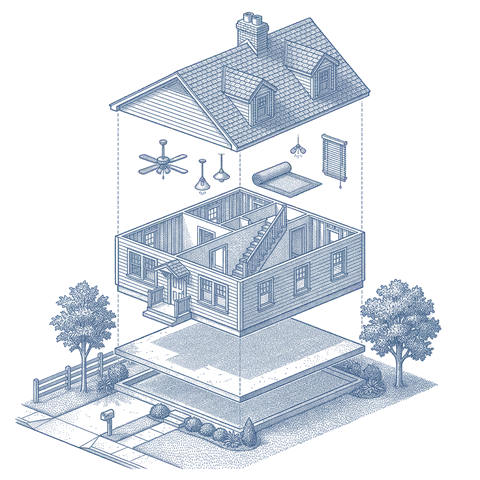
The same house, split into the parts the IRS lets you write off faster.
- 5-yearAppliances, carpet and vinyl plank flooring, decorative lighting, window coverings
- 15-yearDriveway, fencing, landscaping, site drainage, outdoor lighting
- 39-yearRoof, framing, walls, foundation. The building itself stays on the long schedule (a short-term rental with average guest stays under 30 days is generally 39-year; 27.5-year when stays are normally 30 days or more)
Federal bonus applies to the 5, 7 and 15-year parts. For short-term rentals that is typically 19–39% of the building.
The 30-second answer: Oregon conformed to federal §168(k) bonus depreciation for property placed in service through 2025, and decoupled for property placed in service in tax years beginning on or after January 1, 2026, under Senate Bill 1507 (Oregon Laws 2026, chapter 142).
For 2026-and-later property, the Oregon return adds back the difference between the federal §168(k) deduction and the deduction §168(k) allowed as in effect on December 1, 2017. That 2017 version had already phased bonus down to zero for property placed in service after 2019, so the practical effect is that the whole federal bonus is added back, then subtracted in the years regular depreciation would have allowed it (SB 1507 §7 for individuals, §9 for corporations, §10(2) for the placed-in-service test).
Individuals and corporations are treated identically. The federal return is untouched either way: the full federal Year-1 bonus is still claimed there.
On a representative Oregon single-family rental (the single-family rental band we publish, 8–32% of depreciable basis reclassified, 15% representative), the reclassified components alone generate an estimated $16K–$165K of federal Year-1 depreciation, roughly $5,920–$61,570 of federal Year-1 tax savings at the 37% top bracket. On the Oregon return that same amount is either deducted in Year 1 (placed in service through 2025) or spread over the components' regular 5, 7 and 15-year schedules (placed in service from 2026).
Federal vs Oregon, Side by Side
For an investor's cost-segregation-reclassified components, personal income tax and corporation excise tax alike:
| Tax provision | Federal (IRC) | Oregon |
|---|---|---|
| Bonus depreciation under §168(k), property placed in service through 2025 | 100% may apply to qualified property acquired and placed in service after January 19, 2025, subject to §168(k) eligibility, related-party/prior-use, binding-contract and election rules | Conforms. ORS 316.012(2) uses the Code as applicable to the tax year for anything related to taxable income; the only prior add-back (ORS 316.739 / 317.301) was limited to tax years 2009 and 2010 |
| Bonus depreciation under §168(k), property placed in service in tax years beginning on or after January 1, 2026 | Same federal rule | Added back. The difference between the federal §168(k) deduction and the deduction under §168(k) as in effect December 1, 2017, which for 2026 property is the whole federal bonus (SB 1507 §§7, 9, 10(2)) |
| Recovery of the added-back amount | Not applicable | Subtracted in the years it would have been deductible under the 2017 version of the Code, which is regular MACRS over each component's recovery period. Deferred, not lost |
| Who it applies to | Not applicable | Individuals and corporations identically. SB 1507 §7 sits in ORS chapter 316 and §9 adds the same words to chapter 317 |
| §168(n) qualified production property | Separate federal allowance for certain manufacturing property | Not decoupled by SB 1507; rarely relevant to rental real estate |
| Federal usability of the deduction | Subject to passive activity, at-risk, basis and business-interest limits | Same federal limits govern the federal deduction; Oregon's add-back and recovery apply independently |
| MACRS asset class lives | 5 / 7 / 15 / 27.5 / 39 yr per Rev. Proc. 87-56 | Same class lives; for 2026-and-later property they are the schedule Oregon recovers the add-back on |
Source: Enrolled SB 1507, sections 7, 9 and 10; ORS 316.012 and 316.739; IRC §168(k). Federal bonus figures reflect current law; eligibility depends on acquisition and placed-in-service dates and elections.
How the Oregon add-back actually works
The study itself does not change. The same engineering-based reclassification, using public government construction cost data, MACRS classification per Rev. Proc. 87-56, and IRS Pub 5653 ATG-aligned documentation, produces the same component schedule whether the property sits in Oregon or anywhere else. What changes, for property placed in service in tax years beginning on or after January 1, 2026, is what happens on the Oregon return.
SB 1507 section 7 (individuals) and section 9 (corporations) say the same thing: add back to federal taxable income the difference between the amount allowable under §168(k) as applicable to the tax year and the amount allowable under §168(k) as amended and in effect on December 1, 2017. That date is the day before the Tax Cuts and Jobs Act, and the §168(k) of that day contained the PATH Act phase-down: 50% bonus for property placed in service in 2017, 40% in 2018, 30% in 2019, and nothing after 2019. A property placed in service in 2026 gets zero under that version. So the add-back is the entire federal bonus deduction on the reclassified components.
Subsection (2) of each section then lets the added-back amount be subtracted in the tax year for which it would have been allowed as a deduction under that 2017 version of the Code. In practice the Oregon return depreciates the reclassified components on their regular MACRS schedule: a 5-year component comes back over its 5-year recovery period, a 15-year land improvement over 15 years. The deduction is deferred on the Oregon return, not lost.
Your CPA receives the same Cost Seg Smart engineered report, the same Form 4562-ready federal schedule, and the same Form 3115 §481(a) section if this is a lookback study. The Oregon addition and its later subtractions are computed from that same schedule.
The test is the placed-in-service year, not the tax year
SB 1507 section 10(2) applies sections 7 and 9 to property that is placed in service in tax years beginning on or after January 1, 2026. It does not say "deductions claimed in 2026 or later". That distinction matters for two common situations.
A property placed in service in 2025, studied in 2026. The property was placed in service before the cutoff, so Oregon's new add-back does not reach it. Oregon conformed for that property: ORS 316.012(2) incorporates the Code as applicable to the tax year for anything related to the definition of taxable income, and Oregon's only earlier bonus add-back, ORS 316.739 (and 317.301 for corporations), applied by its own enacting note to tax years 2009 and 2010 only. The full federal bonus flows through to the Oregon return.
A Form 3115 lookback on an older property. The federal §481(a) catch-up is claimed in the current year, but the property's placed-in-service year is what it always was. If that year is 2025 or earlier, the add-back does not apply to the catch-up, even though it is claimed in a 2026 or later return.
A property placed in service in 2026 or later. The add-back applies, to individuals and corporations alike, and the Oregon return recovers the amount on the regular MACRS schedule. SB 1507 also moved Oregon's general federal reference date in ORS 316.012(1) from December 31, 2023 to December 31, 2025, and it did not decouple from §168(n).
Typical range: an Oregon single-family rental
The worked example at the top is a short-term rental in Bend, OR. For a single-family rental, the range we publish is below. Using the single-family residential (SFR) band we publish, 8–32% of depreciable basis reclassified into 5/7/15-year property, 15% representative, on a property priced between $250,000 and $650,000, with a 20% residential land allocation, and 100% federal bonus depreciation for eligible components under current law. The Oregon column shows both placed-in-service cases:
| Line item | Federal | Oregon |
|---|---|---|
| Purchase price band | $250,000–$650,000 | Same property |
| Depreciable basis (20% land allocation) | $200,000–$520,000 | Same basis |
| Reclassified to 5/7/15-yr (8–32% of basis) | $16K–$165K | Same components, same class lives |
| Year-1 deduction, placed in service through 2025 | $16K–$165K (100% bonus, if eligible) | Same $16K–$165K: Oregon conforms, no add-back |
| Year-1 deduction, placed in service 2026 or later | $16K–$165K (100% bonus, if eligible) | Federal bonus added back; Year-1 Oregon deduction is the regular MACRS first-year amount on the 5/7/15-year components, with the rest recovered over each component's recovery period |
| Marginal tax rate | Up to 37% | Oregon personal income tax rate (verify current year with the Oregon Department of Revenue) |
| Illustrative Year-1 federal tax savings on reclassified components | ~$5,920–$61,570 (37% × $16K–$165K) | Through 2025: matched in Year 1. From 2026: deferred to the regular MACRS schedule, not lost |
Figures are illustrative and use the site's published SFR reclassification band; your result depends on your basis, land allocation, bracket, component mix and eligibility. Whether the full federal deduction is usable in the current year still depends on your passive-loss, at-risk, basis and business-interest situation.
See a sample cost segregation report
Look at exactly what your Oregon study delivers: the component-by-component 5/7/15-year schedule, the Form 4562-ready numbers, and the documentation your CPA files. Real reports are our best answer to "is this legit?"
Forms your CPA files for an Oregon property
For an Oregon investor, the workflow runs on the federal return and, for property placed in service from 2026, on the Oregon return as well, because the addition and its later subtractions have to be tracked over the components' recovery periods:
- Federal Form 4562: depreciation and amortization, including the §168(k) bonus deduction on eligible reclassified components. Flows to Schedule E (rental) or Schedule C (active business).
- Schedule E (or Schedule C): the accelerated federal deduction reduces federal taxable income in Year 1, subject to the federal passive-loss, at-risk, basis and business-interest limits.
- Oregon return, property placed in service through 2025: nothing to add back. The federal figures carry through.
- Oregon return, property placed in service from 2026: the federal bonus is added back under SB 1507 §7 (or §9 for a corporation). Oregon's existing vehicle for a depreciation difference is Schedule OR-DEPR, with the addition on Schedule OR-ASC. The 2019 OR-DEPR instructions used addition code 152 and subtraction code 354; the Department of Revenue had not published 2026 instructions for the new addition when this page was verified, so confirm the current codes.
- Later Oregon returns: the added-back amount is subtracted as regular depreciation over each component's recovery period, per SB 1507 §7(2).
- Form 3115 §481(a) section: included only if this is a federal lookback method change on a property placed in service in a prior year (see below).
The reclassified schedule is the same engineered output for both books; the difference, for 2026-and-later property, is that federal claims the Year-1 bonus while Oregon depreciates the same components on their regular schedule.
Form 3115 lookback on an Oregon property
If the property was placed in service in a prior tax year and depreciation was reported using a non-segregated method, a federal Form 3115 (Application for Change in Accounting Method) may allow a current-year §481(a) catch-up adjustment for the accelerated depreciation you missed, generally without amending prior returns. This is often the single biggest acceleration mechanism in cost segregation. Any catch-up dollars are illustrative and depend on placed-in-service date, prior depreciation claimed, bonus eligibility, land allocation and component mix.
The federal §481(a) catch-up is the primary lever, and it remains subject to the federal passive-loss, at-risk and basis limits. On the Oregon side, SB 1507 keys on the property's placed-in-service year. A lookback property was by definition placed in service in an earlier year, so for any property placed in service in 2025 or earlier the catch-up carries through to the Oregon return with no add-back, even though it is claimed on a 2026 or later return.
See our full Form 3115 cost segregation guide for federal mechanics, partnership and LLC pass-through treatment, and timing rules.
Should you skip cost segregation in Oregon? No.
Oregon's 2026 add-back changes the timing of the state-side benefit, not the fundamental economics. The math still favors doing the study, for three reasons:
- The full federal Year-1 bonus is intact. Oregon does not reduce the federal deduction; the full §168(k) bonus is claimed on the federal return. How much you use in the current year still depends on your passive-loss, at-risk, basis and business-interest situation.
- Oregon defers the benefit, it does not eliminate it. For 2026-and-later property the reclassified components are depreciated on the Oregon return over 5, 7 and 15 years instead of 27.5 or 39. That is still a large acceleration on the Oregon return compared with no study at all, and property placed in service through 2025 keeps the full bonus on the Oregon return.
- The Form 3115 lookback still captures missed federal years. If the property was placed in service in a prior year and depreciated without cost segregation, the federal §481(a) catch-up may be available, generally without amending prior returns, and for pre-2026 property it carries through to Oregon without an add-back.
The nuance to flag with your CPA is the placed-in-service year of the property and the Oregon schedule that follows from it: a 2026-or-later property needs its OR-DEPR addition and later subtractions tracked on the Oregon return until each component is fully recovered.
Frequently asked
Does Oregon allow bonus depreciation?
It depends on when the property was placed in service. For property placed in service in 2025 or earlier, yes: Oregon's definition of taxable income follows the Internal Revenue Code as applicable to the tax year (ORS 316.012(2)), and Oregon's only earlier bonus add-back applied to tax years 2009 and 2010 only, so the full federal §168(k) deduction flowed through to the Oregon return. For property placed in service in tax years beginning on or after January 1, 2026, no: Senate Bill 1507 (Oregon Laws 2026, chapter 142) adds back the difference between the federal §168(k) deduction and the deduction §168(k) allowed as in effect on December 1, 2017, and that added-back amount is recovered in later years as regular depreciation.
How much can a cost segregation study save on an Oregon rental?
A $1M vacation home in Bend, OR: a cost segregation study moves $200,000 into 5, 7 and 15-year property and adds $197,222 to the Year-1 deduction, about $72,972 in federal tax at a 37% bracket. This assumes you materially participate, so the loss can offset other income. Your result depends on your basis, land allocation, bracket, and eligibility.
What does the December 1, 2017 reference actually mean for a 2026 purchase?
The version of §168(k) in effect on December 1, 2017, before the Tax Cuts and Jobs Act, phased bonus depreciation down: 50% for property placed in service in 2017, 40% in 2018, 30% in 2019, and nothing for property placed in service after 2019. A property placed in service in 2026 would have received no bonus at all under that version. So the add-back equals the entire federal bonus deduction on the reclassified components, and Oregon recovers it through the depreciation that version of the Code would have allowed, which is regular MACRS over each component's recovery period.
Is the add-back permanent, or do I get the deduction back?
You get it back. SB 1507 section 7(2) says amounts added back may thereafter be subtracted in the tax year for which they would have been allowed as a deduction under the Code as in effect on December 1, 2017. In practice that means the Oregon return depreciates the reclassified components on their regular MACRS schedule, so a 5-year component is recovered over its 5-year recovery period and a 15-year component over 15 years. The federal return still takes the bonus in Year 1. It is a timing difference on the Oregon return, not a lost deduction.
Does the same rule apply to an Oregon corporation?
Yes. SB 1507 section 9 adds the identical provision to ORS chapter 317, the corporation excise and income tax, so a C corporation adds back the same difference and recovers it the same way for property placed in service in tax years beginning on or after January 1, 2026. Oregon did not decouple from §168(n), the separate federal allowance for qualified production property, which rarely applies to rental real estate.
I placed a property in service in 2025 and I am ordering the study now. Which rule applies?
The 2025-and-earlier rule, so Oregon conforms. SB 1507 section 10(2) applies the add-back to property that is placed in service in tax years beginning on or after January 1, 2026. The test is the placed-in-service year of the property, not the year the study is done or the year the deduction is claimed. That includes a Form 3115 lookback study on a property placed in service in an earlier year: the federal §481(a) catch-up is claimed in the current year, and because the property was placed in service before 2026, Oregon's new add-back does not reach it.
Is cost segregation still worth it in Oregon?
Yes. The federal Year-1 benefit is the dominant driver and Oregon does not reduce it: the full federal §168(k) bonus is still claimed on the federal return. For 2026-and-later property, the Oregon return defers the reclassified deduction to its regular MACRS schedule instead of taking it in Year 1, which is the same position Oregon would have been in with no cost segregation at all. Cost segregation still pulls the Oregon deduction forward from 27.5 or 39 years to 5, 7 and 15 years. Whether the full federal deduction is usable in the current year depends on the federal passive-activity, at-risk, basis and business-interest limits.
Which Oregon forms carry the add-back?
Oregon's existing mechanism for a depreciation difference is Schedule OR-DEPR, with the addition reported on Schedule OR-ASC and the later subtractions reported there as well. The 2019 OR-DEPR instructions used addition code 152 and subtraction code 354. The Department of Revenue had not published its 2026 instructions for the SB 1507 addition when this page was verified, so confirm the current codes with your CPA before filing.
What does an Oregon cost segregation study rely on for its numbers?
The study reclassifies building components into IRS-recognized MACRS class lives (5, 7 and 15-year) per Rev. Proc. 87-56, using an engineering-based methodology that follows the IRS Cost Segregation Audit Techniques Guide (Publication 5653). The reclassified components may then qualify for federal §168(k) bonus depreciation on the federal return (100% for qualified property acquired and placed in service after January 19, 2025, subject to eligibility and election rules). The Oregon return uses the same component schedule, either with the federal bonus (property placed in service through 2025) or on the regular MACRS schedule after the SB 1507 add-back (property placed in service from 2026). The engine ships our own calibrated cost data, built from public government construction cost data (U.S. Census, BLS, GSA and state DOT sources), with every line traced to its published source.
Related guides
- Bonus depreciation by state: overview
- All 50 states: conformity reference table
- Federal bonus depreciation in 2026: the January 19, 2025 rule
- Bonus depreciation calculator
- Washington bonus depreciation (no income tax today, 9.9% tax on AGI over $1M from 2028)
- California bonus depreciation (decoupled)
- Idaho bonus depreciation
- Form 3115 cost segregation lookback: §481(a) mechanics
- What is cost segregation: the full primer
- Sample cost segregation reports