New Mexico Bonus Depreciation: Individuals Conform, Corporations Add Back From 2027.
The New Mexico personal income tax starts from federal adjusted gross income and never mentions §168(k), so an individual or pass-through owner keeps the full federal bonus on the state return. Senate Bill 151 changes the corporate income tax only, for taxable years beginning on or after January 1, 2027.
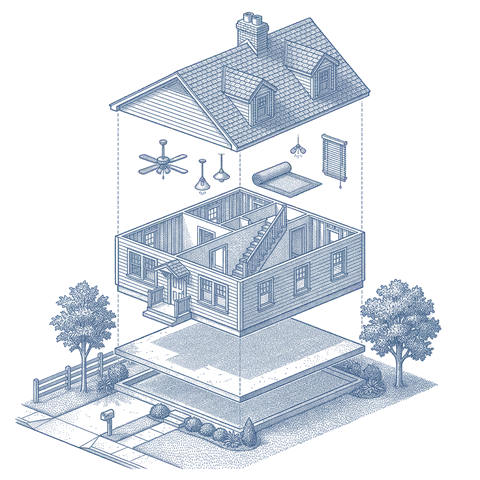
The same house, split into the parts the IRS lets you write off faster.
- 5-yearAppliances, carpet and vinyl plank flooring, decorative lighting, window coverings
- 15-yearDriveway, fencing, landscaping, site drainage, outdoor lighting
- 39-yearRoof, framing, walls, foundation. The building itself stays on the long schedule (a short-term rental with average guest stays under 30 days is generally 39-year; 27.5-year when stays are normally 30 days or more)
Federal bonus applies to the 5, 7 and 15-year parts. For short-term rentals that is typically 19–39% of the building.
The 30-second answer: For the New Mexico personal income tax, New Mexico conforms to federal §168(k) bonus depreciation. Base income is federal adjusted gross income plus two listed items, neither of which is depreciation (NMSA 1978 §7-2-2(B)(2)), and the Internal Revenue Code is incorporated as amended (§7-2-2(J)). The federal bonus you claim on reclassified components carries straight into the New Mexico return.
For the corporate income tax, Senate Bill 151 (signed March 11, 2026, Laws 2026 chapter 69) picks up the §168(k) and §168(n) deduction in excess of regular §168(a) through (j) depreciation in corporate base income, for taxable years beginning on or after January 1, 2027. The Taxation and Revenue Department describes it as an add-back. Corporate returns for 2026 are unaffected.
On a representative New Mexico single-family rental (the single-family rental band we publish, 8–32% of depreciable basis reclassified, 15% representative), the reclassified components alone generate an estimated $16K–$165K of federal Year-1 depreciation, roughly $5,920–$61,570 of federal Year-1 tax savings at the 37% top bracket, and for an individual the same Year-1 deduction is reflected on the New Mexico return.
Federal vs New Mexico, Side by Side
For an investor's cost-segregation-reclassified components:
| Tax provision | Federal (IRC) | New Mexico |
|---|---|---|
| Bonus depreciation under §168(k), personal income tax | 100% may apply to qualified property acquired and placed in service after January 19, 2025, subject to §168(k) eligibility, related-party/prior-use, binding-contract and election rules | Conforms. Base income is federal AGI plus the §172(a) NOL deduction and the pass-through entity credit; no depreciation add-back (NMSA 1978 §7-2-2(B)(2)) |
| Bonus depreciation under §168(k), corporate income tax, taxable years through 2026 | Same federal rule | Conforms. Corporate base income starts from federal taxable income with no bonus adjustment before SB 151 takes effect |
| Bonus depreciation under §168(k) and §168(n), corporate income tax, taxable years beginning on or after January 1, 2027 | Same federal rule | Excess over regular §168(a)-(j) depreciation picked up in base income (SB 151, Laws 2026 ch. 69, amending §7-2A-2(C)); described by the Taxation and Revenue Department as an add-back |
| Which Code version New Mexico uses | Not applicable | The Internal Revenue Code of 1986 "as amended", no fixed date (§7-2-2(J)), so federal changes such as the 2025 restoration of 100% bonus flow through automatically |
| Federal usability of the deduction | Subject to passive activity, at-risk, basis and business-interest limits | Same federal limits govern; New Mexico inherits the federal AGI figure after they apply |
| MACRS asset class lives | 5 / 7 / 15 / 27.5 / 39 yr per Rev. Proc. 87-56 | Same class lives; for a corporation from 2027 they are the schedule the excess is recovered on |
Source: NMSA 1978 §7-2-2; Senate Bill 151 (2026); IRC §168(k). Federal bonus figures reflect current law; eligibility depends on acquisition and placed-in-service dates and elections.
How New Mexico conformity actually works for an individual
The study itself does not change. The same engineering-based reclassification, using public government construction cost data, MACRS classification per Rev. Proc. 87-56, and IRS Pub 5653 ATG-aligned documentation, produces the same component schedule whether the property sits in New Mexico or anywhere else. What is different about New Mexico is how little happens next: the state return starts from the federal number and leaves depreciation alone.
NMSA 1978 §7-2-2(B)(2) defines base income, for taxpayers other than estates and trusts, as the taxpayer's federal adjusted gross income plus exactly two things: the net operating loss deduction taken under §172(a), and, from 2023, the credit claimed under §7-3A-10 for a pass-through entity's distributed net income. Net income is then base income less the federal standard or itemized deduction and the other exclusions listed in §7-2-2. Nothing in the section references §168, §168(k) or depreciation of any kind.
§7-2-2(J) defines the Internal Revenue Code as the Internal Revenue Code of 1986, as amended. There is no fixed conformity date to update each year, so when Congress restored 100% bonus depreciation in July 2025, New Mexico's personal income tax picked it up without any state legislation. The Year-1 bonus on your reclassified components reduces federal AGI, and that reduced AGI is where the New Mexico return begins.
Your CPA receives the same Cost Seg Smart engineered report, the same Form 4562-ready federal schedule, and the same Form 3115 §481(a) section if this is a lookback study. For the New Mexico personal income tax there is no second schedule to keep.
Corporations: what SB 151 changes from 2027
Senate Bill 151 was signed on March 11, 2026 and became Laws 2026, chapter 69. Its title describes it as decoupling the corporate income tax from certain provisions of the federal One Big Beautiful Bill Act. Section 1 amends the definition of base income in NMSA 1978 §7-2A-2(C), the Corporate Income and Franchise Tax Act, to pick up the amount of any deduction taken under §168(k) and §168(n) in excess of the deduction that would have been allowed by §168(a) through (j), that is, in excess of regular depreciation. The act applies to taxable years beginning on or after January 1, 2027.
The Taxation and Revenue Department's bill analysis describes the mechanism as adding the excess back to corporate base income, and its revenue estimate is built on that reading. The enrolled wording places the clause inside the list of amounts subtracted from federal taxable income, which read in isolation would do the opposite; the department's analysis noted that it presumed the bill would be clarified. The act's title says it is subtracting amounts deducted for bonus depreciation, which is the add-back reading in different words. This page follows the department and the title. If you file a New Mexico corporate return, confirm the treatment against the department's CIT-1 instructions for 2027 when they are issued.
Two things SB 151 does not do. It does not touch §7-2-2, so the personal income tax is unchanged. And it does not reach taxable years before 2027, so a corporation's 2026 return still conforms.
This distinction matters because most New Mexico rental real estate is held by individuals, partnerships and LLCs whose owners report on the personal income tax. The conforming rule above covers them. A C corporation, or a pass-through entity that has elected New Mexico's entity-level tax, should plan on the corporate rule for 2027-and-later taxable years and confirm its mechanics with the department.
Typical range: a New Mexico single-family rental
The worked example at the top is a short-term rental in Santa Fe, NM. For a single-family rental, the range we publish is below. Using the single-family residential (SFR) band we publish, 8–32% of depreciable basis reclassified into 5/7/15-year property, 15% representative, on a property priced between $250,000 and $650,000, with a 20% residential land allocation, and 100% federal bonus depreciation for eligible components under current law, held by an individual:
| Line item | Federal | New Mexico (personal income tax) |
|---|---|---|
| Purchase price band | $250,000–$650,000 | Same property |
| Depreciable basis (20% land allocation) | $200,000–$520,000 | Same basis |
| Reclassified to 5/7/15-yr (8–32% of basis) | $16K–$165K | Same components, same class lives |
| Year-1 deduction | $16K–$165K (100% bonus, if eligible) | Same $16K–$165K, already inside the federal AGI New Mexico starts from |
| State add-back | Not applicable | None for an individual. Corporations: excess bonus picked up in base income for taxable years beginning on or after January 1, 2027 |
| Marginal tax rate | Up to 37% | New Mexico personal income tax rate (verify current year with the Taxation and Revenue Department) |
| Illustrative Year-1 federal tax savings on reclassified components | ~$5,920–$61,570 (37% × $16K–$165K) | Plus the New Mexico tax on the same $16K–$165K reduction, in the same year |
Figures are illustrative and use the site's published SFR reclassification band; your result depends on your basis, land allocation, bracket, component mix and eligibility. Whether the full federal deduction is usable in the current year still depends on your passive-loss, at-risk, basis and business-interest situation. The New Mexico column describes the personal income tax; a C corporation with a 2027 or later taxable year should apply the SB 151 rule described above.
See a sample cost segregation report
Look at exactly what your New Mexico study delivers: the component-by-component 5/7/15-year schedule, the Form 4562-ready numbers, and the documentation your CPA files. Real reports are our best answer to "is this legit?"
Forms your CPA files for a New Mexico property
For an individual New Mexico investor, the workflow runs almost entirely on the federal return, because the state return inherits the federal figure:
- Federal Form 4562: depreciation and amortization, including the §168(k) bonus deduction on eligible reclassified components. Flows to Schedule E (rental) or Schedule C (active business).
- Schedule E (or Schedule C): the accelerated federal deduction reduces federal taxable income in Year 1, subject to the federal passive-loss, at-risk, basis and business-interest limits.
- New Mexico Form PIT-1: starts from federal adjusted gross income. The PIT-ADJ schedule carries New Mexico's statutory additions and deductions, and bonus depreciation is not among them.
- New Mexico Form CIT-1 (corporations only): unchanged for 2026. For taxable years beginning on or after January 1, 2027, SB 151 picks up excess §168(k) and §168(n) depreciation in base income; follow the department's instructions for that year.
- Form 3115 §481(a) section: included only if this is a federal lookback method change on a property placed in service in a prior year (see below).
The reclassified schedule is the same engineered output for both books, and for an individual the two books agree.
Form 3115 lookback on a New Mexico property
If the property was placed in service in a prior tax year and depreciation was reported using a non-segregated method, a federal Form 3115 (Application for Change in Accounting Method) may allow a current-year §481(a) catch-up adjustment for the accelerated depreciation you missed, generally without amending prior returns. This is often the single biggest acceleration mechanism in cost segregation. Any catch-up dollars are illustrative and depend on placed-in-service date, prior depreciation claimed, bonus eligibility, land allocation and component mix.
The federal §481(a) catch-up is the primary lever, and it remains subject to the federal passive-loss, at-risk and basis limits. For an individual or pass-through owner, the catch-up reduces federal AGI in the year of change, and New Mexico base income starts from that reduced AGI with no add-back.
See our full Form 3115 cost segregation guide for federal mechanics, partnership and LLC pass-through treatment, and timing rules.
Should you skip cost segregation in New Mexico? No.
New Mexico is one of the simpler states for an individual investor. The math favors doing the study, for three reasons:
- The full federal Year-1 bonus is intact. The full §168(k) bonus is claimed on the federal return. How much you use in the current year still depends on your passive-loss, at-risk, basis and business-interest situation.
- New Mexico matches it in the same year. Base income is federal AGI with no depreciation add-back, so the state tax saving arrives alongside the federal one rather than being deferred.
- The Form 3115 lookback still captures missed federal years. If the property was placed in service in a prior year and depreciated without cost segregation, the federal §481(a) catch-up may be available, generally without amending prior returns, and it flows through to New Mexico the same way.
The one nuance to flag with your CPA is entity type. A C corporation, or a pass-through entity that has elected New Mexico's entity-level tax, should plan on the SB 151 corporate rule for taxable years beginning on or after January 1, 2027, under which the excess bonus is recovered on the regular MACRS schedule rather than in Year 1.
Frequently asked
Does New Mexico allow bonus depreciation?
For individuals, yes. New Mexico's personal income tax starts from federal adjusted gross income: NMSA 1978 §7-2-2(B)(2) defines base income for taxpayers other than estates and trusts as federal AGI plus two listed items, the §172(a) net operating loss deduction and the pass-through entity tax credit under §7-3A-10. Nothing in the section mentions §168(k) or depreciation, and §7-2-2(J) incorporates the Internal Revenue Code as amended, with no fixed date. Whatever federal bonus depreciation reduced your federal AGI stays reduced on the New Mexico return.
How much can a cost segregation study save on a New Mexico rental?
An $850K casita in Santa Fe, NM: a cost segregation study moves $170,000 into 5, 7 and 15-year property and adds $167,639 to the Year-1 deduction, about $62,026 in federal tax at a 37% bracket. This assumes you materially participate, so the loss can offset other income. Your result depends on your basis, land allocation, bracket, and eligibility.
What changed for corporations in 2026?
Senate Bill 151, signed March 11, 2026 as Laws 2026 chapter 69, amends the corporate income tax definition of base income in NMSA 1978 §7-2A-2(C). For taxable years beginning on or after January 1, 2027, the amount of any §168(k) and §168(n) deduction in excess of what §168(a) through (j) would have allowed is picked up in corporate base income. The Taxation and Revenue Department's fiscal analysis describes this as adding the excess bonus depreciation back to base income, and the bill title says the same. A C corporation's 2026 return is unaffected.
I hold my rentals in an LLC or partnership. Which rule applies to me?
The personal income tax rule, which conforms. A partnership or LLC taxed as a partnership passes its income through to owners who report on the New Mexico personal income tax return, and that return starts from federal AGI with no bonus depreciation add-back. SB 151 amends the Corporate Income and Franchise Tax Act only. If your entity elects New Mexico's pass-through entity tax, confirm the entity-level computation with your CPA, since that election changes which return the income is reported on.
The SB 151 text says subtracting. Is it really an add-back?
The enrolled bill places the §168(k) and §168(n) clause inside the list of amounts subtracted from federal taxable income in §7-2A-2(C). Read on its own, that wording would lower corporate base income. The Taxation and Revenue Department's bill analysis says the department presumed the bill would be clarified so that these federal deductions are added back, the act's own title says it is subtracting amounts deducted for bonus depreciation, and every practitioner summary we have seen reads it as an add-back that raises corporate taxable income. This page describes it the way the department and the title do. A corporate filer should confirm against the department's CIT-1 instructions for 2027 when they are issued.
Is cost segregation still worth it in New Mexico?
Yes, and for an individual investor the state return simply mirrors the federal one: the full federal §168(k) bonus on reclassified components flows through to New Mexico income with no adjustment. For a C corporation with property placed in service in a 2027 or later taxable year, the federal bonus is still claimed on the federal return, and on the New Mexico return the reclassified components are depreciated on their regular 5, 7 and 15-year schedules instead of in Year 1, which is still far faster than 27.5 or 39 years. Whether the full federal deduction is usable in the current year depends on the federal passive-activity, at-risk, basis and business-interest limits.
Can I use Form 3115 on a New Mexico property I bought years ago?
Often, yes, at the federal level. If the property was placed in service in a prior tax year and depreciation was reported using a non-segregated method, a federal Form 3115 (Application for Change in Accounting Method) may allow a current-year §481(a) catch-up for the accelerated depreciation you missed, generally without amending prior returns. For an individual or pass-through owner, the catch-up flows through to New Mexico the same way any other federal AGI item does, with no add-back. Any catch-up dollars are illustrative and depend on placed-in-service date, prior depreciation, bonus eligibility, land allocation and component mix.
What does a New Mexico cost segregation study rely on for its numbers?
The study reclassifies building components into IRS-recognized MACRS class lives (5, 7 and 15-year) per Rev. Proc. 87-56, using an engineering-based methodology that follows the IRS Cost Segregation Audit Techniques Guide (Publication 5653). The reclassified components may then qualify for federal §168(k) bonus depreciation on the federal return (100% for qualified property acquired and placed in service after January 19, 2025, subject to eligibility and election rules), and for an individual the same figure carries into New Mexico base income. The engine ships our own calibrated cost data, built from public government construction cost data (U.S. Census, BLS, GSA and state DOT sources), with every line traced to its published source.
Related guides
- Bonus depreciation by state: overview
- All 50 states: conformity reference table
- Federal bonus depreciation in 2026: the January 19, 2025 rule
- Bonus depreciation calculator
- Arizona bonus depreciation (conforms, with a recalculated subtraction)
- Colorado bonus depreciation (conforms)
- Texas bonus depreciation (no personal income tax)
- Form 3115 cost segregation lookback: §481(a) mechanics
- What is cost segregation: the full primer
- Sample cost segregation reports