Why bigger deductions aren't always better
The difference between an aggressive cost segregation position and a defensible one — and why we sometimes accelerate less.
Every cost segregation study answers hundreds of classification questions. The goal isn't to accelerate every dollar possible — it's to classify every dollar according to the facts, the tax authorities, and the available evidence.
Most marketing in this field competes on one number: the size of the deduction. We think that's incomplete. A deduction is only worth what it's worth if it holds up — and the person who has to stand behind it is the CPA signing the return. So we optimize for a different thing.
How we reach classification decisions
A defensible classification combines controlling tax authority with property-specific evidence. We begin with the governing law and judicial authorities, then apply them to the documented facts of the property. The higher a source sits, the more it drives the answer.
What this looks like in practice
The same building holds assets that belong in very different places. Cost segregation is the analysis that sorts them — and being principled means the sorting cuts both ways.
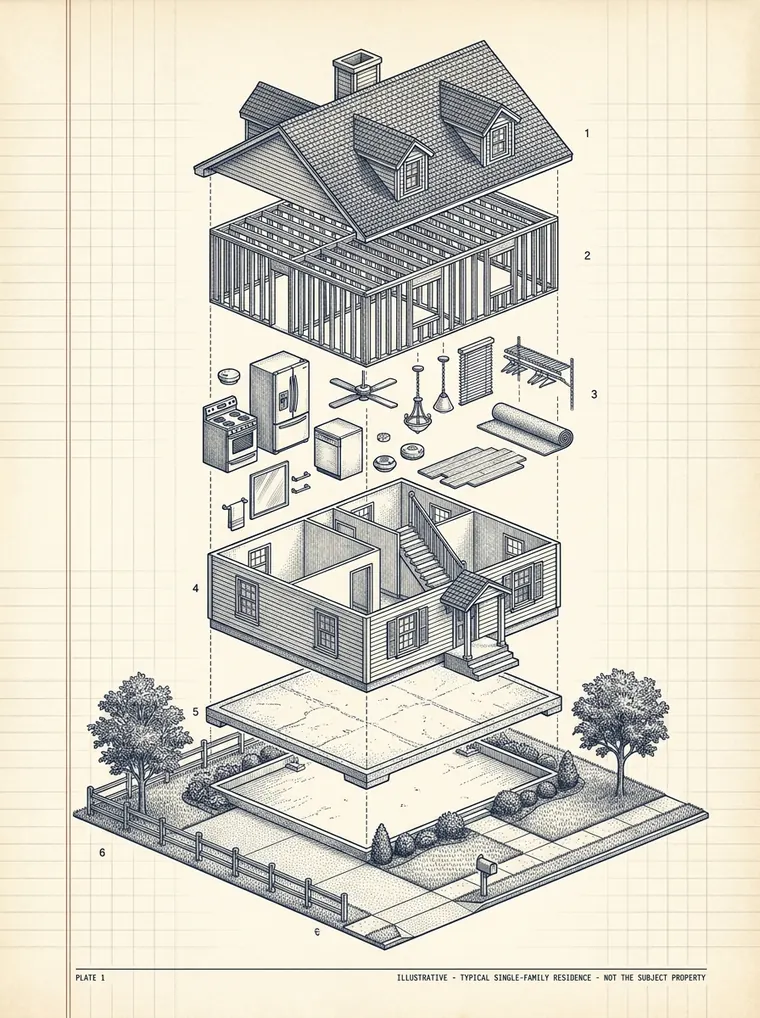
One building, three kinds of answer
Illustrative. Actual classifications are made per property, on the facts.

When we do accelerate — and why
Take a qualifying dedicated appliance circuit. When electrical wiring, an outlet, conduit, or a circuit breaker serves a specific appliance — and can be distinguished from the building's general electrical distribution — it may have a stronger basis for treatment as equipment-related personal property.
We accelerate qualifying components such as appliances, dedicated appliance connections, certain decorative or special-purpose lighting, carpet and vinyl flooring, window treatments, FF&E, and eligible site improvements when the facts and applicable authorities support doing so. Being defensible doesn't mean being timid — it means knowing why each asset belongs where we put it.

When we generally don't
Ordinary, permanently-installed residential cabinetry and permanent countertops are a common area for aggressive classification. We generally classify them as structural because their permanence, function, and relationship to the operation of the residence usually weigh toward treatment as building components. AmeriSouth XXXII v. Commissioner, T.C. Memo. 2012-67, is one relevant residential cost-segregation authority addressing the distinction between structural building components and §1245 property.
Different facts can produce a different answer — specialized business-use casework, modular installations, display fixtures, or cabinetry designed to be readily removed may warrant separate analysis. But standard residential kitchen cabinetry and permanent countertops generally remain with the building in our studies. We'd rather report the deduction supported by the facts than enlarge it through a position we couldn't confidently explain.
When reasonable professionals disagree
Cost segregation is not a mechanical exercise. Two qualified professionals can look at the same property and reasonably reach different conclusions on some classifications — that's the nature of applying facts to authority. Our philosophy is simple: favor positions we believe are well supported by the facts, IRS guidance, and applicable court decisions. When a call is genuinely close, we lean toward the position we'd be comfortable explaining.
What we won't do
- We don't tune classifications to hit a target acceleration percentage.
- We don't assume premium finishes because they produce larger deductions.
- We don't classify an asset simply because another report did.
- We don't grow a deduction by ignoring contrary evidence.
- Every accelerated asset should have a factual and legal basis.
Why this matters to the person signing the return
When the IRS looks at a study, it isn't grading ambition — it's asking whether each position is supported. The study that's worth ordering is the one where every dollar accelerated has a reason you'd be comfortable explaining to an examiner. That's the study a CPA — or any tax professional who has to evaluate and rely on it — can comfortably stand behind.
Frequently asked
Is a bigger cost segregation deduction riskier?
Not by itself. What matters is whether each accelerated component has a factual and legal basis. A larger deduction built on well-documented, evidence-backed classifications can be stronger than a smaller one built on assumptions. The question isn't 'how big' — it's 'can you explain every dollar.'
Do you accelerate kitchen cabinetry and countertops?
Generally no for ordinary, permanently installed residential cabinetry and permanent countertops — their permanence, function, and relationship to the operation of the residence usually weigh toward treatment as building components. If the facts are materially different — specialized business-use casework, modular, or readily removable installations — the analysis can change. We classify on the facts, not on a target.
What makes a cost segregation study audit-ready?
Component-level engineering analysis, cost basis supported by industry-standard construction cost data (not purchase-price rules of thumb), documentation aligned with the IRS Cost Segregation Audit Techniques Guide (Pub 5653), and a classification for each asset that you could explain to an examiner. We deliver a 40+ page report with cited methodology and quality checks.
Can two qualified firms reach different conclusions?
Yes. Cost segregation is not a mechanical exercise — reasonable professionals can disagree on some classifications. Our philosophy is to favor positions we believe are well supported by the facts, IRS guidance, and applicable court decisions.
This page describes our classification philosophy in general terms; it is not tax advice for a specific property. See our methodology and audit-support scope. Classifications are made per property, on the facts, and quality-checked before delivery.