Gas Station Cost Segregation: Fuel Equipment, Canopies, and the 15-Year Building Rule
A gas station is one of the most equipment-dense properties an investor can own. Dispensers, tanks, the canopy, and acres of forecourt paving all depreciate far faster than the c-store shell, and a qualifying station may depreciate the entire building over 15 years. Here is how the numbers work, what qualifies, and the special rule that sets fuel retail apart.

A gas station is one of the most equipment-dense properties an investor can own. Dispensers, tanks, the canopy, and acres of forecourt paving all depreciate far faster than the c-store shell, and a qualifying station may depreciate the entire building over 15 years. Here is how the numbers work, what qualifies, and the special rule that sets fuel retail apart.
A gas station is mostly equipment and pavement wrapped around a small building. The dispensers, the underground tanks, the canopy, the c-store coolers, and acres of forecourt concrete all depreciate far faster than the 39-year building shell, which is why cost segregation reclassifies more of a gas station’s basis than almost any other commercial property type. A typical convenience-store plus fuel station commonly moves roughly 30 to 58 percent of its depreciable basis into 5-year and 15-year MACRS categories, most often around 37 percent. Under 100% bonus depreciation, permanently restored by the One Big Beautiful Bill Act in 2025, those reclassified components are deductible in Year 1. And for a qualifying station, the entire building may depreciate over 15 years instead of 39.
Why gas stations accelerate so well
Cost segregation reclassifies a building’s components from the default 39-year commercial schedule into shorter 5-, 7-, and 15-year recovery periods. For most property types the building shell dominates the basis, so the reclassification percentage is moderate. Gas stations are the opposite. Strip out the fuel equipment, the storage tanks, the canopy, and the forecourt, and there is not much “building” left.
Think about what you actually buy when you buy a fuel station:
- A row of fuel dispensers or multi-product dispensers (MPDs), often 4 to 12 of them.
- Underground storage tanks and piping for the fuel.
- A large steel fuel canopy over the dispenser islands.
- Point-of-sale and payment systems, plus automatic tank gauging (ATG) and tank monitoring.
- A convenience store full of refrigeration, walk-in coolers, and merchandising fixtures.
- Acres of forecourt paving, dispenser islands, drainage, an oil-water separator, a pylon sign, site lighting, and bollards.
- And a relatively small c-store building shell to house it all.
The first several categories are overwhelmingly 5-year personal property and 15-year land improvements. The structure, the part that sits on the 39-year schedule, is a small slice of the total, and for a qualifying station even that slice may move to 15-year.
The component breakdown
Here is how a typical gas station sorts into MACRS classes:
- 5-year personal property: fuel dispensers and MPDs, point-of-sale and payment systems, automatic tank gauging (ATG) and tank monitoring, c-store refrigeration and walk-in coolers, signage electronics, and EV chargers. Underground storage tanks and connected piping are treated as 5-year petroleum-storage equipment.
- 15-year land improvements: the fuel canopy, concrete dispenser islands, forecourt paving, site drainage and the oil-water separator, the pylon sign structure, site lighting, and bollards.
- 39-year structural shell: the convenience-store building, foundation, roof structure, and basic building service, unless the station qualifies for the 15-year building rule described below.
The exact mix shifts with the configuration. A large convenience store with a quick-service kitchen carries more 5-year c-store equipment; a small pay-at-the-pump kiosk carries less building and more canopy and forecourt. The principle holds: the equipment and the site dominate, the shell is thin.
A worked example
Consider a $2.8M convenience-store and fuel station with a 3,000 square-foot c-store, 8 dispensers, 4 underground tanks, and about a 3,500 square-foot canopy, acquired as real estate plus the operating site with the equipment documented in the purchase-price allocation. An illustrative cost-seg study on a site like this, with the equipment documented, lands at about 59 percent of depreciable basis in accelerated classes, at the top of the typical range:
- A large share to 5-year personal property, the dispensers, tanks, ATG, POS, and c-store refrigeration.
- A substantial share to 15-year land improvements, the canopy, islands, forecourt paving, drainage, and sign structure.
- The remainder on the 39-year shell (unless the station qualifies for the 15-year building rule).
On roughly $2.2M of depreciable basis, putting nearly 60 percent into accelerated classes, with 100% bonus depreciation, drives a Year-1 deduction well into seven figures versus a few tens of thousands on straight-line. (These figures are illustrative and rounded. Your result depends on your actual configuration, the equipment in the acquisition basis, and your documentation.)
The special rule: a qualifying station may depreciate the entire building over 15 years
This is the differentiator that sets fuel retail apart from generic retail. Under Revenue Procedure 97-10, a qualifying retail motor fuels outlet (RMFO) may depreciate the entire building as 15-year property instead of 39-year.
A station generally may qualify if either of these is true:
- The building is 1,400 square feet or smaller, OR
- 50 percent or more of the building’s gross revenue, OR 50 percent or more of its floor space, is devoted to petroleum marketing sales.
When a station qualifies, the building shell that would normally sit on the 39-year schedule moves to 15-year, which can dramatically increase the accelerated share and the Year-1 deduction. A small kiosk or pay-at-the-pump station is often a strong candidate. A large convenience store with a big deli or quick-service kitchen may not meet the 50 percent petroleum test, in which case the building stays 39-year, though the dense c-store equipment still drives strong acceleration on its own.
Whether a specific station qualifies depends on its facts, including the floor-space and revenue mix. Confirm eligibility with your CPA. This is an educational explanation of the rule, not a guarantee and not tax advice.
What did you actually buy?
Because equipment is so much of the value, the single biggest driver of your deduction is what was part of your acquisition basis, and whether you can document it.
- Real estate only. You bought the dirt and the structure, not an operating site. The study covers the building, the canopy, and the site work; equipment that is not yours to depreciate stays off the study.
- Real estate plus operating station (turnkey). The dispensers, tanks, ATG, POS, and c-store equipment came with the deal. They are reclassifiable 5-year personal property, and with an allocation, schedule, or invoices, they are captured at documented (observed) cost, the most defensible result.
- Real estate plus business assets. Many fuel-retail acquisitions bundle the real estate, the equipment, and intangibles like goodwill, a fuel-supply agreement, a brand license, or customer relationships. Those intangibles are Section 197 property, not depreciable building basis, and must be carved out rather than swept into the cost-seg study. Getting this allocation right is what separates a defensible study from an aggressive one.
When you provide a purchase-price allocation or equipment schedule, the equipment is booked at actual cost. When you do not, it is modeled conservatively from the configuration (dispenser count, tank count, canopy size), and we flag where documentation would strengthen the result.
Bonus depreciation makes the timing aggressive, in your favor
With 100% bonus depreciation restored, every component a study moves into the 5-, 7-, or 15-year buckets is deductible in the year the property is placed in service. For an asset class where well over half the basis can land in those buckets, and where a qualifying building may move entirely to 15-year, the Year-1 impact is large. Pair that with a lookback study on a station you have owned for a couple of years and the catch-up deduction can be substantial.
Built for operators, jobbers, and NNN fuel-retail investors
Fuel retail is a favorite of independent operators, multi-site jobbers, c-store roll-ups, and net-lease investors who own the dirt under a branded fuel pad. All of them are strong candidates for systematic cost segregation: the acceleration is large, the components are relatively standardized, and the equipment-heavy economics reward precise allocation. Whether you own one station or are acquiring a portfolio, the study process is the same, and it scales. (See our gas station cost segregation hub for the operator and NNN-investor playbook.)
See it on a real report
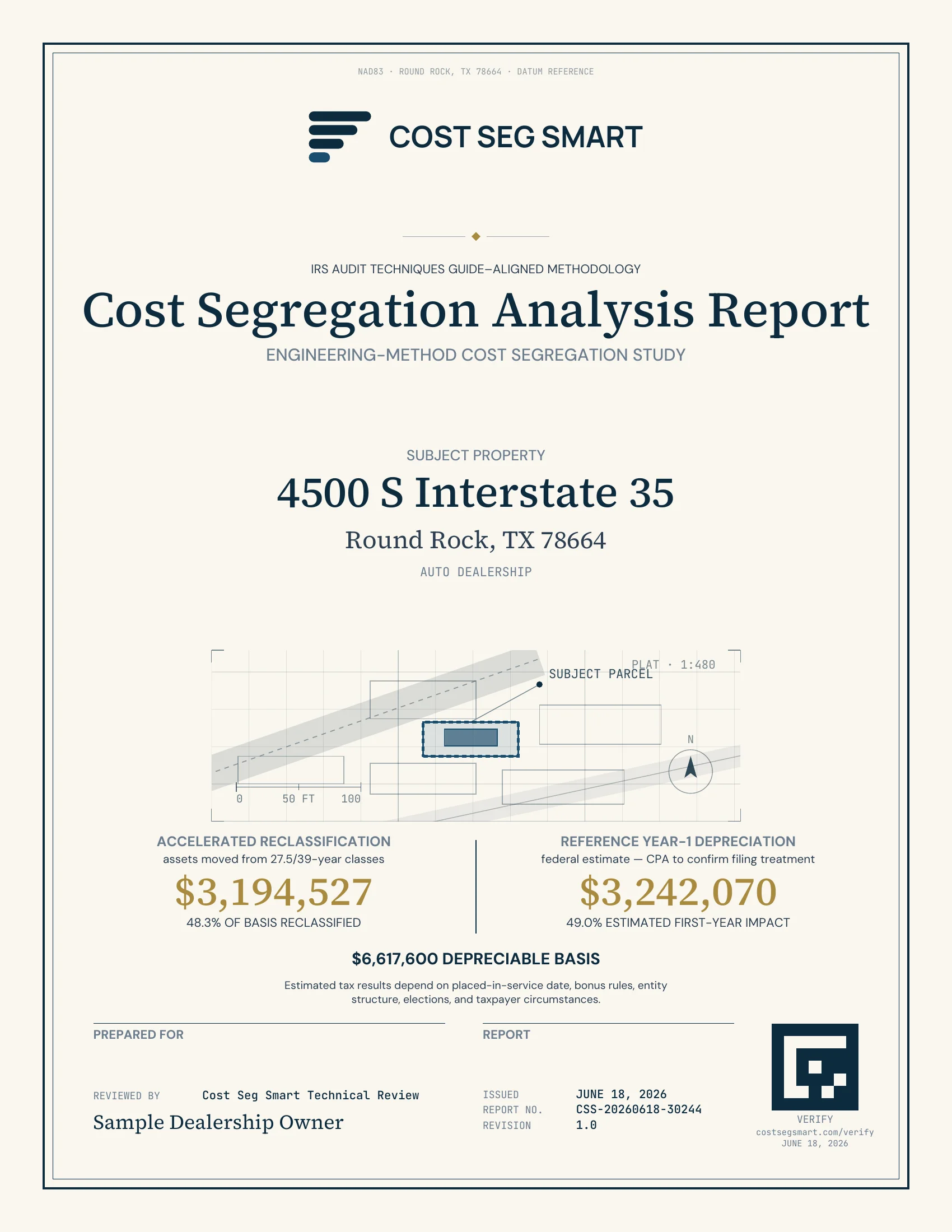
The fastest way to understand the impact is to look at a finished study. Our gas station sample report shows the full component-level MACRS allocation, the 39-year-vs-accelerated comparison, the treatment of the RMFO 15-year building rule, and the methodology a CPA needs to file.
When you are ready, a gas station cost segregation study starts at $2,495, is CPA-ready, and is completed remotely for most gas stations; larger or more complex sites may include an on-site observation. Because gas stations are equipment-dense, every order is reviewed before delivery during our calibration phase.
Cost Seg Smart uses industry-standard construction cost data and IRS-recognized engineering methodology. Reclassification ranges cited here are general industry observations, not predictions for any specific property; your study is based on your property’s actual characteristics and documentation. The Retail Motor Fuels Outlet rule under Revenue Procedure 97-10 applies only to qualifying stations; eligibility depends on your facts and should be confirmed with your CPA. This article is educational and not tax advice. Your CPA files the study with your return.
Frequently asked
How much of a gas station can cost segregation reclassify?
Gas stations are among the most accelerated commercial property types because so much of the value is equipment and site work rather than the building shell. A typical convenience-store plus fuel station commonly reclassifies roughly 30 to 58 percent of depreciable basis into 5-year and 15-year MACRS categories, most often around 37 percent. The exact figure varies with the c-store size, the canopy, the amount of forecourt paving, the number of dispensers, and whether the site adds a quick-service kitchen or EV charging. Ranges cited here are general industry observations, not a prediction for your specific property.
What parts of a gas station qualify for accelerated depreciation?
Most of it. The 5-year personal property bucket typically includes the fuel dispensers and multi-product dispensers (MPDs), the point-of-sale and payment systems, the automatic tank gauging (ATG) and tank monitoring, c-store refrigeration and walk-in coolers, signage electronics, and any EV chargers. Underground storage tanks and the connected piping are treated as petroleum-storage equipment on the 5-year schedule. The 15-year land-improvement bucket includes the fuel canopy, the concrete dispenser islands, the forecourt paving, site drainage and the oil-water separator, the pylon sign structure, site lighting, and bollards. Only the c-store building shell remains on the long 39-year schedule, unless the station qualifies for the 15-year building rule below.
What is the Retail Motor Fuels Outlet (RMFO) 15-year building rule?
Under Revenue Procedure 97-10, a qualifying retail motor fuels outlet may depreciate the entire building as 15-year property rather than 39-year. A station generally may qualify if the building is 1,400 square feet or smaller, OR if 50 percent or more of the building's gross revenue, or 50 percent or more of its floor space, is devoted to petroleum marketing sales. This is the single biggest differentiator versus a generic retail store. Whether a specific station qualifies depends on its facts, so confirm eligibility with your CPA. This is an educational explanation, not a tax determination.
How is a c-store with a large convenience operation different from a fuel-only station?
It comes down to the mix. A small kiosk or pay-at-the-pump station with a tiny building is often the strongest candidate for the 15-year building rule, because the building is small and petroleum sales dominate. A large convenience store with a deli, coolers, and a quick-service kitchen may not meet the 50 percent petroleum test, so the building shell may stay 39-year, but the dense c-store equipment (refrigeration, coolers, POS, kitchen) adds a great deal of 5-year personal property. Either way the acceleration is strong; the path to it differs.
Do EV chargers and a quick-service kitchen change the study?
Yes, and usually in your favor. EV charging equipment is generally 5-year personal property, and the associated switchgear and conduit may be partly 5-year and partly 15-year site work depending on how it is installed. A co-located quick-service restaurant adds kitchen equipment, hoods, walk-ins, and grease handling, much of which is 5-year. Both add depreciable personal property on top of the fuel and site components. We capture documented equipment at its actual cost when you provide invoices or an allocation.
How much does a gas station cost segregation study cost and can I do a lookback?
Cost Seg Smart gas station studies are priced by a transparent matrix: $2,995 under $1M of basis, $4,995 at $1M to $2M, $7,995 at $2M to $4M, and $9,995 at $4M to $7M, with larger sites quoted by proposal. Gas stations are equipment-dense, so every order is reviewed before delivery during our calibration phase. Yes, you can run a lookback study on a station you bought in a prior year. A lookback catches up all the missed accelerated depreciation in the current tax year via IRS Form 3115 and a Section 481(a) adjustment, with no amended returns required.