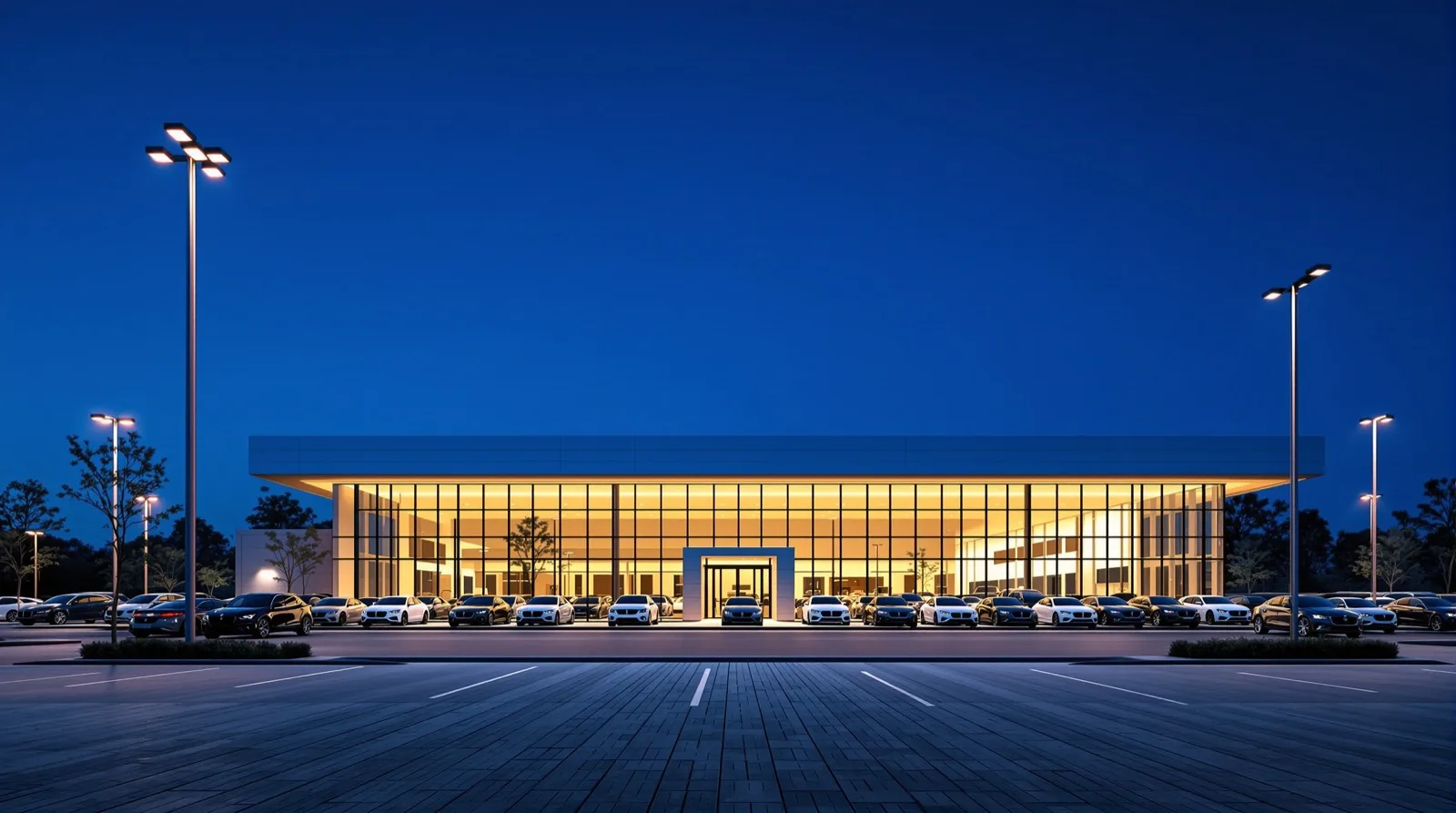
Auto Dealership Cost Segregation: A Worked Example (40.7%)
Modeled by our engine on an illustrative $5M Las Vegas dealership — not a client result. The class-by-class split, what drives it, and how a different store would come out.
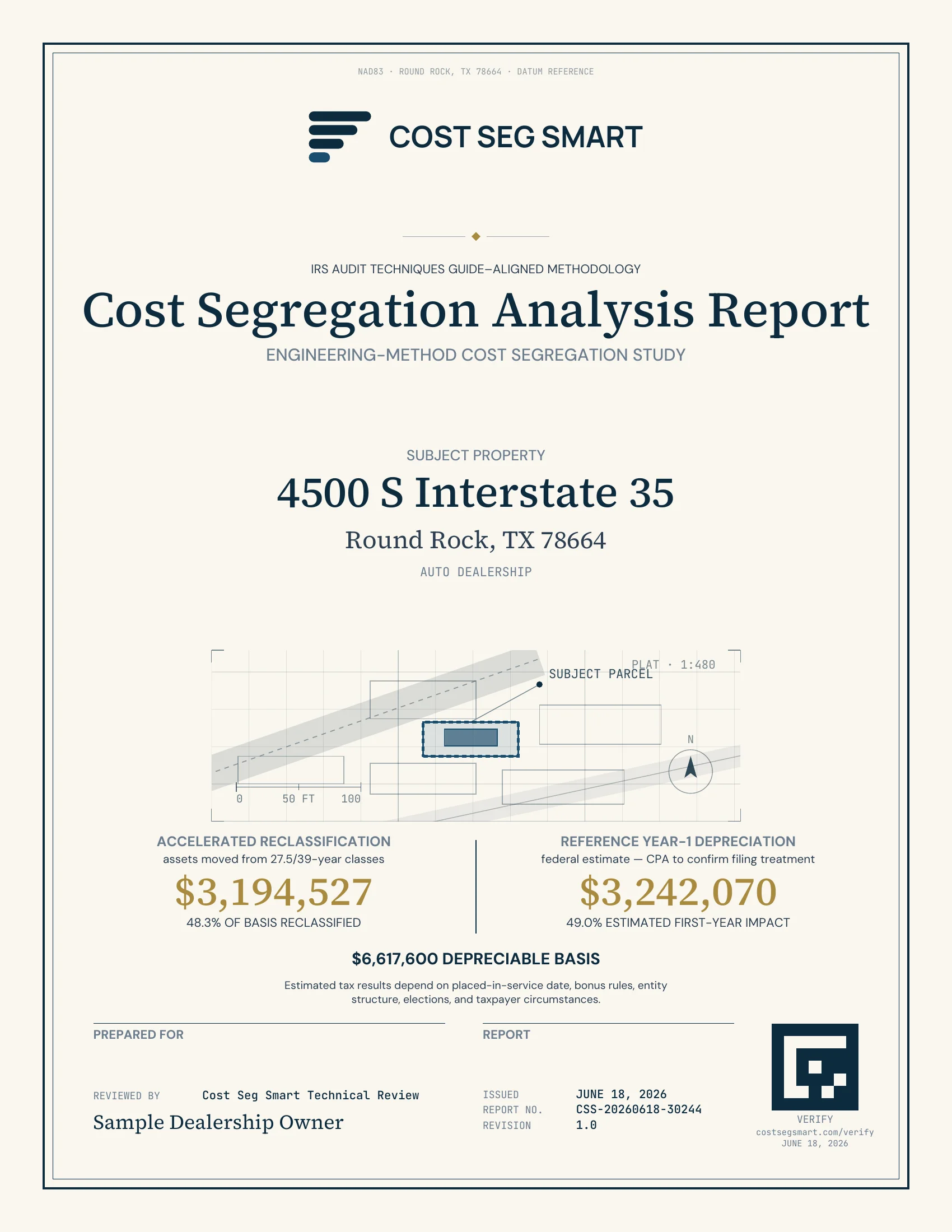
This is a worked example, modeled by our engine on an illustrative $5 million Las Vegas dealership — not a client engagement. It reclassifies 40.7% of the depreciable basis out of 39-year property: service-bay equipment and showroom fixtures to 5-year, furnishings to 7-year, and the paved display lot with its lighting to 15-year, all deductible in Year 1 under 100% bonus depreciation. A store with a smaller lot or fewer service bays reclassifies materially less.
This is a worked example, not a case study. The numbers below were produced by our engine on an illustrative Las Vegas, NV dealership with a $4,028,000 depreciable basis, so that the full class-by-class split can be shown without redacting a client. Nothing here is a delivered result. On that basis the study reclassifies 40.7% — $1,637,874 — out of 39-year property, and the Year-1 deduction with 100% bonus depreciation is $1,671,070 (41.5% of basis, the accelerated classes plus the first year on the shell). Dealerships pair service-bay equipment (5-year) with an exceptionally large paved-lot and lighting 15-year bucket.
The split, class by class
| MACRS class | Basis | Share | What is in it |
|---|---|---|---|
| 5-Year Personal Property | $896,495 | 22.3% | Service-bay equipment, lifts, specialty electrical, fixtures |
| 7-Year Personal Property | $40,000 | 1.0% | Furnishings and specialty equipment |
| 15-Year Land Improvements | $701,379 | 17.4% | Large paved display/inventory lot, lot lighting, site work |
| 39-Year Commercial Shell | $2,390,126 | 59.3% | Structural building, showroom, base systems |
| Total depreciable basis | $4,028,000 | 100% | Purchase price less the land allocation |
The 5-year class is the service operation and the showroom: lifts, compressed air, exhaust extraction, specialty electrical, display lighting and fixtures — tangible personal property under IRC §1245, which is what puts it on the 5-year schedule rather than the building’s. The 15-year class is almost entirely paving and lot lighting; a dealership sits on several times its building footprint in display and inventory lot, and Rev. Proc. 87-56 puts land improvements on 15 years. What remains — $2,390,126, 59.3% — is the structure and base building systems on 39 years.
Why a dealership comes out this high
This illustrative Las Vegas dealership reached 40.7%, among the highest of any property type, because it pairs a service operation with acres of paved lot. Dealerships frequently contain:- Large paved display and inventory lots
- Lot and site lighting
- Service-bay lifts and equipment
- Specialty electrical and compressed air
- Wash bays and specialty plumbing
- Showroom finishes and signage
What a different store would do
A reclassification this high is typical only for heavily improved dealerships with extensive paved display and inventory areas plus full service facilities. A dealership with less site work and fewer service bays will reclassify materially less. Two things move the result most. The lot: paving scales with acreage, so a store on a tight urban parcel has a fraction of this 15-year class. The shop: a used-car lot with a two-bay service area has little of the 5-year equipment a franchise store with a collision center carries. Age matters too — a 1990s store that has not been re-imaged carries older finishes at lower cost. The study prices what is there; it does not assume a full shop or a full lot.
Illustrative result from one sample report. Actual reclassification varies substantially with property age, improvements, tenant finish, equipment, land value, and other facts. Not a benchmark or expected range.
What the study costs on a dealership
Dealerships are priced on the specialty-commercial ladder, one step above plain office and retail, because of the equipment and site work they carry: from $2,995, and $8,995 for a store at this example’s price. Delivered as a CPA-ready PDF, usually the next business day for smaller stores; a larger dealership may include an on-site observation. The dealership guide covers the two levers in more depth, and the auto dealership hub has the order flow.
Sources
- IRS Cost Segregation Audit Techniques Guide — Publication 5653
- Rev. Proc. 87-56 asset classes — IRS Publication 946, Appendix B
- 26 U.S.C. § 168(k) — Bonus depreciation
- 26 U.S.C. § 1245 — Personal property
Frequently asked
Is this a real dealership?
No. The figures are produced by our engine on an illustrative $5,000,000 Las Vegas dealership so the class-by-class split can be shown in full; they are not an anonymized client result and no client's data is in them. The sample report the numbers come from is available on the sample-report page. A real study classifies the property's own components, and the result moves with lot size, service capacity, age and land value.
What dealership components are 5-year property?
The service and body shop drive the 5-year bucket: vehicle lifts, alignment racks, tire machines and balancers, compressed-air and lube/waste-oil distribution, vehicle exhaust extraction, and a body-shop paint booth. On the showroom side: branded/OEM image-program finishes, display lighting, digital signage and AV, reception/sales millwork, and parts-department racking. Equipment books as 5- or 7-year property only when it is present and documented.
Is the paved display lot 15-year property?
Yes. Paving, striping, curbing and site lighting are land improvements with a 15-year recovery period under Rev. Proc. 87-56, not the building's 39 years. On a dealership the display and inventory lot, customer parking and service drive are usually several times the building footprint, which is why the 15-year class is typically one of the largest reclassifications in the study.
I bought my dealership years ago — is it too late?
No. A lookback study produces the same class-by-class schedule for a property placed in service in a prior year; your CPA files Form 3115 under the automatic-consent procedures and the missed depreciation is claimed as one §481(a) adjustment on the current return, with no amended returns.