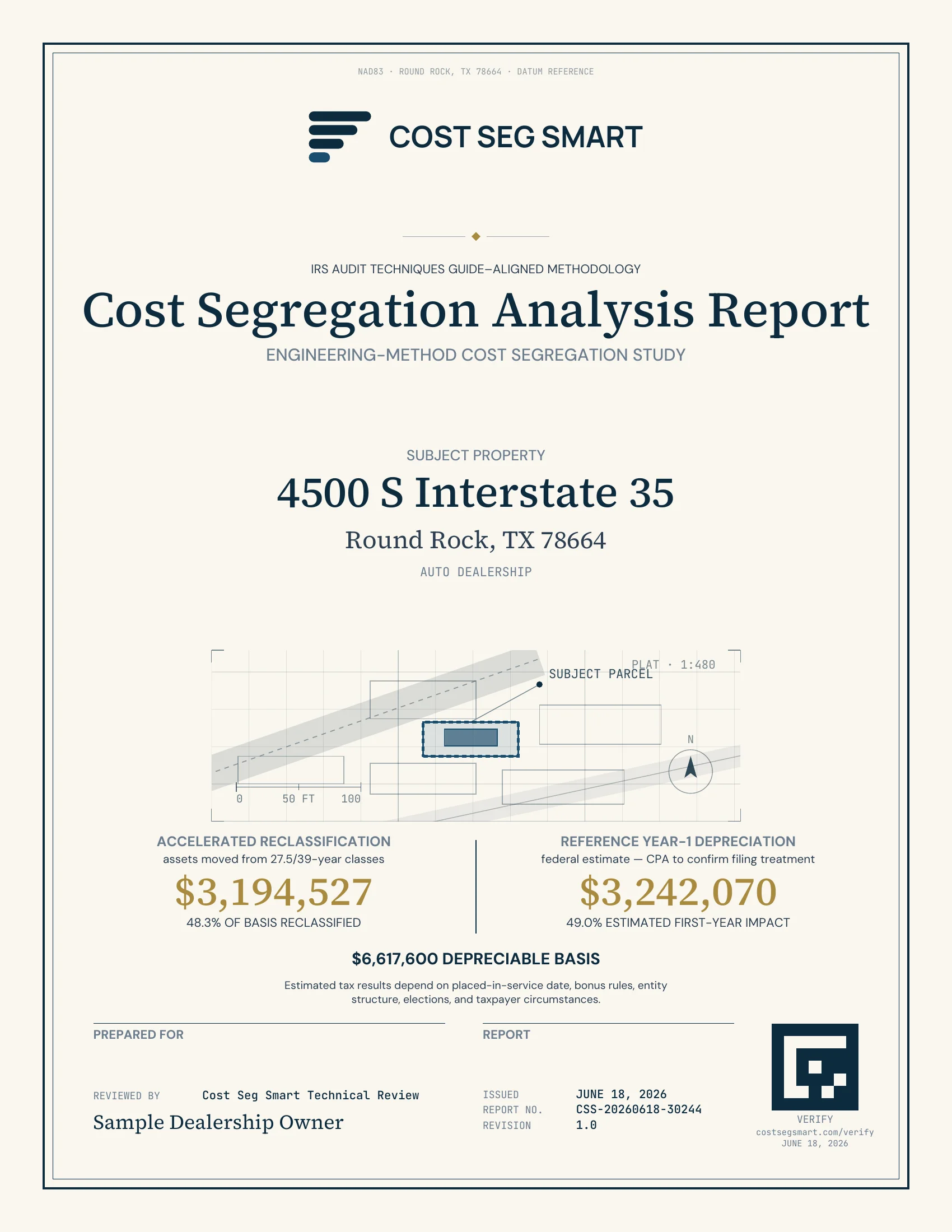
Cost Segregation for Veterinary Clinics: 2026 Guide with Real Numbers
Veterinary clinics typically reclassify 19–36% of building basis into 5/7/15-year property: kennels, surgical O2, imaging power, exam casework. A $1.2M animal hospital sees roughly $75K of Year-1 federal savings, or $136K with documented clinical equipment.
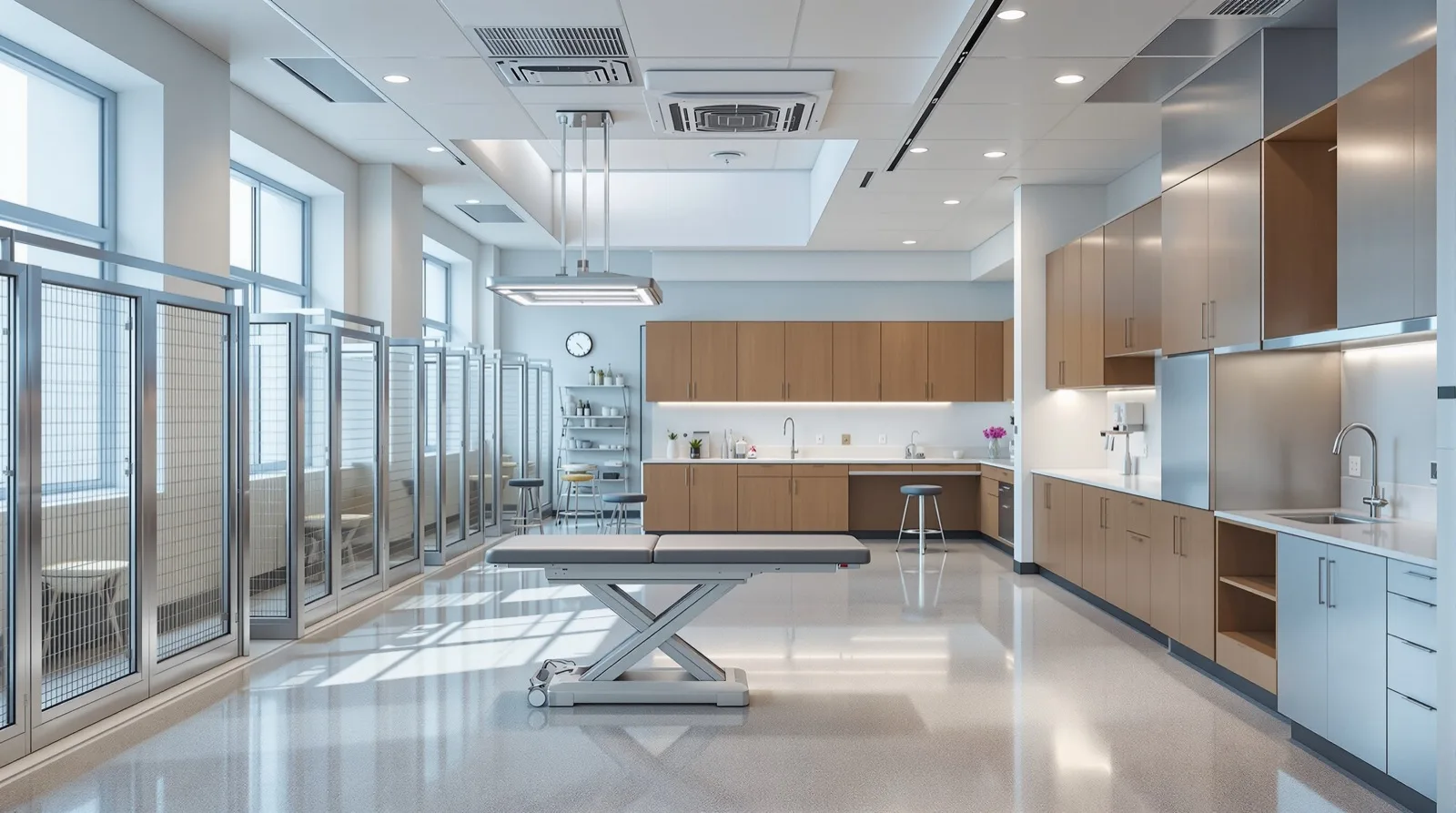
A veterinary clinic typically reclassifies 19 to 36 percent of its depreciable building basis, most often around 23 percent, out of the 39-year schedule into 5-, 7-, and 15-year MACRS classes. The clinical fit-out is what drives it: exam casework, medical-gas distribution, imaging power, kennels, and animal-facility drainage. Documented equipment that conveyed with the practice can push the Year-1 deduction toward 37 percent.
Veterinary clinics are one of the densest commercial property types for cost segregation, because so much of what you bought is clinical infrastructure rather than building shell. A typical animal hospital reclassifies 19–36% of its depreciable building basis, most often around 23%, into accelerated 5-, 7-, and 15-year MACRS classes: exam and treatment casework, surgical oxygen and anesthesia distribution, dedicated imaging power, removable kennels and runs, in-house lab casework, specialty floor drainage, and the parking and dog-run site work. On a $1.2 million clinic, that is roughly $203,400 reclassified into Year 1, worth about $75,000 in federal tax at the 37% bracket with 100% bonus depreciation. When the purchase included documented imaging, surgical, and kennel equipment, the Year-1 deduction can reach $367,000, about 37% of basis. Studies are priced as specialty commercial property, from $2,995 and $4,995 for a typical clinic, and delivered in 1–2 business days. Here’s exactly how it works.
This is general information, not tax advice. Confirm the treatment of any component with your CPA before relying on a position below.
The Veterinary Cost Segregation Opportunity
When you buy or build a veterinary clinic, the IRS default is to depreciate the whole thing over 39 years as nonresidential real property under IRC §168(e)(2)(B). That is the slowest schedule in the code, and it is wrong for most of what a clinic actually is. A veterinary practice is not a plain office. It is a building wrapped around surgical suites, treatment bays, kennels, imaging rooms, a wet lab, and heavy animal-facility plumbing. Those systems wear out, get replaced, and are removable on a timeline measured in years, not decades.
Cost segregation is the engineering-based study that separates those shorter-lived components out of the 39-year bucket and into their correct 5-, 7-, and 15-year classes. The methodology is the one the IRS sets out in its Cost Segregation Audit Techniques Guide, Publication 5653. With 100% bonus depreciation permanent again, the reclassified amount is deductible in Year 1 instead of dripping out over four decades.
Which asset class a veterinary clinic sits in
A veterinary practice is a service business, so the personal property inside it falls under asset class 57.0 of Rev. Proc. 87-56, distributive trades and services, which carries a 5-year recovery period. Office furniture is class 00.11 at 7 years, data and low-voltage cabling is class 00.12 at 5 years, and the site work is class 00.3 at 15 years. Every line in a study should name the class it claims, because that citation is the first thing an examiner reads.
What a cost segregation study changes.
| Metric | Without cost seg (39-year) | With cost seg + 100% bonus |
|---|---|---|
| Year-1 depreciation | ~$23,400 | ~$221,000 |
| Year-1 tax savings @ 37% | ~$8,650 | ~$82,000 |
| Reclassified into 5/7/15-yr | $0 | ~$203,000 (≈22%) |
| With documented equipment | — | up to ~$367,000 (≈37%) |
| Study cost | N/A | $4,995 |
| Delivery time | N/A | 1–2 business days (most residential) |
What Is Cost Segregation? (The 60-Second Version)
You didn’t just buy a building. You bought exam-room casework, a surgical suite, an oxygen and anesthesia distribution system, kennels, an imaging room with lead-lined walls and dedicated power, a wet lab, floor and trench drains, a parking lot, and an outdoor run. The IRS lets different components depreciate at different rates, and most of that clinical and site infrastructure has a much shorter useful life than the 39-year shell.
A cost segregation study breaks your property into those components and reclassifies the short-lived ones into 5-year property (clinical fit-out and equipment), 7-year property (office and reception furniture), and 15-year property (site and land improvements). With bonus depreciation, qualifying property in all three classes is fully deductible in Year 1 rather than spread across the building’s life. For a veterinary owner, that means a large deduction in the first year you own the practice.
What makes a component 5-year rather than building
The test is permanence, not convenience. Whiteco Industries, Inc. v. Commissioner, 65 T.C. 664 (1975), sets out six factors, and Pub 5653 adopts them: whether the property can be and has been moved, whether it was designed to remain permanently in place, what the intended length of affixation was, how substantial and time-consuming removal is, how much damage removal causes, and how the property is affixed.
That last point matters more than most write-ups admit. An argument that says only “it is removable” has invoked one factor out of six. Affixation to the building does not by itself exclude property from the personal-property category, and the mere theoretical capability of being moved does not establish that something is not inherently permanent. A kennel run bolted to a slab and a surgical boom anchored to structure are both fixed in place; what puts them in the 5-year class is that they serve identifiable clinical equipment and are replaced on a clinical cycle, not a building one.
Why Veterinary Practices Benefit More Than a Plain Office
A medical or dental office is already a good cost-seg candidate. A veterinary hospital is better, because it carries everything a human clinic does plus systems no office has: boarding kennels and runs, animal-facility floor and trench drainage, hydrotherapy and grooming rough-ins, and a surgical and anesthesia setup sized for procedures all day. That is why a clinic’s reclassification lands in the low-to-mid 20s on the building alone, ahead of a comparable general office.
The same logic drives every fit-out vertical we model. A child day care centre reclassifies for licensing-driven reasons rather than clinical ones, and a church reclassifies almost entirely into 7-year property because of who owns it. The principle is constant: the further a component sits from the weather envelope, the shorter its life.
Plug your purchase price into the cost segregation calculator to see your own reclassification before reading further.
The second lever is what conveyed with the practice
Many veterinary purchases are practice acquisitions where the imaging, surgical, lab, and kennel equipment conveyed with the real estate. When that equipment is documented, it is classified as observed personal property at 5 and 7 years and carved into its correct class rather than buried in the 39-year building. That is what moves a study from about 22% on the building alone toward 37%.
The word doing the work there is documented. An undocumented assertion that equipment conveyed does not survive review, and it should not: a study that prices equipment nobody can evidence has invented basis. A purchase agreement that itemises the equipment, a bill of sale, or an allocation schedule is what turns that lever.
What Gets Reclassified in a Veterinary Clinic
Our engine models a veterinary clinic from a dedicated component library built bottom-up from industry-standard construction cost data (GSA schedules, public procurement pricing, and DOT unit-cost data). Here is what typically moves out of the 39-year shell.
Five-year property: the clinical fit-out, and the big bucket
Every line here is class 57.0, and every one of them rests on the same argument: the system serves identifiable clinical equipment rather than the building’s general occupancy.
| Component | Why it leaves the 39-year shell |
|---|---|
| Exam and treatment-room casework | Sink cabinets and procedure counters, replaced on practice turnover |
| Oxygen, anesthesia and medical-gas distribution, with waste-gas scavenging | Piping sized and routed for identifiable surgical equipment |
| Specialty animal-facility plumbing | Floor and trench drains, hose bibs, hydrotherapy rough-ins |
| Kennels, runs and animal housing | Removable cages, gates and enclosures |
| Surgical suite lighting, booms and ceiling service columns | Mounted task equipment, not general illumination |
| Imaging mounts and dedicated power | Serving identifiable X-ray, ultrasound and CT equipment |
| Wash, grooming and prep stations | Tubs, tables and the plumbing dedicated to them |
| In-house lab and pharmacy casework | Diagnostic rough-ins and refrigeration |
| Tech call, patient monitoring and clinical data cabling | Class 00.12 information systems |
| Decorative lobby and reception finishes | Branded trade dress, replaced on rebrand |
| Lead-lined partitions and doors for X-ray shielding | Shielding installed to serve identifiable imaging equipment, and an engineer-review item |
That last row is worth pausing on. Whether lead shielding reads as equipment or as part of the room enclosure turns on how it was built into the wall, which is a question a photograph cannot settle. It is flagged for review rather than classified automatically, and a study that takes it silently has taken a position it did not earn.
Seven-year property
Office and reception furniture, and waiting-room seating and décor. This is class 00.11, and it is a small bucket in most clinics.
Fifteen-year property: the site
Client parking with its paving, striping and accessible markings; the outdoor dog run or exercise yard with its fencing and surfacing; site lighting; sidewalks and accessible ramps; landscaping and irrigation; and monument signage. All of it is class 00.3, recovered over 15 years on a 150% declining balance method, and all of it is bonus-eligible.
A Worked Example: $1.2M Animal Hospital
Take a 5,000-square-foot veterinary hospital purchased for $1.2 million. After removing the land, roughly $912,000 is depreciable building basis.
Without a study, that $912,000 depreciates straight-line over 39 years — about $23,400 a year. At a 37% federal bracket, that’s roughly $8,650 of tax benefit in Year 1.
With a cost segregation study, the engineering breakdown identifies about $203,000 of that basis as shorter-lived property:
- 5-year property (~$147,000) — exam casework, surgical O2/anesthesia, imaging power, kennels, lab casework, clinical cabling
- 7-year property (~$9,500) — office and reception furniture
- 15-year property (~$46,000) — parking, the outdoor run, site lighting, sidewalks, landscaping, signage
Under 100% bonus depreciation, permanent for property placed in service January 20, 2025 onward under the One Big Beautiful Bill Act, that entire $203,400 is deductible in Year 1, plus the normal first-year depreciation on the remaining shell. Total Year-1 deduction is roughly $221,000 instead of $23,400. At a 37% bracket, that’s about $82,000 of Year-1 tax savings against a $4,995 study fee. You can check the fee for your own basis on the pricing page before you order anything.
$1.2M veterinary clinic · 5,000 SF · CPA-ready report
This is the building-acquisition case — the conservative posture the engine takes by default. A clinic bought as a turnkey practice, with the imaging, surgical, lab, and kennel equipment documented in the purchase, reclassifies materially more: the Year-1 deduction on the same property reaches ~$367,000 (≈37%) once that equipment is captured as observed 5- and 7-year personal property rather than left in the building basis.
Illustrative model. Actual reclassification and tax savings vary by property, basis, location, and what equipment is documented. Confirm with your CPA before filing.
If You Lease the Space and Paid for the Build-Out
A large share of veterinary practices operate in leased space where the practice, not the landlord, paid for the clinical build-out. That build-out is yours to depreciate, and a veterinary fit-out is exactly the kind of dense, short-lived improvement cost segregation is built for. The study runs on your build-out basis instead of a building purchase.
Fifteen years, not the lease term
The most common error we see on a tenant-funded fit-out is depreciating it over the lease. Interior improvements to nonresidential real property placed in service after the building was first placed in service are Qualified Improvement Property, recovered over 15 years under IRC §168(e)(6) and eligible for bonus. The lease term does not set the recovery period. If you paid for it and you own it, who depreciates a build-out is worth reading before you file, because the answer changes what schedule your investment belongs on.
Tenant build-outs are quality-checked before the report is delivered, so the classification matches how the improvements were actually funded rather than who happens to occupy the space.
Bought Your Practice Years Ago? Claim the Catch-Up
You don’t have to do this in the year you buy. The IRS allows a lookback (catch-up) study: file a Form 3115 with your current-year return, and all the accelerated depreciation you missed in prior years flows through at once, with no amended returns. Lookback studies fall under the IRS automatic-consent procedures, so there’s no separate approval step. If you’ve owned your clinic for several years without a study, the cumulative catch-up can be substantial.
The §481(a) adjustment is what carries it. It’s a single-year catch-up of the difference between what you did claim and what you could have claimed, and it lands on the return you’re filing now. Your CPA handles the mechanics; what you need to know is that waiting does not forfeit the deduction, it defers it. If you’re weighing whether the timing works, the cost segregation calculator will size the deduction before you commit to anything, and what a study costs sets the fee against it.
The Bottom Line for Your Practice
If you own a veterinary clinic on the 39-year schedule, you are very likely leaving $50,000 to $130,000 or more in first-year depreciation on the table. Those are real reductions in your tax bill, assuming you have practice income to offset. A veterinary hospital reclassifies more than almost any other professional-services property, because so much of it is clinical and site infrastructure rather than shell.
When this isn’t worth doing
Three cases, said plainly. If your building or build-out basis is under about $400,000, the study fee gets thin against the benefit and you should wait until you buy something larger. If you have no practice income this year and no passive income to shelter, the deduction is a carryforward rather than cash, and the timing may be better next year. And if you’re planning to sell the clinic inside two or three years, run the depreciation recapture question with your CPA first: accelerating deductions you’ll recapture shortly afterward can be a wash or worse. We’d rather tell you that now than after you’ve paid for a study.
Should you do this?
A cost seg study probably makes sense on your veterinary clinic if any of these are true:
- You bought, built, or built-out the clinic in the last 1–10 tax years. A lookback study via Form 3115 captures the catch-up without amending old returns.
- Your building or build-out basis is at least ~$400K. Below that the study fee gets thin against the benefit.
- Imaging, surgical, lab, or kennel equipment conveyed with the purchase — documented equipment is where the study moves from ~22% toward ~37%.
- You lease and funded your own build-out — that improvement basis is dense with reclassifiable clinical infrastructure.
- You have practice income the deduction can actually reduce. No tax bill, no benefit.
Scenarios above are illustrative. Outcomes depend on basis, land allocation, tax bracket, and documented equipment. Confirm with your CPA before filing.
Cost Seg Smart is the modern cost segregation company — reports in 1–2 business days, not six weeks, and specialty-commercial pricing from $2,995 rather than five-figure fees. If you own or lease a veterinary clinic, order your study → and the CPA-ready report lands in your inbox in 1–2 business days. See the full veterinary cost segregation overview for component-level detail and worked examples.
Frequently asked
Do veterinary clinics qualify for cost segregation?
Yes. Any veterinary practice that owns its building or its build-out can reclassify the clinical fit-out — exam and treatment casework, surgical oxygen/anesthesia and waste-gas scavenging, imaging power, kennels and runs, in-house lab casework, specialty floor drainage, and the site work — out of the default 39-year commercial schedule into 5-, 7-, and 15-year MACRS classes. A typical clinic reclassifies 19–36% of its depreciable building basis, most often around 23%, and materially more when documented imaging, surgical, and kennel equipment conveyed with the practice.
What veterinary clinic components are 5-year property?
The clinical fit-out is the 5-year bucket: exam and treatment-room casework, oxygen/anesthesia/medical-gas distribution and waste-gas scavenging, specialty animal-facility plumbing (floor and trench drains, hose bibs, hydrotherapy rough-ins), removable kennels and runs, surgical suite lighting and booms, imaging mounts and dedicated power for X-ray/ultrasound/CT, wash and grooming prep stations, in-house lab and pharmacy casework, and clinical low-voltage cabling. Office and waiting-room furniture is 7-year; parking, the outdoor dog run, site lighting, sidewalks, landscaping, and signage are 15-year land improvements.
How much can a veterinary practice save with cost segregation?
On a $1.2M animal hospital, an engineering-based study typically reclassifies about $200,000 of the building basis into accelerated classes — roughly 22% on the building alone. With 100% bonus depreciation, that is deductible in Year 1, worth about $75,000 in federal tax at the 37% bracket. When the purchase included documented imaging, surgical, and kennel equipment, the Year-1 deduction can reach ~$367,000 (about 37% of basis), worth ~$136,000. Actual results vary with the property and what equipment is documented.
I bought my clinic years ago — is it too late?
No. A lookback (catch-up) study lets you claim the depreciation you missed in prior years without amending old returns. Your CPA files a Form 3115 (Change in Accounting Method) with your current-year return under the IRS automatic-consent procedures, and the cumulative missed depreciation flows through in a single year.
I lease my space and paid for the build-out myself — does cost segregation still apply?
Yes, and it is often a strong fit. A tenant who funded the build-out depreciates that investment, and a veterinary build-out is dense with reclassifiable clinical infrastructure. The study is run on your build-out basis rather than a building purchase. Tenant build-outs are reviewed before delivery so the classification matches how the improvements were actually paid for.
How much does a veterinary cost segregation study cost?
Veterinary clinics are priced as specialty commercial property: studies start at $2,995 for sub-$1M basis and run $4,995 for a typical $1M–$3M clinic, delivered as a CPA-ready PDF, within 1–2 business days. Most are completed remotely; a larger or more complex property may include an on-site observation. Traditional firms charge $5,000–$15,000 and take four to six weeks.
Is 100% bonus depreciation still available for veterinary owners?
Yes. The One Big Beautiful Bill Act made 100% bonus depreciation permanent for property placed in service on or after January 20, 2025, and for 2026 and beyond. (Property placed in service January 1–19, 2025 is at 40%.) Every dollar reclassified into 5-, 7-, or 15-year property is fully deductible in the year of acquisition.
Does a cost segregation study increase audit risk for a veterinary practice?
No. Cost segregation is explicitly supported by the IRS Cost Segregation Audit Techniques Guide (Publication 5653) and Rev. Proc. 87-56. A properly prepared engineering-based study — built from industry-standard construction cost data and backed by quality checks — provides exactly the documentation the IRS expects.