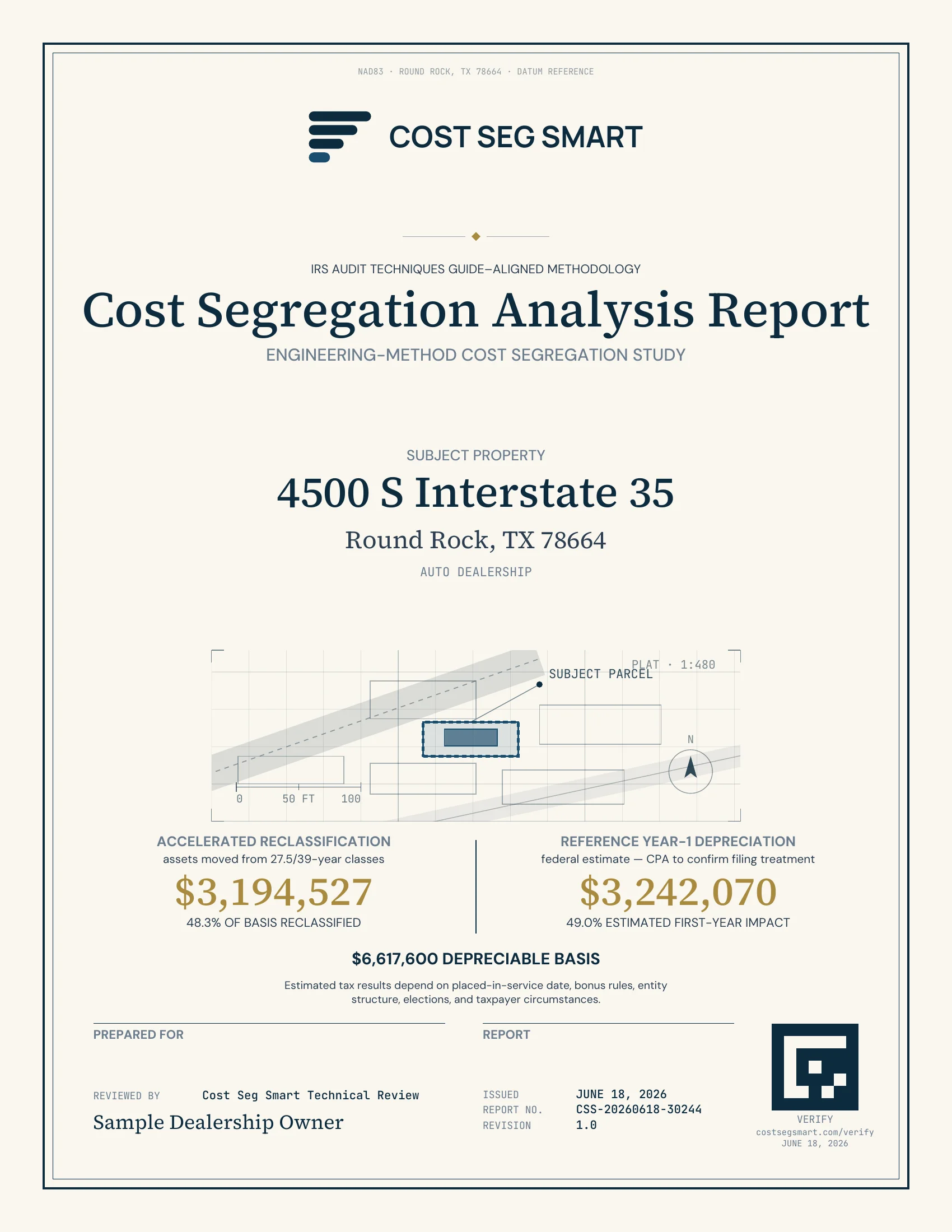
Car Wash Cost Segregation: The Highest-Acceleration Real Estate You Can Buy
A car wash is mostly equipment and pavement wrapped around a thin building shell — which is exactly why cost segregation reclassifies far more of the basis than almost any other property type. Here's how the numbers work, what qualifies, and what documentation drives the biggest deductions.
A car wash is mostly equipment and pavement wrapped around a thin building shell — which is exactly why cost segregation reclassifies far more of the basis than almost any other property type. Here's how the numbers work, what qualifies, and what documentation drives the biggest deductions.
A car wash is the rare commercial property where the building is almost an afterthought. The real money is in the tunnel equipment, the vacuums, the water-reclaim system, and acres of pavement — and nearly all of it depreciates far faster than the 39-year shell. That’s why our car-wash model reclassifies roughly 39–65% (most often around 48%) of a car wash’s depreciable basis into 5- and 15-year MACRS categories, well above what a typical office or retail building yields. Under 100% bonus depreciation (permanently restored by the One Big Beautiful Bill Act in 2025), those reclassified components are deductible in Year 1.
Why car washes accelerate so well
Cost segregation reclassifies a building’s components from the default 39-year commercial schedule into shorter 5-, 7-, and 15-year recovery periods. For most property types the building shell dominates the basis, so the reclassification percentage is moderate. Car washes are the opposite: strip out the equipment and the site work and there isn’t much “building” left.
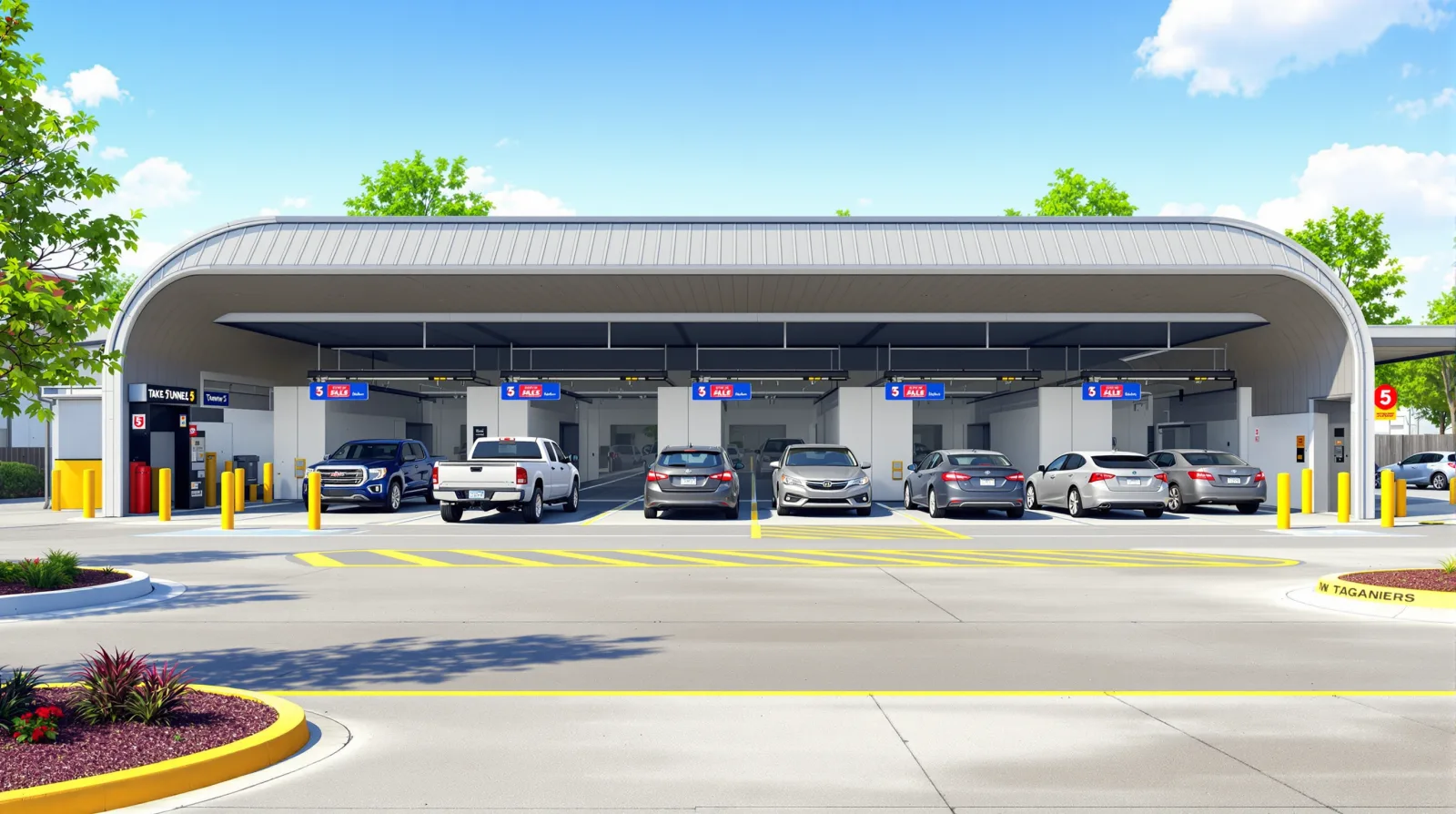
Think about what you actually buy when you buy an express tunnel wash:
- A conveyor and a sequence of wash equipment — correlators, arches, applicators, brushes, high-pressure pumps.
- A bank of dryers and blowers.
- A canopy with self-serve vacuum stalls — often 12 to 40 of them.
- A water reclamation and treatment system.
- A chemical delivery system and tunnel controls / POS pay stations.
- Acres of paving, queuing lanes, vacuum-pad concrete, drainage, and lighting.
- And a relatively simple structure to house it all.
The first six categories are overwhelmingly 5-year personal property and 15-year land improvements. The structure — the part that sits on the 39-year schedule — is a small slice of the total.
The component breakdown
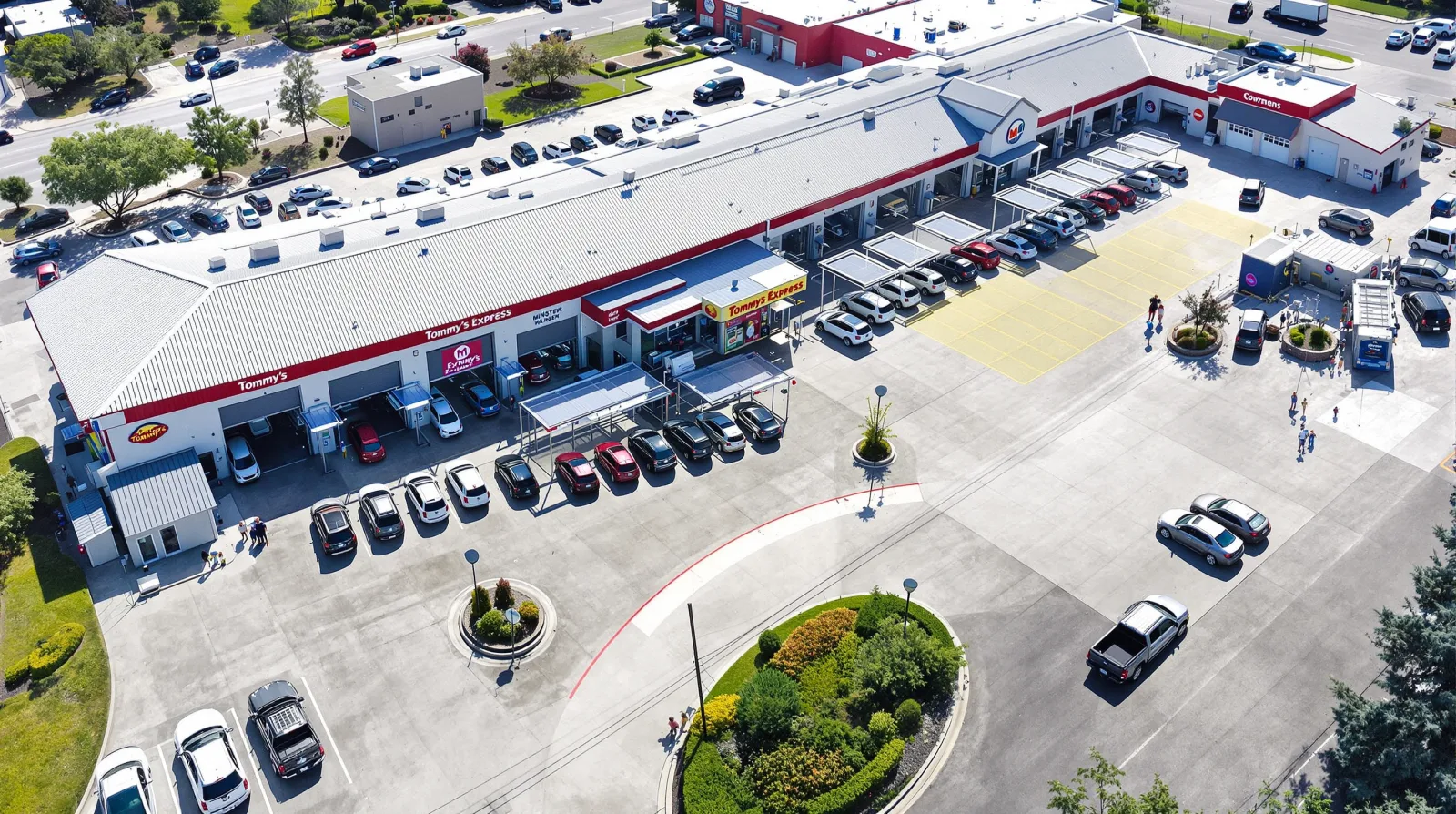
Here’s how a typical car wash sorts into MACRS classes:
- 5-year personal property (§1245): tunnel conveyor and wash arches, dryers and blowers, vacuum systems, water reclamation/treatment equipment, chemical delivery systems, pay stations and tunnel controls, and signage.
- 15-year land improvements: asphalt/concrete paving, drive and queuing lanes, vacuum-pad concrete, site drainage and oil-water separators, canopies, exterior and lot lighting, fencing, and landscaping.
- 39-year structural shell: tunnel structure, equipment/pump room, office, foundation, roof structure, and basic building service.
For a true self-service or in-bay automatic site the mix shifts — fewer linear feet of tunnel, more bay equipment — but the principle holds: the equipment and the site dominate, the shell is thin.
A worked example
Consider a $3.2M express tunnel acquisition — real estate plus the operating wash, with the equipment documented in the purchase-price allocation. A conservative cost-seg study might land roughly like this:
- ~40–50% to 5-year personal property — the tunnel equipment, dryers, vacuums, reclaim, pay stations.
- ~25–35% to 15-year land improvements — the paving, queue lanes, drainage, canopies, and lighting.
- The remainder on the 39-year shell.
That can put two-thirds or more of the basis into accelerated classes — and with 100% bonus depreciation, deductible in Year 1. On a property like this the Year-1 deduction often runs into seven figures versus a few hundred thousand on straight-line. (Industry case studies on facilities in this range have shown first-year depreciation jumping roughly 5×. Those are observations from specific studies, not a prediction for your property — your result depends on your actual configuration and documentation.)
The most important question: what did you actually buy?
Because equipment is the whole ballgame for a car wash, the single biggest driver of your deduction isn’t the building — it’s whether the wash equipment is part of your acquisition basis, and whether you can document it.
- Real estate only. You bought the dirt and the structure, not an operating wash. The study covers the building and site work; equipment isn’t yours to depreciate here.
- Real estate + operating car wash (turnkey). The equipment came with the deal. It’s reclassifiable 5-year personal property — and if you have an allocation, schedule, or invoices, it’s captured at documented (observed) cost, the most defensible result.
- Real estate + business assets. Many private-equity and operator acquisitions bundle the real estate, the equipment, and intangibles like goodwill, customer lists, or a trade name. Those intangibles are §197 property — not depreciable building basis — and have to be carved out, not swept into the cost-seg study. Getting this allocation right is what separates a defensible study from an aggressive one.
This is why a good car-wash study leans on documentation. When you provide a purchase-price allocation or equipment schedule, the equipment is booked at its actual cost; when you don’t, it’s modeled conservatively from the configuration (tunnel length, vacuum count, reclaim system) — and we’ll flag where documentation would strengthen the result.
Bonus depreciation makes the timing aggressive — in your favor
With 100% bonus depreciation restored, every component a study moves into the 5-, 7-, or 15-year buckets is deductible in the year the property is placed in service. For an asset class where well over half the basis can land in those buckets, the Year-1 impact is dramatic. Pair that with a lookback study on a wash you’ve owned for a couple of years and the catch-up deduction can be large enough to reshape your tax year.
Built for operators and PE buyers
Car washes have become a favorite of private-equity roll-ups and multi-site operators, and they’re an unusually good fit for systematic cost segregation: the acceleration is large, the layouts are relatively standardized, and the equipment-heavy economics reward precise allocation. Whether you own one express tunnel or are acquiring a portfolio of them, the study process is the same — and it scales. (See our express car wash portfolio guide for the multi-site and sale-leaseback playbook.)
See it on a real report
The fastest way to understand the impact is to look at a finished study. Our car wash sample report shows the full component-level MACRS allocation, the 39-year-vs-accelerated comparison, and the methodology a CPA needs to file.
When you’re ready, a car wash cost segregation study starts at $2,995, is CPA-ready, and doesn’t require a site visit. Larger express tunnels and multi-site roll-ups are quoted by proposal.
Cost Seg Smart uses industry-standard construction cost data and IRS-recognized engineering methodology. Reclassification ranges cited here are general industry observations, not predictions for any specific property; your study is based on your property’s actual characteristics and documentation. This article is educational and not tax advice — your CPA files the study with your return.
Frequently asked
How much of a car wash can cost segregation reclassify?
Car washes are one of the most accelerated property types because so little of the cost is the building shell. Our car-wash model runs roughly 39–65% of depreciable basis into 5-year and 15-year MACRS categories, most often around 48% — and equipment-heavy express tunnels with documented equipment allocations can go higher. The exact figure depends on the wash configuration (tunnel length, vacuum count, reclaim system), how much equipment was included in the purchase, and the quality of the cost documentation. That range is a general observation, not a prediction for your specific property.
What parts of a car wash qualify for accelerated depreciation?
Most of the value. The 5-year personal property bucket (§1245) typically includes the tunnel conveyor and wash arches, dryers and blowers, vacuum systems, water reclamation and treatment equipment, chemical delivery systems, pay stations and controls, and signage. The 15-year land-improvement bucket includes paving and drive/queue lanes, vacuum-pad concrete, canopies, site drainage and oil-water separators, exterior and lot lighting, fencing, and landscaping. Only a relatively thin 39-year shell — tunnel structure, equipment room, office — remains on the long schedule.
Does the wash equipment have to be included in the purchase to depreciate it?
To include equipment in the building study, it has to be part of the acquisition basis — i.e., you bought the real estate and the operating car wash together (a turnkey or business purchase), or you can document the equipment as part of the purchase-price allocation. Equipment you buy separately after closing is depreciated on its own invoices, not in the building study. That's why the single most important question on a car-wash study is what was actually acquired, and whether you have an allocation, equipment schedule, or invoices.
How does a PE firm or multi-site operator handle cost seg on a car wash portfolio?
Express-wash roll-ups, sale-leasebacks, and multi-site acquisitions are ideal cost-seg candidates because the acceleration is large and the layouts are relatively standardized. Each site is studied individually (the equipment package, tunnel length, and site work differ), but the process scales across a portfolio. With documented purchase-price allocations from the transaction, the equipment is captured precisely as observed cost rather than modeled estimate — the most defensible result.
How much does a car wash cost segregation study cost and how long does it take?
Cost Seg Smart car-wash studies start at $2,995, with most sites priced by a transparent matrix up to about $7M of basis and larger tunnels or portfolio deals quoted by proposal. Reports are CPA-ready and include component-level MACRS schedules, methodology, and source documentation. Traditional engineering firms typically charge $5,000–$15,000+ and take 4–8 weeks for a commercial study of this complexity.
Can I do a car wash study on a property I bought a few years ago?
Yes. A lookback study lets you catch up all the missed accelerated depreciation in the current tax year via IRS Form 3115 (Change in Accounting Method) and a Section 481(a) adjustment — no amended returns required. Because so much of a car wash's basis belongs in the 5- and 15-year buckets, the accumulated missed depreciation on a wash you've owned for a few years can be substantial.