Cost Segregation for Restaurants: 2026 Guide with Real Numbers
A restaurant is the densest commercial property type for cost segregation: the kitchen, bar, and decorative front-of-house are personal property, not building. A $900K full-service restaurant reclassifies about $310K (≈43%) of its basis — roughly $117,000 in Year-1 federal tax savings.
A restaurant is the densest commercial property type for cost segregation: the kitchen, bar, and decorative front-of-house are personal property, not building. A $900K full-service restaurant reclassifies about $310K (≈43%) of its basis — roughly $117,000 in Year-1 federal tax savings.
With the kitchen and bar documented, restaurants are among the densest commercial property types for cost segregation — often more reclassifiable, dollar for dollar, than retail, office, or a warehouse. The reason is simple: a restaurant is mostly equipment and trade fixtures, not building. The kitchen exhaust hoods, walk-in coolers, bar refrigeration, draft and glycol lines, decorative dining lighting, booth seating, branded finishes, and POS systems are 5-year personal property when you own them; the parking, patio, and signage are 15-year land improvements. Only the bare shell is left on the 39-year schedule. On a $900,000 full-service restaurant with a documented kitchen and bar, about $310,000 (≈43%) of the depreciable basis reclassifies into faster classes — worth roughly $117,000 in Year-1 federal tax savings at the 37% bracket with 100% bonus depreciation, against a $2,995 study fee. A study identifies and documents those assets; it does not assume them.
Why Restaurants Reclassify More Than Anything Else
Most commercial buildings are mostly building — walls, roof, structure, generic systems — with a thin layer of reclassifiable property on top. A restaurant inverts that. The thing that makes it a restaurant, the kitchen and the dining room, is largely tangible personal property and trade fixtures that the tax code does not want sitting on a 39-year schedule.
The kitchen and bar. The exhaust hood and its fire-suppression and make-up air, the walk-in coolers and freezers, specialty above-slab plumbing serving the dish and prep stations, underbar refrigeration and glass washers, draft-beer and soda lines with their CO2 and glycol distribution, and the ice systems — all of it serves identifiable cooking and beverage equipment, so it is generally 5-year property, not building.
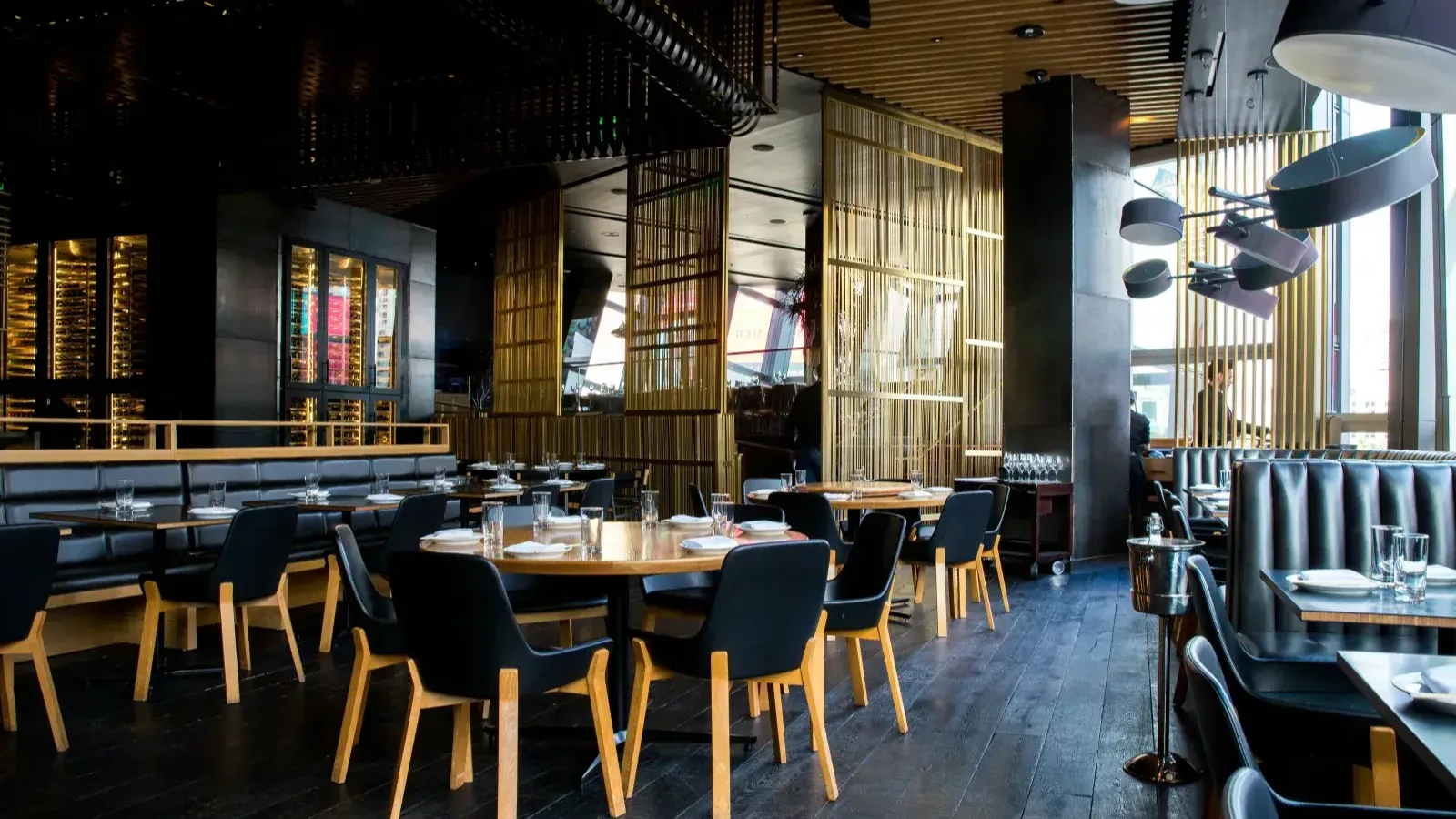
The front of house. Decorative pendant and dining lighting (ambiance, not required general illumination), built-in banquettes and booth seating, the built-in bar and its decorative front, branded wall treatments and trade-dress finishes, and the POS, audio, and kitchen-display electronics are trade fixtures and decorative property — typically 5-year, replaced at every concept change.
The site. A restaurant’s parking lot, outdoor patio hardscape, site and parking-lot lighting, landscaping, and monument signage are 15-year land improvements. The lot is smaller than a retail center’s, but it is still real reclassification the 39-year default buries.
What a cost segregation study changes.
| Metric | Without cost seg (39-year) | With cost seg + 100% bonus |
|---|---|---|
| Year-1 depreciation | ~$18,600 | ~$316,000 |
| Year-1 tax savings @ 37% | ~$6,900 | ~$117,000 |
| Reclassified into 5/7/15-yr | $0 | ~$310,000 (≈43%) |
| Study cost | N/A | $2,995 |
| Delivery time | N/A | 1–2 business days (most residential) |
What Gets Reclassified
Our engine models a restaurant from a dedicated component library built bottom-up from industry-standard construction cost data (GSA schedules, public procurement pricing, DOT unit-cost data). Here’s what moves out of the 39-year shell.
Five-year property — kitchen, bar, and front of house:
- Kitchen exhaust hood, fire suppression, ducting & make-up air, walk-in coolers & freezers, specialty kitchen plumbing (pre-rinse, dishwasher rough-ins), kitchen make-up air HVAC
- Bar equipment infrastructure (underbar refrigeration, glass washers, speed rails), draft-beer / soda / CO2 / glycol lines, ice systems, display & service-line refrigeration
- Decorative & dining lighting, built-in banquettes & booth seating, built-in bar & dining millwork, branded interior finishes, POS / audio / surveillance / kitchen-display systems
Fifteen-year land improvements — the site:
- Parking lot, outdoor patio hardscape, site & parking-lot lighting, landscaping & irrigation, monument / pylon signage, trash & grease-bin enclosures
Here’s how the most common restaurant assets typically classify:
| Component | Typical recovery period |
|---|---|
| Kitchen exhaust hood, fire suppression & make-up air | 5-year personal property |
| Walk-in coolers & freezers | 5-year personal property |
| Specialty kitchen plumbing (pre-rinse, dishwasher rough-ins) | 5-year personal property |
| Bar refrigeration, glass washers, draft & CO2/glycol lines | 5-year personal property |
| Ice systems, display & service-line refrigeration | 5-year personal property |
| Decorative & dining lighting (pendants, chandeliers) | 5-year personal property |
| Built-in banquettes, booth seating & dining millwork | 5-year personal property |
| Branded interior finishes & decorative wall treatments | 5-year personal property |
| POS, audio, surveillance & kitchen-display systems | 5-year personal property |
| Freestanding kitchen equipment & dining furniture (documented) | 5/7-year personal property |
| Parking lot, patio hardscape & site lighting | 15-year land improvement |
| Landscaping, irrigation & monument signage | 15-year land improvement |
| Building shell, structure & general systems | 39-year real property |
Recovery periods reflect typical treatment under IRS Publication 5653 (which addresses restaurant property directly) and Rev. Proc. 87-56. The classification of any specific asset depends on its facts and is determined in the study — and equipment lines are included only when the asset is present and documented, never assumed. A few items, such as an under-slab grease interceptor or an attached drive-thru canopy, are reviewed case by case before any reclassification.
A Worked Example: $900K Full-Service Restaurant
Take a 3,000-square-foot full-service restaurant purchased for $900,000 with its kitchen and bar in place. After land, roughly $725,000 is depreciable basis.
Without a study, that depreciates straight-line over 39 years — about $18,600 a year. At a 37% bracket, ~$6,900 of Year-1 benefit.
With a cost segregation study, the engineering breakdown identifies about $310,000 of the basis as shorter-lived property — the kitchen and bar infrastructure, the decorative front-of-house, the documented equipment, and the site work. Under 100% bonus depreciation that’s deductible in Year 1, producing roughly $316,000 of first-year depreciation worth about $117,000 in federal tax savings — against a $2,995 study fee. That’s a return of well over 30 to 1 in the first year.
$900K restaurant · 3,000 SF · documented kitchen + bar · CPA-ready report
This is an owner study on a restaurant bought with its kitchen and bar in place. The specialty kitchen infrastructure, the decorative dining room, and the documented freestanding equipment all book as 5- and 7-year personal property, and the parking and patio as 15-year land improvements — leaving only the bare shell on the 39-year schedule.
Illustrative model. Actual reclassification and tax savings vary by property, basis, concept, and documented equipment. Confirm with your CPA before filing.
Quick-Service, Bars, Breweries & Franchises
The same playbook flexes across the segment. A quick-service or drive-thru restaurant carries a compact kitchen but adds the drive-thru lane, order canopy, signage, and parking on the 15-year side. Bars, breweries, and taprooms are heavy on underbar refrigeration, draft and glycol systems, CO2 distribution, and decorative lighting. A full-service or franchise restaurant carries the whole package — kitchen, bar, and branded decorative build-out. Whether you run a single independent concept or a multi-unit franchise, the study captures what’s actually present and documented.
Bought Years Ago? Claim the Catch-Up
You don’t have to do this in the year you buy or build. A lookback study lets you file a Form 3115 with your current-year return and pull all the depreciation you missed in prior years into one year — no amended returns, automatic IRS consent.
The Bottom Line for Your Restaurant
If you own a restaurant on the 39-year schedule, you’re very likely leaving six figures of first-year depreciation on the table — because the kitchen, the bar, and the dining room that make it a restaurant are exactly the property a generic study under-classifies.
Should you do this?
A cost seg study probably makes sense on your restaurant if any of these are true:
- You bought or built the restaurant in the last 1–10 tax years. A lookback study via Form 3115 captures the catch-up without amending old returns.
- You own the kitchen and the build-out — you bought the building with its equipment, or you built it out yourself.
- You’re the tenant who funded your own build-out. That basis usually reclassifies even more — ask about a tenant-improvement study.
- Your basis is at least ~$500K and you have restaurant income the deduction can reduce.
Scenarios above are illustrative. Outcomes depend on basis, ownership of the build-out, concept, tax bracket, and documented equipment. Confirm with your CPA before filing.
Cost Seg Smart is the modern cost segregation company — reports in 1–2 business days, not six weeks, and specialty-commercial pricing from $2,995 rather than five-figure fees. If you own a restaurant, order your study → and the CPA-ready report lands in your inbox in 1–2 business days. See the full restaurant cost segregation overview for component-level detail and worked examples.
Frequently asked
What is cost segregation for a restaurant?
Cost segregation is an engineering-based analysis that separates a restaurant's purchase or build-out cost into its component assets and assigns each the shorter recovery period the tax code allows. Instead of depreciating the whole property over 39 years, the study identifies the specialty kitchen and bar infrastructure, the decorative front-of-house, and the documented equipment as 5-year personal property, and the parking, patio, and site work as 15-year land improvements — accelerating those deductions into the early years of ownership. It identifies and documents these assets; it does not assume them.
Do restaurants qualify for cost segregation?
Yes. Restaurants are one of the property types that benefit most from cost segregation, because so much of a restaurant is specialty equipment and trade fixtures rather than building. The kitchen exhaust hoods, walk-in coolers, bar refrigeration, decorative lighting, booth seating, and branded finishes are 5-year personal property when you own them and they are documented; the parking and patio are 15-year land improvements. A full-service restaurant commonly reclassifies more of its basis than any other commercial type.
Are commercial kitchen hood and exhaust systems 5-year property?
Generally yes. A kitchen exhaust hood, its fire-suppression system, exhaust ducting, and the dedicated make-up air that serves it are treated as personal property that serves identifiable cooking equipment, not as part of the building's general HVAC — so they are typically depreciated over 5 years rather than 39. The IRS Cost Segregation Audit Techniques Guide (Publication 5653) discusses restaurant property specifically. Classification of any specific asset depends on its facts and is confirmed in the study.
Are walk-in coolers and freezers 5-year property?
Yes, when they are freestanding, removable refrigerated boxes — which is the usual case. Walk-in coolers and freezers, their refrigeration equipment and insulated panels, plus ice machines, display refrigeration, and underbar coolers, are classic Section 1245 personal property depreciated over 5 years. They are reclassified only when present and documented in the study.
I lease my restaurant space and paid for the build-out myself — does it still apply?
Yes, and the math is often even stronger. A tenant who funded the kitchen and dining build-out depreciates that investment, and because there is no land or 39-year building shell to strip out, a restaurant build-out typically reclassifies far more of its cost than an owner study. That is handled as a tenant-improvement study on your build-out basis — see our restaurant tenant-improvement page.
How much does a restaurant cost segregation study cost?
Restaurants are priced as specialty commercial property: from $2,995 for a sub-$1M basis and $4,995 for a $1M–$3M restaurant, delivered as a CPA-ready PDF, within 1–2 business days. Most are completed remotely; a larger or more complex property may include an on-site observation. Traditional firms charge $10,000–$30,000 and take four to six weeks.
Does this work for fast-food, QSR, bars, breweries, or franchise restaurants?
Yes. The engineering follows the property, not the concept. A quick-service or drive-thru restaurant leans on the drive-thru lane, signage, and parking plus a compact kitchen; a bar or brewery adds underbar refrigeration, draft and glycol lines, and CO2 distribution; a full-service or franchise restaurant carries the full kitchen, bar, and decorative package. Each is captured from what is actually present and documented.
I bought my restaurant years ago — is it too late?
No. A lookback (catch-up) study lets you claim the depreciation you missed in prior years without amending old returns. Your CPA files a Form 3115 with your current-year return under the IRS automatic-consent procedures, and the cumulative missed depreciation flows through in a single year.
Is 100% bonus depreciation still available for restaurant owners?
Yes. The One Big Beautiful Bill Act made 100% bonus depreciation permanent for property placed in service on or after January 20, 2025, and for 2026 and beyond. (Property placed in service January 1–19, 2025 is at 40%.) Every dollar reclassified into 5-, 7-, or 15-year property is fully deductible in the year of acquisition or build-out.
Does a cost segregation study increase audit risk for a restaurant?
No. Cost segregation is explicitly supported by the IRS Cost Segregation Audit Techniques Guide (Publication 5653) and Rev. Proc. 87-56, and the Guide addresses restaurant property directly. A properly prepared engineering-based study — built from industry-standard construction cost data, backed by quality checks, with the equipment documented — provides exactly the support the IRS expects.