Cost Segregation for Townhomes (and Townhome STRs): 2026 Guide
A townhome owns its building and lot — so it reclassifies like a single-family home, typically ~11–19% of basis, not like a condo. Run it as a furnished short-term rental and the FF&E stack puts it at ~20–39%. Here's the breakdown, with real numbers.
A townhome owns its building and lot — so it reclassifies like a single-family home, typically ~11–19% of basis, not like a condo. Run it as a furnished short-term rental and the FF&E stack puts it at ~20–39%. Here's the breakdown, with real numbers.
A townhome is the cost-seg property type that gets miscategorized most often — because owners assume it works like a condo, or that all its stairs somehow add up to a bigger deduction. Both assumptions are wrong, and they cost real money. The right way to model a townhome is as a single-family home with a smaller lot: you own the structure and the land, so your interior finishes, appliances, fixtures, and site improvements all reclassify out of the default 27.5-year residential schedule. A typical long-term townhome reclassifies about 11–19% of its depreciable basis into 5- and 15-year property, most often around 12%. Run it as a furnished short-term rental and the hospitality FF&E puts that at roughly 20–39%. On a $650,000 townhome held long-term, that’s roughly $54,600 into Year 1 — worth roughly $20,202 in federal tax at the 37% bracket with 100% bonus depreciation. Studies are priced as residential — from $495, $895–$1,295 for a typical townhome — and delivered in 1–2 business days.
Townhome, Condo, or House? Ownership Is What Matters
People use “townhome,” “townhouse,” “rowhouse,” and even “condo” interchangeably in everyday speech, but for depreciation the only thing that matters is what you hold title to.
- A detached single-family home owns the whole structure plus a full lot — driveway, yard, landscaping, the works. Most 15-year site work lives here.
- A condominium owns the interior airspace of a unit. The HOA owns the shell, foundation, roof, elevators, and grounds. A condo study is almost entirely interior 5-year property with virtually no 15-year site work.
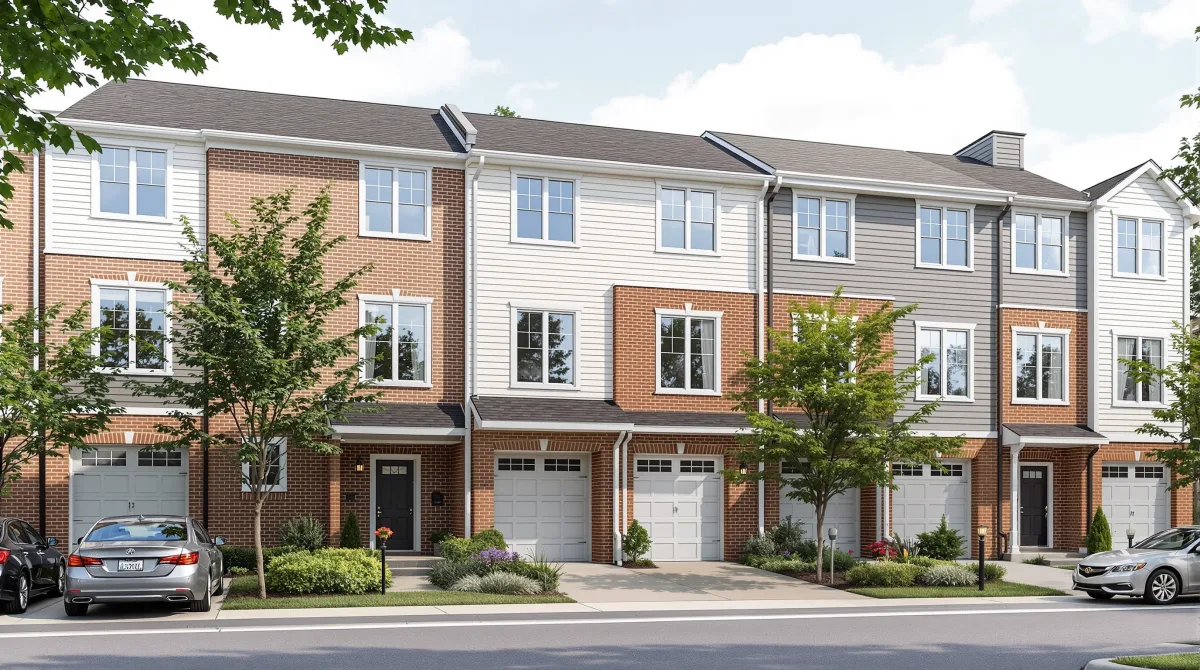
- A fee-simple townhome sits in between, but much closer to the house: you own the entire structure (walls, roof, foundation under your unit) and the lot it stands on. You share party walls with your neighbors, and your lot is small — but it’s yours.
That ownership map is the whole story. Because a townhome owns its building and land, its building systems and site improvements are both depreciable to you — unlike a condo, where they belong to the association.
Why a townhome reclassifies like a house, not a condo.
| Metric | Condo (owns interior only) | Townhome (owns structure + lot) |
|---|---|---|
| 5-year interior (finishes, appliances) | Yes — full | Yes — full |
| 15-year site work (paving, landscaping) | Almost none — HOA owns grounds | Yes — reduced for small lot |
| Building shell / roof / foundation | HOA property | Owner property (27.5-yr) |
| Typical reclassification (long-term) | ~10–19% | ~11–19% |
| As a furnished short-term rental | ~6–36% | ~20–39% |
The Stairs Myth (Why “More Floors” ≠ “More Deduction”)
The single most common thing we hear about townhomes is some version of “it has three floors and a lot of stairs, so there must be more to depreciate.” It’s intuitive, and it’s wrong.
Stairs are structural. The framing, stringers, treads, and landings are part of the building shell — 27.5-year §1250 property — the same recovery period as the walls around them. Adding a floor adds shell, not accelerated property. The only part of a staircase that accelerates is what’s laid on top of it: carpet or a runner (5-year) and the stairwell light fixtures (5-year) — and on any given home that’s a rounding error.
So where does a townhome’s deduction actually come from? Exactly where a house’s does:
- 5-year property — removable interior finishes (carpet, vinyl plank), appliances, removable kitchen and bath fixtures, window treatments, ceiling fans, closet systems.
- 15-year property — the site improvements on your lot: the short driveway or parking pad, walkways, the small landscaped area, any patio or fence.
- 27.5-year property — the structure itself: framing (including those stairs), drywall, roof, plumbing and electrical systems, HVAC.
We model townhomes on the single-family interior profile — the same appliances, finishes, and fixtures a detached home has — with a reduced 15-year site-work allocation to reflect the smaller, often shared lot. That’s the accurate picture, and it’s the conservative one: a townhome lands a few points below a comparable detached home precisely because it has less yard, never above it.
A Worked Example: $650K Long-Term Townhome
The reclassified amount is concentrated in interior finishes and appliances, with a modest slice of 15-year site work for the driveway, walks, and landscaping on the lot. Because 100% bonus depreciation is permanent again, that entire amount is deductible in the first year you own the property rather than dripping out over 27.5 years.
Townhome Short-Term Rentals: The FF&E Stack
A huge share of townhome cost-seg interest comes from vacation markets — Park City, Lake Tahoe, Big Bear, Palm Springs, Mammoth, the Smokies. Townhomes are everywhere in ski and resort towns because they pack more sleeping space onto a small footprint, which is exactly what a short-term-rental operator wants.
When a townhome is run as a furnished short-term rental, two things change:
- Hospitality FF&E gets added. Furniture, mattresses and linens, electronics and TVs, kitchen smallwares, and décor are 5-year personal property that a long-term rental doesn’t carry. This is the big lever — it’s why an STR reclassifies meaningfully more than the same property as a long-term rental.
- The income may be non-passive. If your average guest stay is 7 days or less and you materially participate, the Year-1 deduction can offset active income, including W-2 wages — not just rental income. (Confirm the material-participation tests with your CPA.)
The result is a townhome STR typically landing at 20–39% of basis, most often around 25%, versus the 11–19% of the same townhome held long-term. The building math is identical; the difference is the furniture.
Long-term vs. short-term rental treatment.
| Metric | Long-term rental | Short-term rental (furnished) |
|---|---|---|
| 5-year interior + appliances | Standard residential | Standard + hospitality FF&E |
| Typical reclassification | ~11–19% | ~20–39% |
| Can offset W-2 income? | Only if RE professional | Yes, with 7-day + material participation |
| Study price (residential) | $495–$1,295 | $495–$1,295 |
What’s Different About How We Model It
We treat townhome and townhome short-term rental as their own property types in the engine, rather than forcing you to pick “single-family” or “condo” and getting the wrong mix:
- The interior (5-year finishes, appliances, fixtures) is modeled identically to a detached single-family home — because you own all of it.
- The 15-year site work is trimmed to reflect a small or shared lot — one number, applied transparently, so the study never claims a quarter-acre of landscaping a townhome doesn’t have.
- The structure stays at full residential weight — you own the shell, unlike a condo.
- A townhome STR inherits all of the above and adds the hospitality FF&E layer.
The point is conservatism you can defend: a townhome study should read like a single-family study with a smaller yard, and ours does.
Should You Do It? A Quick Gut Check
A townhome cost seg study makes sense when…
- You own the structure and the lot (fee-simple townhome / townhouse / rowhouse), not just a condo interest.
- Your depreciable basis is meaningful — generally a purchase price of ~$200K or more after land.
- You have rental or other income the deduction can actually offset (or you run it as a short-term rental and materially participate).
- You plan to hold for at least a few years — the benefit is a timing shift subject to recapture at sale.
Scenarios above are illustrative. Outcomes depend on basis, land allocation, tax bracket, and whether the property is furnished and run as a short-term rental. Confirm with your CPA before filing.
Cost Seg Smart is the modern cost segregation company — reports in 1–2 business days, not six weeks, and residential pricing from $495 rather than five-figure fees. If you own a townhome or townhouse, order your study → and the CPA-ready report lands in your inbox in 1–2 business days.
Frequently asked
Do townhomes qualify for cost segregation?
Yes. A fee-simple townhome — one where you own the structure and the lot it sits on — qualifies exactly like a single-family rental. The study reclassifies removable interior finishes, appliances and fixtures (5-year), and the site improvements on your lot (15-year) out of the default 27.5-year residential schedule. A typical long-term townhome reclassifies about 11–19% of its depreciable basis, most often around 12%; run as a furnished short-term rental it typically lands at roughly 20–39%, most often around 25%, once hospitality FF&E is added.
Is a townhome treated like a condo or like a single-family home for cost segregation?
Like a single-family home. The distinction is ownership, not the building's shape. A condo owner holds title to the interior airspace while the HOA owns the shell, foundation, roof, and grounds — so a condo study is concentrated in interior 5-year property with almost no 15-year site work. A townhome owner usually holds title to the whole structure and the lot underneath it, so the building systems and the site improvements are both yours to depreciate. That puts a townhome's reclassification slightly below a detached home (it has a smaller lot and less site work) and clearly above a condo.
Do the extra stairs in a townhome mean more depreciation?
No — and this is the most common misconception. Stairs are structural: the framing, stringers, and landings are part of the 27.5-year building shell (§1250), so adding floors does not add accelerated property. The only accelerated piece of a staircase is what sits on top of it — carpet or a runner and the stairwell light fixtures — which is minor. A townhome's acceleration comes from the same place a house's does: interior finishes, appliances, fixtures, and site work. We model townhomes on the single-family interior profile with a reduced site-work allocation, not on a stair count.
How much can a townhome owner save with cost segregation?
On a $650,000 townhome with roughly $455,000 of depreciable basis, a study typically reclassifies about $60,000–$70,000 into 5- and 15-year property — worth roughly $22,000–$26,000 in Year-1 federal tax at the 37% bracket with 100% bonus depreciation. A furnished short-term-rental townhome at the same basis reclassifies materially more once hospitality FF&E is included. Actual results depend on basis, land allocation, and your bracket.
Can I use the depreciation from a short-term-rental townhome against my W-2 income?
Potentially. If the average guest stay is 7 days or less, the activity is a trade or business rather than a rental under the passive-activity rules, and if you materially participate (typically 100+ hours and more than anyone else), the resulting loss — including Year-1 bonus depreciation — is non-passive and can offset W-2 wages and other active income. A long-term-rental townhome follows the standard passive-activity rules unless you qualify as a real estate professional.
I bought my townhome a few years ago — is it too late?
No. A lookback (catch-up) study lets you claim the depreciation you missed in prior years without amending old returns. Your CPA files a Form 3115 (Change in Accounting Method) with your current-year return under the IRS automatic-consent procedures, and the cumulative missed depreciation flows through in a single year.
How much does a townhome cost segregation study cost?
Townhomes are priced as residential property — the same ladder as a single-family rental. Studies start at $495 for lower-basis properties and run about $995–$1,295 for a typical townhome, delivered as a CPA-ready PDF, within 1–2 business days with no site visit. Traditional firms charge $5,000–$15,000 and take four to six weeks.
Is 100% bonus depreciation still available?
Yes. The One Big Beautiful Bill Act made 100% bonus depreciation permanent for property placed in service on or after January 20, 2025, and for 2026 and beyond. (Property placed in service January 1–19, 2025 is at 40%.) Every dollar reclassified into 5- or 15-year property is fully deductible in the year of acquisition.
Does a cost segregation study increase audit risk?
No. Cost segregation is explicitly supported by the IRS Cost Segregation Audit Techniques Guide (Publication 5653) and Rev. Proc. 87-56. A properly prepared engineering-based study — built from industry-standard construction cost data and backed by quality checks — provides exactly the documentation the IRS expects.