Express Tunnel vs In-Bay vs Self-Serve: How Each Car Wash Type Depreciates
Two car washes with the same square footage can differ by hundreds of thousands of dollars in depreciable equipment. Here's why car-wash cost seg is driven by configuration — tunnel length, vacuum count, reclaim — not building size, and how each format breaks down.
Two car washes with the same square footage can differ by hundreds of thousands of dollars in depreciable equipment. Here's why car-wash cost seg is driven by configuration — tunnel length, vacuum count, reclaim — not building size, and how each format breaks down.
Two car washes with identical square footage can differ by hundreds of thousands of dollars in depreciable equipment. That single fact is why car-wash cost segregation works differently from almost every other property type. For an office or a warehouse, building square footage is a reasonable proxy for cost. For a car wash, it isn’t even close — the value lives in the conveyor, the dryers, the vacuums, and the reclaim system, and those scale with configuration, not floor area.
The count-driven method
A 60-foot tunnel and a 120-foot tunnel might occupy similar buildings but carry very different equipment packages. So instead of estimating from square footage, a credible car-wash study models from the things that actually drive equipment cost:
- Tunnel length (linear feet) — or, for non-tunnel sites, the number of bays.
- Vacuum stalls — often the second-largest equipment line after the tunnel.
- Pay stations and controls — frequently a six-figure category on multi-lane sites.
- Dryers / blowers — high-horsepower units, priced per unit.
- Water reclaim system — present or not, and at what scale.
Those counts drive the 5-year personal property estimate. The 15-year site work — paving, queue lanes, vacuum-pad concrete, drainage, canopies, lighting — scales more reasonably with site size. And documented equipment cost, when you have it, always supersedes the modeled estimate. This is the same philosophy we use for multifamily per-unit systems and restaurant kitchen equipment: model what’s standard, document what’s specific.
Express exterior tunnel
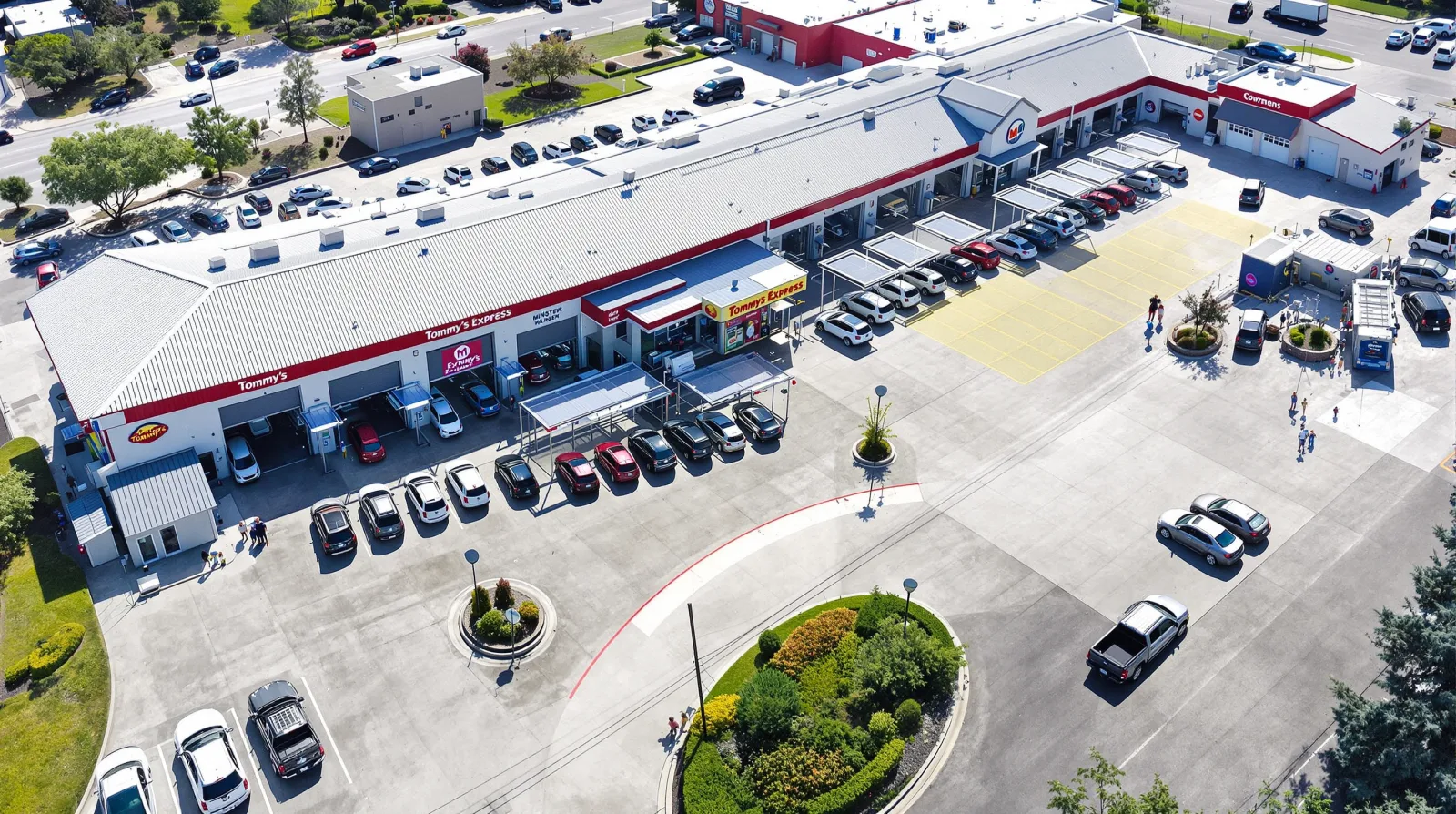
The most equipment-dense format, and the highest acceleration potential. An express tunnel runs cars on a conveyor past a sequence of equipment, then through a large dryer bank, with a big self-serve vacuum lot alongside.
- 5-year: the conveyor and correlator, wash arches and applicators, high-pressure pumps, large dryer banks, the full vacuum lot (often 12–40 stalls), reclaim and chemical systems, multi-lane pay stations and tunnel controls.
- 15-year: extensive paving and stacking/queue lanes (express sites need deep queuing), vacuum-pad concrete, drainage and oil-water separators, canopies, and lot lighting.
- 39-year: a long but simple tunnel structure plus the equipment room and a small office.
This is where you see the headline numbers — well over half the basis frequently lands in accelerated classes when the equipment is documented.
In-bay automatic
A single bay where either gantry equipment travels over a stationary car (rollover) or the car is pulled through a compact in-bay system. Lower equipment intensity than a tunnel, but still a substantial package relative to the building.
- 5-year: the in-bay machine itself (the dominant line), pumps, dryers, reclaim if present, pay station and controls.
- 15-year: apron paving, drainage, signage, lighting, and any vacuum stalls.
- 39-year: the bay structure and equipment room.
In-bay sites often sit at convenience stores or gas stations, where the wash is one profit center among several — the study isolates the wash equipment and site work from the rest.
Self-serve bays
The lightest equipment load per bay, but still a real cost-seg candidate — and the site work is meaningful.
- 5-year: bay equipment (wands, brushes, foamers), the central pump room, R/O and water-treatment equipment, coin/card pay systems, and vacuum stalls.
- 15-year: the bay aprons and paving, drainage, canopies, lighting, and signage.
- 39-year: the open bay structure.
Per bay the equipment is modest, but a multi-bay self-serve site adds up, and the heavy paving and drainage push a healthy share into 15-year property.
What to have ready
Because the model is count-driven, the intake asks for what actually matters:
- Configuration — tunnel length (ft) or number of bays, vacuum stalls, pay stations, dryers, and whether there’s a reclaim system.
- Acquisition scope — did you buy real estate only, or an operating wash? Bundled business purchases often include goodwill and other §197 intangibles that are not depreciable building basis and have to be carved out separately.
- Documentation — a purchase-price allocation, equipment schedule, or invoices. Documented equipment cost is booked at actual value (the most defensible result); without it, we model conservatively from your counts and flag where documentation would help.
See the breakdown on a finished report
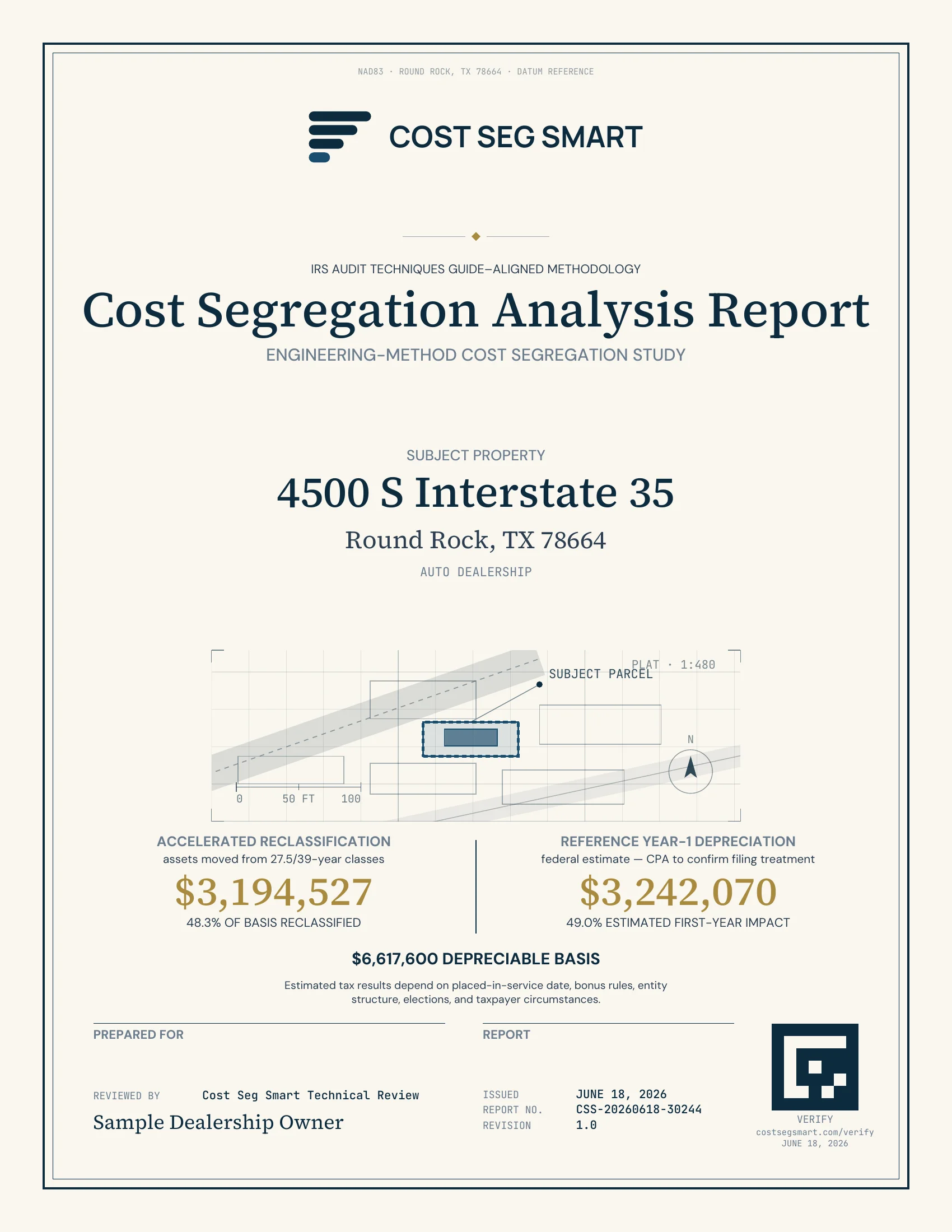
Our car wash sample report walks through a full component-level allocation so you can see exactly how a tunnel, vacuums, reclaim, and site work sort into the MACRS classes. When you’re ready, a car wash study starts at $2,995 and is delivered CPA-ready — and for multi-site operators, see the express car wash portfolio guide.
Cost Seg Smart uses industry-standard construction cost data and IRS-recognized engineering methodology. Component classifications depend on how each item is installed and documented; this article is educational and not tax advice.
Frequently asked
Why isn't a car wash study based on square footage like other commercial properties?
Because the most valuable assets in a car wash don't scale with building size. A 60-foot tunnel and a 120-foot tunnel can sit in similar-size buildings but carry very different conveyor, dryer, and equipment packages. Two 4,500-square-foot washes can differ by hundreds of thousands of dollars depending on tunnel length, vacuum count, whether there's a water-reclaim system, and the conveyor design. A per-square-foot model would under-value big express tunnels and over-value small in-bay sites, so a credible car-wash study is driven by counts and configuration plus documented equipment cost.
What's the difference between express tunnel, in-bay automatic, and self-serve for cost seg?
Express tunnels are the most equipment-dense: a long conveyor, multiple arches, large dryer banks, and big vacuum lots — the highest acceleration potential. In-bay automatics (a single bay where the equipment moves over a stationary car, or the car sits while gantry equipment runs) have a smaller but still significant equipment package. Self-serve bays are the lightest on equipment per bay but still carry meaningful 5-year pumps, R/O systems, and bay equipment, plus the usual 15-year site work. All three are strong cost-seg candidates relative to a typical building; they just have different component mixes.
What information should I provide to get the most accurate car wash study?
The high-value inputs are configuration counts and equipment documentation: tunnel length in feet (or number of self-serve/in-bay bays), number of vacuum stalls, number of pay stations, number of dryers, whether there's a water-reclaim system, and — most importantly — whether wash equipment was included in your acquisition and any purchase-price allocation, equipment schedule, or invoices. Documented equipment cost always takes precedence over a modeled estimate.
Does a water reclaim system change the depreciation?
It can. Water reclamation and treatment equipment is generally 5-year personal property and is a meaningful line item — systems range from modest to several hundred thousand dollars on high-volume sites. Whether a given component is treated as removable 5-year equipment versus part of the 15-year site infrastructure depends on how it's installed and documented, which is one of the things an engineering-based study sorts out.