Multifamily Cost Segregation: What Reclassifies, From Duplexes to 100+ Units
Small multifamily (2–4 units) typically reclassifies 14–28% of depreciable basis through cost segregation, and buildings of 5+ units 14–26%. Worked examples from duplex to 100+ unit apartment complexes.

Small multifamily (2–4 units) typically reclassifies 14–28% of depreciable basis through cost segregation, and buildings of 5+ units 14–26%. Worked examples from duplex to 100+ unit apartment complexes.
Multifamily properties are among the highest-ROI candidates for cost segregation because each unit multiplies the reclassifiable components — kitchens, bathrooms, appliances, flooring, and fixtures are all 5-year personal property under MACRS, and shared building systems (HVAC, fire suppression, parking, landscaping) qualify as 7-year or 15-year property. Typical reclassification runs 14–28% of depreciable basis for two to four units and 14–26% for five or more, depending on building size and common area amenities. All residential rental property — regardless of unit count — depreciates over 27.5 years, not the 39-year commercial schedule (a common misconception). A duplex may accelerate $15,000 to $30,000 in Year 1 deductions, a 20-unit building $100,000 to $200,000, and a 100-unit complex $500,000 or more. With 100 percent bonus depreciation permanently restored under recent federal tax law, these amounts are fully deductible in the year the property is placed in service. For partnerships and syndications, the accelerated depreciation flows to each partner’s K-1 based on ownership percentage. Studies for multifamily 2-4 units start at $995; 5+ units start at $1,995. See a sample cost segregation report for what the finished analysis includes, or compare the full cost segregation study cost breakdown.
Why Multi-Family Is the Sweet Spot for Cost Segregation
Cost segregation for multi-family properties reclassifies building components from the default 27.5-year residential depreciation schedule into 5-year, 7-year, and 15-year MACRS categories using an engineering-based analysis. Multi-family properties produce larger cost segregation benefits than single-family rentals because each unit multiplies the reclassifiable components: every additional unit adds its own kitchen, bathroom, appliances, flooring, and fixtures — all of which qualify as 5-year personal property. A duplex typically accelerates $15,000 to $30,000 in first-year deductions, a fourplex $25,000 to $60,000, and a 100-unit apartment complex $500,000 or more. With 100% bonus depreciation permanently restored under the One Big Beautiful Bill Act (2025+), these reclassified amounts are fully deductible in Year 1. Common accelerated components in multi-family properties include cabinetry, countertops, appliances, flooring, plumbing fixtures, light fixtures, and land improvements such as parking lots, landscaping, fencing, and exterior lighting.
our engineering methodology → See a $1M Multifamily Breakdown
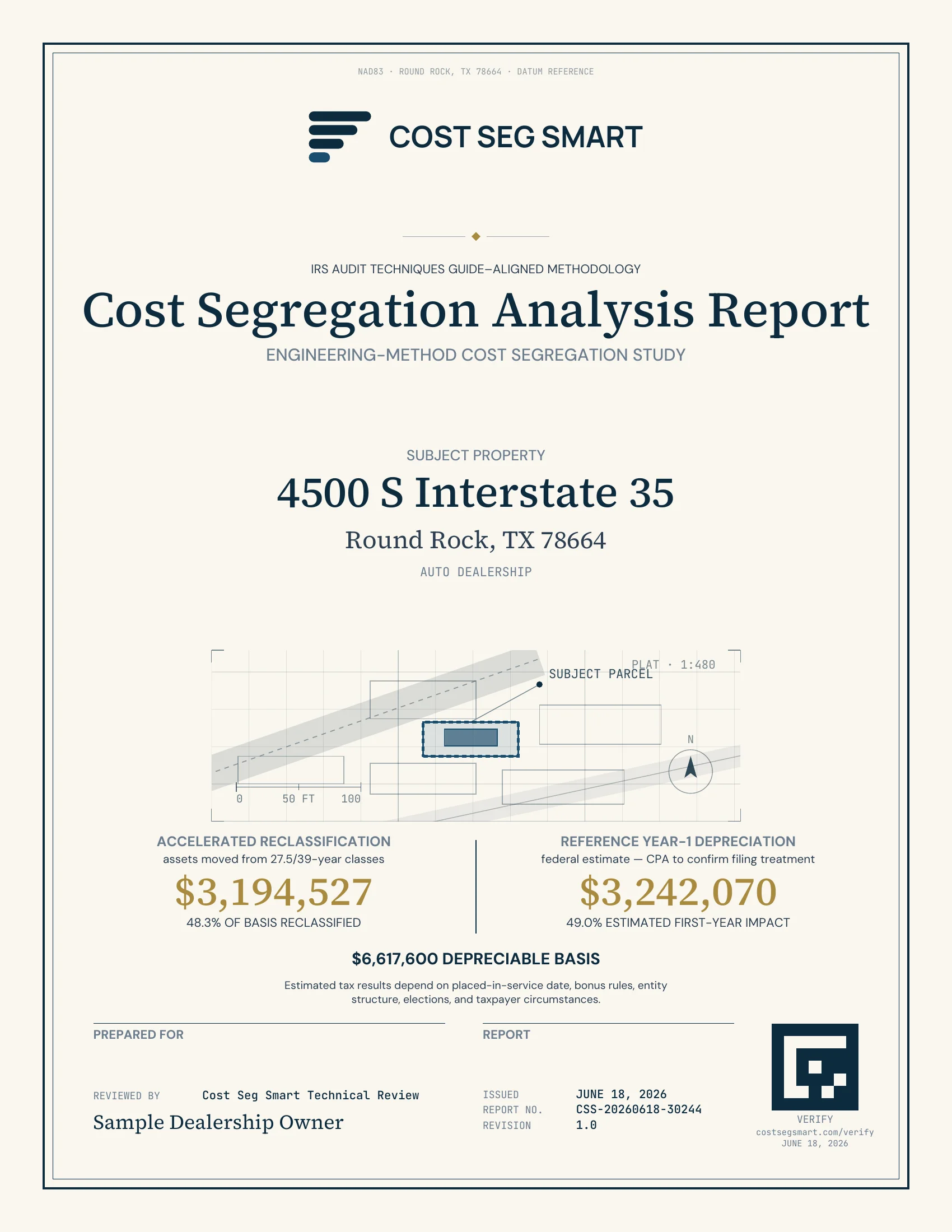
View the detailed MACRS class allocation, per-unit component analysis, and estimated tax savings for a $1M multifamily property. View Multifamily Example →
The Multi-Family Spectrum: Duplexes Through Large Apartments
Multi-family real estate spans a wide range, and each segment has its own cost segregation profile. For multifamily benchmarks by unit count, see our benchmarks page. Let us break down the categories.
Duplexes, triplexes, and fourplexes are the entry point for most real estate investors. These are 2-to-4-unit residential properties. They qualify for residential financing, they are manageable for a first-time landlord (see our guide to house hacking with duplexes), and they are common in nearly every metro area. From a cost seg perspective, small multi-family properties contain duplicate sets of unit-specific components (kitchens, bathrooms, flooring, appliances) that multiply the reclassifiable basis. A fourplex has four complete kitchens and four complete bathrooms. That is four times the cabinetry, countertops, fixtures, and appliances compared to a single-family rental. Not every duplicated system reclassifies, though: our triplex cost segregation guide works through a $600K three-unit building and shows why the extra furnaces and water heaters mostly stay on the 27.5-year schedule while the extra kitchens do not.
5+ unit apartment buildings are where the math really starts to compound. At this scale, you also begin to see significant shared building systems: centralized HVAC, common-area lighting, parking lots, elevators, fire suppression systems, and laundry rooms. Each of these shared systems contains reclassifiable components. A 20-unit building with a central boiler system, paved parking lot, and landscaped common areas can have $50,000 or more in 15-year land improvements alone, before you even count the unit-specific items.
Large apartment complexes (50+ units) represent the highest dollar opportunity. At this scale, there are dedicated maintenance facilities, clubhouses, swimming pools, fitness centers, gated entries, extensive paving, and irrigation systems. The amount of reclassifiable property in a 100-unit garden-style apartment complex is substantial in dollars, because every unit and every amenity adds to it.
| Building Type | Typical Reclassification | Why |
|---|---|---|
| Duplex / Triplex / Fourplex | 14–28% | Unit-level finishes, limited common areas |
| 5+ units | 14–26% | Common area systems, laundry, fitness, landscaping; larger complexes add parking, fire suppression, elevators and amenity packages |
The ranges we publish per property type; most small multifamily studies land around 18% and most 5+ unit studies around 17%. Actual results vary by age, condition, location, and construction quality.
Key point: The more units a property has, the more duplicate building components exist. Each additional unit adds kitchens, bathrooms, flooring, and fixtures, all of which are prime candidates for reclassification to shorter depreciation lives. That is why multi-family consistently produces some of the highest dollar-value cost segregation results in residential real estate.
Run your specific unit count and purchase price through the cost segregation calculator to see where your building falls in the ranges above.
Residential or Commercial? The Depreciation Schedule Question
One of the most common misconceptions in multi-family cost segregation is around depreciation schedules. Many investors assume that once a property crosses the 5-unit threshold, it shifts from residential (27.5-year) to commercial (39-year) depreciation. That is not how it works.
The IRS classification is based on the nature of the property, not the number of units. A 200-unit apartment building where people live in residential units still depreciates over 27.5 years, because it is residential rental property. The 39-year commercial schedule applies to properties like office buildings, retail centers, and warehouses, not to apartment buildings.
The threshold that does matter is four units versus five or more for financing purposes. Properties with 1 to 4 units can use conventional residential mortgages (Fannie Mae, Freddie Mac). Properties with 5+ units require commercial lending. But the depreciation schedule remains 27.5 years for all residential rental property, regardless of unit count.
This is actually good news for multi-family investors. The 27.5-year base schedule is already shorter (and therefore more favorable) than the 39-year commercial schedule. When you layer cost segregation on top of an already-favorable base rate, the acceleration is even more impactful.
What Gets Reclassified in a Multi-Family Cost Seg Study?
A cost segregation study on a multi-family property identifies and reclassifies building components into shorter depreciation categories. Here is what typically gets pulled out of the 27.5-year bucket.
5-Year Property is where the bulk of multi-family reclassification lives. This includes all appliances in every unit (refrigerators, stoves, dishwashers, microwaves, garbage disposals, washer/dryer hookups or units), all cabinetry, countertops, carpet and vinyl flooring, light fixtures, ceiling fans, bathroom vanities, mirrors, towel bars, door hardware, window treatments, and shelving. In a 20-unit building, multiply each of those items by 20. The totals add up quickly.
7-Year Property captures certain specialized items like decorative millwork, built-in furniture in common areas, and some electronic security or access control systems.
15-Year Property (Land Improvements) is a major category for multi-family, especially larger properties. This includes:
- Parking lots and paved driveways
- Sidewalks and curbing
- Landscaping, trees, and irrigation systems
- Fencing and retaining walls
- Outdoor lighting (parking lot lights, pathway lighting)
- Swimming pools and pool decking
- Playgrounds and sport courts
- Signage and monument signs
- Storm drainage and detention systems
For apartment complexes with significant site improvements, the 15-year land improvement category alone can represent 8% to 15% of the total property basis. Add the 5-year and 7-year unit-specific components, and a 5+ unit building typically sees 14–26% of the building basis accelerated into shorter depreciation lives.
Shared building systems deserve special attention in multi-family properties. Central boiler and chiller systems contain components that are classified as personal property (5-year) versus structural (27.5-year). Electrical panels, distribution wiring for dedicated equipment, fire alarm and suppression systems, intercom and access control, and elevator components all contain reclassifiable elements. A cost segregation engineer breaks these systems down to their component level and allocates the appropriate portion to shorter-lived categories.
The Economics: Bigger Basis, Bigger Benefit
The fundamental economics of cost segregation favor multi-family properties for one simple reason: purchase prices tend to be higher, which means the depreciable basis is larger, which means the dollar value of accelerated deductions is larger.
Consider the difference. A single-family rental purchased for $350,000 might yield $40,000 to $60,000 in accelerated first-year deductions from a cost seg study. That is excellent, and the study pays for itself many times over. But a $1.2 million 8-unit apartment building might yield $150,000 to $200,000 in accelerated first-year deductions. A $5 million, 40-unit complex could produce $600,000 or more.
The cost of a study does increase with property value, but nowhere near proportionally. A residential cost seg study on a duplex starts at $995 (under $300K basis). A study on a $5 million apartment complex is $7,995 under our Multifamily 5+ matrix. Meanwhile, the deduction benefit scales almost linearly with basis. The ROI on cost segregation improves dramatically as property values increase, making mid-size and large multi-family properties among the highest-return candidates for this strategy.
| Example: $2M 20-Unit Apartment Building | Amount |
|---|---|
| Purchase price | $2,000,000 |
| Depreciable basis (80%) | $1,600,000 |
| Reclassified to 5/7/15-year (17%, representative) | $272,000 |
| Year 1 tax savings (37% bracket) | ~$100,640 |
| Study cost (MF 5+, $1M–$3M band) | $3,595 |
| ROI on study | ~28x |
Illustrative. Actual results vary by property condition, location, and configuration.
Rule of thumb: If your multi-family property was purchased for more than $300,000 and you plan to hold it for at least a few years, a cost segregation study will almost certainly produce a positive ROI. For properties above $750,000, the benefit is substantial enough that skipping a study is leaving real money on the table.
Example: $1.2 Million 8-Unit Apartment Building
Let us walk through an illustrative example. You purchased an 8-unit apartment building in Indianapolis for $1,200,000. The building was constructed in 2005. Each unit has two bedrooms and one bathroom. The property includes a paved parking lot, landscaping, an outdoor laundry room, and basic common-area improvements.
Without cost segregation: After allocating approximately 20% to land ($240,000), your depreciable basis is $960,000. At straight-line depreciation over 27.5 years, your annual depreciation deduction is roughly $34,909. Predictable, but slow.
With cost segregation: The engineering study identifies and reclassifies the following components:
- 5-year property: $134,400 (8 sets of appliances, 8 kitchens worth of cabinetry and countertops, carpet/vinyl in all units, light fixtures, bathroom fixtures, door hardware, window treatments)
- 7-year property: $9,600 (common-area millwork, security system)
- 15-year property: $76,800 (parking lot, sidewalks, landscaping, fencing, outdoor lighting, drainage)
- Remaining 27.5-year property: $739,200 (structural shell, roof, foundation, load-bearing walls, permanent HVAC ductwork)
With bonus depreciation applied, the 5-year and 7-year property ($144,000 combined) is deducted in Year 1. The 15-year property ($76,800) also qualifies for bonus depreciation. That gives you approximately $220,800 in accelerated first-year deductions, compared to $34,909 under straight-line. At a 37% marginal tax rate, that translates to roughly $81,696 in estimated tax impact in Year 1.
The cost of the study? $3,595 on our Multifamily 5+ matrix. The return on that investment: over 20x.

Lookback Studies: Recapture Years of Missed Depreciation
If you have owned a multi-family property for several years and never ordered a cost segregation study, you are not out of luck. The IRS allows what is called a lookback study (sometimes called a catch-up study), which lets you retroactively claim all the accelerated depreciation you missed since you acquired the property.
Here is how it works. Your CPA files a Form 3115 (Application for Change in Accounting Method) with your current-year tax return. This is an automatic consent procedure, meaning you do not need separate IRS approval. The form calculates the difference between the depreciation you actually claimed (straight-line over 27.5 years) and the depreciation you should have claimed (with the cost seg reclassification). That entire difference, called the Section 481(a) adjustment, flows through your current-year return as a single deduction.
For multi-family investors who have held properties for 3, 5, or even 10 years without a cost seg study, the lookback benefit can be enormous. Consider our $1.2 million apartment building example. If you had owned it for 5 years without cost seg, the cumulative missed accelerated depreciation could be well over $100,000 in additional deductions, all captured in a single tax year.
There is no deadline or lookback limit for filing a 3115. Whether you bought the property 2 years ago or 15 years ago, you can still benefit. The only caveat is that you cannot have already claimed bonus depreciation on the property. If you have been using straight-line depreciation, a lookback study is almost certainly worth exploring.
Bonus Depreciation: 100% Is Back
Bonus depreciation is the mechanism that makes cost segregation so powerful. It allows you to deduct the full cost of qualifying 5-year, 7-year, and 15-year property in the year the asset is placed in service, rather than spreading it over the asset’s class life.
After several years of phase-downs under the original TCJA schedule, the One Big Beautiful Bill Act (OBBBA), signed in July 2025, permanently restored 100% bonus depreciation for qualified property acquired and placed in service after January 19, 2025. Here is the current schedule:
- 2022 and prior: 100% bonus depreciation
- 2023: 80% bonus depreciation
- 2024: 60% bonus depreciation
- 2025 and beyond: 100% bonus depreciation (restored by OBBBA)
This restoration makes now the best time in years to get a cost segregation study done. With 100% bonus depreciation, every dollar reclassified into 5-year, 7-year, or 15-year property is fully deductible in Year 1. For multi-family properties with large reclassifiable bases, the impact is substantial. And if you are doing a lookback study for a property placed in service in 2023 or 2024, your CPA will apply the bonus rate from the original placed-in-service year.
Working with Your CPA
A cost segregation study is an engineering product, but its value is realized through your tax return. That means your CPA is a critical part of the process. Here is how to make the collaboration smooth.
How Cost Segregation Flows Through a K-1
For partnerships and LLCs taxed as partnerships — which is how most multifamily deals are structured — the accelerated depreciation flows to each partner’s K-1 (Schedule K-1, Form 1065) based on ownership percentage. Each partner claims their share on their personal return via Schedule E of Form 1040.
The study is ordered by the entity, not the individual partners. If you’re a 25% owner of a 20-unit building that generates $400,000 in reclassified depreciation, your K-1 reflects $100,000 of that deduction. Passive activity rules still apply at the partner level — material participation is tested individually, not at the entity level.
For syndications, the GP typically orders the study and the LP benefits pass through proportionally. If you’re a limited partner, confirm with the sponsor that a cost segregation study has been (or will be) completed — it’s one of the highest-ROI questions you can ask about a deal.
Before ordering the study, talk to your CPA. Let them know you are considering cost segregation on your multi-family property. They can advise you on whether the deductions will be useful given your specific tax situation, including passive activity rules, at-risk limitations, and your overall income profile. For most multi-family investors, the answer is yes, but your CPA can identify any edge cases.
After receiving the report, hand it directly to your CPA. A well-prepared cost seg report (like those from Cost Seg Smart) is designed to be CPA-ready, meaning it contains the exact depreciation schedules, asset classifications, and supporting documentation your accountant needs to implement the study on your tax return. If you are doing a lookback study, your CPA will prepare the Form 3115 and calculate the Section 481(a) adjustment.
If you’re shopping providers, 10 multifamily-focused firms ranked $795 to $15K are compared at costsegregationreviews.com — scored on apartment-specific component capture, turnaround, and audit defense.
Keep the report in your records. A cost segregation study is a supporting document for your tax return. If the IRS ever questions your depreciation claims, the engineering-based study is your defense. The IRS has explicitly endorsed cost segregation as a legitimate tax planning strategy, and a properly prepared study meets the documentation requirements they expect to see. For a deeper look at what triggers scrutiny and what doesn’t, see our analysis of whether cost segregation increases audit risk. Browse a full sample cost segregation report to see how this works in practice for a multi-family property.
Free preliminary depreciation estimate — property summary, basis allocation, five-year schedule. We do the work; you get the PDF.
See my estimated Year-1 savings →The Bottom Line for Multi-Family Investors
Multi-family properties, from duplexes to large apartment complexes, are among the most effective candidates for cost segregation. The combination of duplicate unit components, shared building systems, significant land improvements, and a favorable 27.5-year base depreciation schedule creates an ideal scenario for acceleration.
If you purchased a multi-family property for $300,000 or more and have not done a cost segregation study, you are very likely leaving meaningful tax deductions unclaimed. For larger properties in the $1 million to $10 million range, the unclaimed deductions could be in the six figures.
The process is straightforward. Order a study, receive your CPA-ready report, and hand it to your accountant. The entire process takes days, not months, and the ROI is typically 20x to 100x the cost of the study.
Multi-family real estate is already one of the best wealth-building vehicles available. Cost segregation is how you make the tax side of the equation work just as hard as the income side.
Cost Seg Smart is the modern cost segregation company. We handle everything from duplexes to 100+ unit apartment buildings. Reports delivered in a day or two, not six weeks. Starting at $495 for small multi-family, not $5,000. You spent hundreds of thousands (or millions) on a multi-family property but won’t spend $995 to save five or six figures in taxes? This isn’t just for institutional investors. Everyone who owns multi-family property should be doing this. Order your multi-family study → and the report ships the next business day.