5 Tax Mistakes Rental Investors Make (+ Fixes)
Each of these five mistakes commonly costs $10K-$50K per property per year — straight-line defaults, missed lookbacks, bonus depreciation left on the table.

Each of these five mistakes commonly costs $10K-$50K per property per year — straight-line defaults, missed lookbacks, bonus depreciation left on the table.
The seven most expensive mistakes rental investors make: using straight-line depreciation on everything (ignoring cost segregation), missing the lookback opportunity on older properties, managing passive losses incorrectly, forgetting to track material participation hours for STRs, ignoring Form 3115 catch-up rules, over-allocating basis to land instead of improvements, and missing bonus depreciation on furniture. Each commonly costs $10K–$50K+ per property per year.
You Might Be Overpaying by Thousands Every Year
The five most costly tax mistakes rental property investors make are: (1) using default 27.5-year straight-line depreciation without a cost segregation study, forfeiting $30,000 to $80,000 in accelerated first-year deductions; (2) failing to claim 100% bonus depreciation on qualifying 5-year, 7-year, and 15-year property components; (3) not filing a lookback study with Form 3115 to recapture missed accelerated depreciation from prior years; (4) incorrectly classifying short-term rental activity as passive when it may qualify as active under the IRS 7-day rule (Treasury Reg. 1.469-1T), which would allow losses to offset W-2 income; and (5) over-allocating land value, which reduces the depreciable basis and shrinks every year’s deduction. On a typical $500,000 rental property, correcting just the first two mistakes can produce $25,000 to $45,000 in additional Year 1 tax savings at a 37% marginal rate.
how cost segregation studies work →
Mistake #1: Depreciating Everything Over 27.5 Years
This is the big one. When you buy a rental property, the IRS lets you depreciate the building (not the land) over 27.5 years for residential or 39 years for commercial. That straight-line depreciation is automatic — your CPA sets it up the year you buy, and it runs on autopilot.
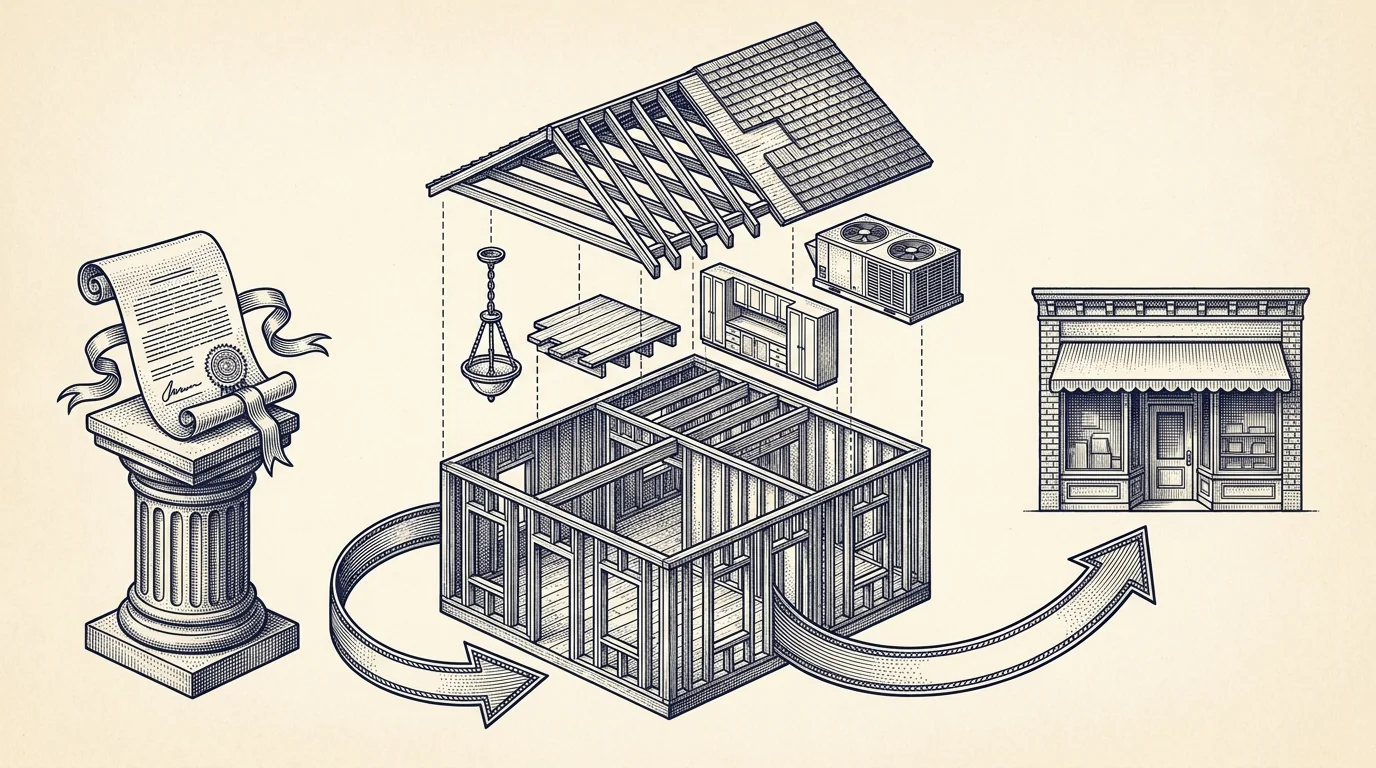
But here’s what most investors miss: not everything in your property has a 27.5-year life. A cost segregation study breaks your property down into its individual components — flooring, cabinetry, appliances, light fixtures, landscaping, paving, plumbing fixtures, electrical outlets, and hundreds of other items — and reclassifies many of them into shorter depreciation categories: 5-year, 7-year, and 15-year property.
For a typical residential rental, somewhere between 20% and 35% of the depreciable basis can be reclassified into these shorter-life categories. That’s a significant chunk of the property’s value that you can depreciate much faster.
Let’s put numbers on it. Say you bought a single-family rental for $500,000. After land allocation, your depreciable basis is roughly $400,000. Without cost segregation, you’re depreciating $400,000 over 27.5 years — about $14,500 per year. With a cost segregation study, you might reclassify $80,000 to $120,000 into accelerated categories. Combined with bonus depreciation (more on that in a moment), that can mean $60,000 to $90,000 in additional first-year deductions.
At a 37% tax bracket, that’s $22,000 to $33,000 in tax savings — in Year 1 alone.
The fix: Get a cost segregation study. This is an engineering-based analysis of your property that identifies every component eligible for accelerated depreciation. Your CPA uses the study to reclassify assets on your tax return. It’s a one-time study that delivers benefits for years.
Mistake #2: Not Taking Advantage of 100% Bonus Depreciation
Cost segregation is valuable on its own, but it becomes dramatically more powerful when combined with bonus depreciation. Bonus depreciation allows you to deduct a large percentage of eligible asset costs in the year the property is placed in service — rather than spreading that deduction over 5, 7, or 15 years.
Here’s the good news: the One Big Beautiful Bill Act (OBBBA), signed in July 2025, permanently restored 100% bonus depreciation for qualified property acquired and placed in service after January 19, 2025. After years of phasedowns, the full deduction is back.
- 2023: 80% bonus depreciation
- 2024: 60% bonus depreciation
- 2025 and beyond: 100% bonus depreciation (restored by OBBBA)
This is the best environment for cost segregation in years. With 100% bonus depreciation, every dollar reclassified into 5-year, 7-year, or 15-year property is fully deductible in Year 1.
Let’s use that same $500,000 rental. If a cost segregation study identifies $100,000 in assets eligible for 5-year and 15-year treatment, here’s how bonus depreciation changes the Year 1 picture:
- At 100% bonus (2025+): $100,000 deducted in Year 1 — the full reclassified amount
- Without bonus depreciation: Those assets depreciate over 5, 7, and 15 years normally — still faster than 27.5, but no first-year windfall
The difference between acting now with 100% bonus depreciation and waiting is potentially tens of thousands of dollars in Year 1 deductions. Congress restored this benefit, but there’s no guarantee it stays forever.
The fix: If you own rental property and haven’t done a cost segregation study, now is the time. With 100% bonus depreciation fully restored, the benefit has never been stronger. Cost segregation studies are relatively inexpensive compared to the deductions they generate — act while the full 100% deduction is available.
Mistake #3: Not Tracking Improvement Costs Separately
You renovate the kitchen for $45,000. You replace the HVAC system for $12,000. You put on a new roof for $18,000. Where do these costs go on your tax return?
Too often, the answer is: they get lumped into the property’s overall basis and depreciated over whatever remains of the 27.5-year schedule. Or worse — some investors accidentally expense items that should be capitalized, or capitalize items that could be expensed under the de minimis safe harbor or repair regulations.
The IRS has detailed rules (under the Tangible Property Regulations) about what constitutes an improvement versus a repair. Improvements must be capitalized and depreciated. Repairs can be expensed in the current year. The distinction matters enormously.
But even among properly capitalized improvements, there’s an additional step most investors skip: each improvement starts its own depreciation schedule. That $45,000 kitchen renovation doesn’t get tacked onto your original 27.5-year clock. It starts a new 27.5-year life from the date it’s placed in service. More importantly, many of the components within that renovation — countertops, cabinets, appliances, flooring — qualify for shorter depreciation lives if they’re identified through a cost segregation analysis.
Think about it this way: you spend $45,000 on a kitchen. Without proper tracking and segregation, you deduct about $1,636 per year for 27.5 years. With proper segregation, you might reclassify $20,000 of that renovation into 5-year property. With 100% bonus depreciation, that’s $20,000 deducted in Year 1 — compared to $727 per year the old way. That’s a $19,273 difference in first-year deductions, just from one renovation.
The fix: Keep detailed records of every improvement you make — not just the total cost, but an itemized breakdown. Separate the cabinets from the countertops from the flooring from the appliances. When it’s time for your tax return, your CPA can properly classify each component. And if the improvement is significant (say, $20,000 or more), consider getting a cost segregation study that covers the improvement specifically.
Mistake #4: Missing the Material Participation Rules for STRs
If you own a short-term rental — an Airbnb, a Vrbo, a vacation rental — there’s a tax advantage available to you that most long-term rental owners can’t access. And most STR owners either don’t know about it or don’t take the steps necessary to claim it.
Here’s the short version: rental activities are generally classified as “passive” under IRC Section 469. That means losses from your rental can usually only offset other passive income — not your salary, not your business income. For most W-2 earners with long-term rentals, this limits how useful depreciation losses actually are.
But the IRS has a specific carve-out: if the average period of customer use is 7 days or fewer, the activity is not classified as a rental activity for passive loss purposes. That’s most short-term rentals. Instead, the STR is treated as a regular business activity.
our Airbnb tax strategy guide →
The second piece of the puzzle is material participation. If you materially participate in your STR — and the IRS has seven tests for this, with the most common being the 500-hour test or the 100-hour test where no one else participates more — then your losses from the STR are treated as non-passive. They can offset your W-2 income, your consulting income, your business income.
When you combine the STR exception with cost segregation, the result can be transformative. An STR owner who materially participates might use accelerated depreciation to create a paper loss of $50,000 to $100,000 or more in Year 1, and deduct that loss directly against their active income. For a high-earning W-2 professional, that can mean $20,000 to $40,000 in actual tax reduction.
The fix: If you own an STR, talk to your CPA about the material participation tests and whether you qualify. Keep a detailed log of your hours — guest communication, pricing adjustments, maintenance coordination, cleaning oversight, bookkeeping, everything. The documentation is what makes this defensible if the IRS ever asks. And if you haven’t paired this with a cost segregation study, you’re leaving the most powerful part of the strategy on the table.
Mistake #5: Waiting Too Long to Do a Lookback Study
This one catches a lot of investors off guard. Let’s say you bought a rental property five years ago and have been depreciating everything over 27.5 years. You just learned about cost segregation. Is it too late?
No. Not even close. And every year you continue to wait is another year of missed deductions.
The IRS allows you to do what’s called a “lookback study” or a “catch-up” through Form 3115 (Application for Change in Accounting Method). Here’s how it works: you get a cost segregation study done on your property as of the original placed-in-service date. The study identifies all the components that should have been classified into shorter depreciation lives from the beginning. Then, using Form 3115, you claim all the missed accelerated depreciation in a single year — no amended returns needed.
Read that again: all the missed depreciation in a single year.
If you bought a $750,000 property five years ago and a cost segregation study identifies $150,000 in assets that should have been on 5-year or 15-year schedules, the cumulative missed depreciation could easily be $80,000 to $100,000. All of that flows through as a deduction on your current-year tax return via the Section 481(a) adjustment.
The catch-up is filed as a change in accounting method, which the IRS allows as an automatic consent change — meaning you don’t need to request permission. Your CPA files Form 3115 with your return, and the adjustment is taken in the year of change.
The mistake investors make is assuming the ship has sailed. They think cost segregation is only for new acquisitions. It’s not. A lookback study can be done on any property you currently own, regardless of when you bought it. The only requirement is that you still own the property.
The fix: If you own a rental property purchased in any prior year and never had a cost segregation study done, a lookback study with Form 3115 can recover years of missed deductions in a single tax year. There’s no expiration date on this strategy — but every additional year you wait is one more year of optimal deductions you’re not taking. Talk to your CPA about whether a catch-up makes sense for your portfolio. We publish worked examples and a §481(a) calculator at catchupdepreciation.com so you can sanity-check the math on a few properties before that conversation.
The Common Thread
Look at these five mistakes together and a pattern emerges. Every one of them comes back to the same core issue: most rental property investors are depreciating their properties in the simplest way possible, and “simple” isn’t the same as “optimal.”
The tax code is complex, but the strategies available to real estate investors are well-established. Cost segregation, bonus depreciation planning, proper improvement tracking, the STR material participation exception, and lookback studies are all tools that have been in the code for years. They’re used by sophisticated investors and real estate-focused CPAs every day.
The gap isn’t in the tax code — it’s in awareness. Most investors don’t know these strategies exist, and most generalist CPAs don’t proactively suggest them. That’s not a knock on generalist CPAs. The tax code is vast, and real estate tax strategy is a specialty within a specialty. But it does mean the responsibility falls on you as the investor to ask the right questions.
If you’re reading this and recognizing yourself in one or more of these mistakes, that’s actually good news. It means there’s money to reclaim. Start by talking to your CPA about which of these strategies apply to your situation. If your CPA isn’t familiar with cost segregation or the STR material participation rules, consider getting a second opinion from a real estate-focused tax professional.
The numbers are real. The strategies are proven. The only mistake now would be doing nothing about it.
Cost Seg Smart is the modern cost segregation company. We deliver engineering-based, CPA-ready reports in a day or two, not six weeks. Starting at $495, not $5,000. You spent hundreds of thousands on a rental property but won’t spend $895 to fix the biggest tax mistake on this list? This isn’t just for people who can afford five-figure studies. Everyone who owns rental property should be doing this. You can get it done right now.
Free preliminary depreciation estimate — property summary, basis allocation, five-year schedule. We do the work; you get the PDF.
See my estimated Year-1 savings →Frequently Asked Questions What is the biggest tax mistake rental property investors make?
Using standard straight-line depreciation without a cost segregation study. Under straight-line, the entire building depreciates over 27.5 years, producing roughly $14,500/year on a $400K basis. A cost segregation study reclassifies 15-30% of the basis into 5-year, 7-year, and 15-year MACRS categories eligible for 100% bonus depreciation. On a $500K property, this can increase Year 1 deductions from $14,500 to $80,000+. The difference in Year 1 tax savings alone is often $15,000-$40,000. Cost Seg Smart studies start at $495 with delivery usually within the same business day. Can I fix missed depreciation from prior years without amending returns?
Yes. A lookback cost segregation study with IRS Form 3115 (Change in Accounting Method) lets you claim all missed accelerated depreciation from prior years on your current-year return. No amended returns are required. This is an automatic-consent filing under Revenue Procedure 2015-13. The cumulative missed depreciation is taken as a single Section 481(a) adjustment. Whether you bought the property 2 years ago or 10 years ago, the lookback captures the full missed amount. Should STR owners treat their rental as a business for tax purposes?
STR owners who materially participate in their short-term rental (average guest stay under 7 days, per IRC Section 469) may be able to classify their rental activity as non-passive. This allows rental losses — including accelerated depreciation from cost segregation — to offset active income like W-2 wages. Standard passive activity rules limit rental losses to $25,000/year for most taxpayers. The material participation exception removes this cap for qualifying STR owners. This distinction can mean the difference between $25,000 and $80,000+ in usable Year 1 deductions. How do I know if my CPA is handling my rental depreciation correctly?
Check your Form 4562 (Depreciation and Amortization) attached to your Schedule E. If you see only one line item for the building at 27.5 years with no separate entries for 5-year, 7-year, or 15-year property, your CPA is using straight-line depreciation without cost segregation. This is the default approach most generalist CPAs take. Ask your CPA whether cost segregation has been considered. If they are not familiar with the strategy, consider consulting a real estate-focused tax professional or ordering a study from Cost Seg Smart to give them the data they need.
Frequently asked
What is the biggest tax mistake rental property investors make?
Using standard straight-line depreciation without a cost segregation study. Under straight-line, the entire building depreciates over 27.5 years, producing roughly $14,500/year on a $400K basis. A cost segregation study reclassifies 15-30% of the basis into 5-year, 7-year, and 15-year MACRS categories eligible for 100% bonus depreciation. On a $500K property, this can increase Year 1 deductions from $14,500 to $80,000+. The difference in Year 1 tax savings alone is often $15,000-$40,000. Cost Seg Smart studies start at $495 with delivery usually within the same business day.
Can I fix missed depreciation from prior years without amending returns?
Yes. A lookback cost segregation study with IRS Form 3115 (Change in Accounting Method) lets you claim all missed accelerated depreciation from prior years on your current-year return. No amended returns are required. This is an automatic-consent filing under Revenue Procedure 2015-13. The cumulative missed depreciation is taken as a single Section 481(a) adjustment. Whether you bought the property 2 years ago or 10 years ago, the lookback captures the full missed amount.
Should STR owners treat their rental as a business for tax purposes?
STR owners who materially participate in their short-term rental (average guest stay under 7 days, per IRC Section 469) may be able to classify their rental activity as non-passive. This allows rental losses — including accelerated depreciation from cost segregation — to offset active income like W-2 wages. Standard passive activity rules limit rental losses to $25,000/year for most taxpayers. The material participation exception removes this cap for qualifying STR owners. This distinction can mean the difference between $25,000 and $80,000+ in usable Year 1 deductions.
How do I know if my CPA is handling my rental depreciation correctly?
Check your Form 4562 (Depreciation and Amortization) attached to your Schedule E. If you see only one line item for the building at 27.5 years with no separate entries for 5-year, 7-year, or 15-year property, your CPA is using straight-line depreciation without cost segregation. This is the default approach most generalist CPAs take. Ask your CPA whether cost segregation has been considered. If they are not familiar with the strategy, consider consulting a real estate-focused tax professional or ordering a study from Cost Seg Smart to give them the data they need.