First-Time Airbnb Owner? The Cost Seg Playbook
Most CPAs don't mention the 100-hour rule until March — when last year's hours can't be reconstructed. The Day 1 playbook for first-year STR owners.

In year one, do three things from the day you close: keep a running hour log, check your average guest stay every month, and order the cost segregation study before you file. Losses offset W-2 income only if the average stay is 7 days or less and you materially participate, usually 100+ hours and more than anyone else.
What first-time Airbnb owners most often miss: the material participation rules, usually the 100-hour test. Most CPAs don’t bring it up until March, when the prior tax year’s hours can’t be reconstructed. If you want to offset W-2 income with short-term rental losses — which is the whole point of the STR tax loophole — you need to log hours and monitor your average guest stay starting the day you close. This post walks through what to track, the rules behind it, and the three mistakes that cost first-year owners the most money.
If you bought your first Airbnb this year and nobody mentioned the 100-hour material participation rule, you’re not crazy. Most CPAs won’t bring it up until March — when it’s too late to fix the documentation for the prior year. Cost seg is the biggest deduction you’ll claim in Year 1, and most of the value is locked behind one specific regulation (IRC Section 469) that nobody explains until you’ve already lost the opportunity to qualify.
This isn’t complicated, but it does require you to know a few things the day you close. Everything below is what a good real-estate-focused CPA would tell a first-time STR owner in their first meeting. If your CPA didn’t say this, they’re probably just not a cost seg specialist — most general-practice CPAs aren’t.
The 7-day rule — why STRs are different from long-term rentals
The entire tax advantage of an STR over a long-term rental comes from one regulation: Treasury Regulation 1.469-1T(e)(3)(ii)(A). It says that if your average rental period is 7 days or less (the 7-day rule), the property isn’t treated as a “rental activity” for passive loss purposes. It’s treated as a business. And business losses, unlike rental losses, can offset your W-2 or other active income if you materially participate.
The 7-day average stay rule
The “average” is calculated across all stays in the tax year. Total nights rented, divided by number of stays. If you had 48 stays totaling 310 nights, your average is 6.46 — under the 7-day threshold.
A handful of 8-day stays can push the average over. This is the single most common way first-time owners accidentally disqualify themselves. Monitor it monthly — not in April.
This is different from the “14 days or less” rule for personal use. That rule is about whether rental income is taxable at all. The 7-day rule is about whether losses are passive. Two totally separate tests. First-time owners often confuse them.
Material participation — the 100-hour rule nobody explains
Even if your STR qualifies under the 7-day rule, losses are still passive unless you materially participate. The IRS gives seven possible tests for material participation (Treasury Regulation 1.469-5T). For a deeper walkthrough, see our material participation guide. For most STR owners, the realistic path is Test #3:
The individual participates in the activity for more than 100 hours during the taxable year, and such individual’s participation in the activity for the taxable year is not less than the participation in the activity of any other individual (including individuals who are not owners of interests in the activity) for such year. (Treas. Reg. §1.469-5T(a)(3))
The other realistic path is Test #1, more than 500 hours in the year, which ignores how many hours anyone else put in.
Read that second clause carefully. You need to log 100+ hours and at least as many hours as anyone else on the property, including your cleaners and handyman. If you hired a property manager who spent 200 hours on your rental, you lose — the manager participated more than you did, regardless of your own hour count. This is why owner-operated STRs pass more easily than property-manager-operated STRs.

The regulation lets you prove hours by “any reasonable means” (Treas. Reg. §1.469-5T(f)(4)): a spreadsheet, calendar, Toggl, whatever. In practice a log kept during the year carries far more weight than one reconstructed in March.
What counts toward your hours
| Activity | Counts? | Notes |
| Guest communication (messages, calls) | Yes | Including after hours |
| Check-ins / check-outs | Yes | Whether in-person or remote |
| Cleaning (if you do it) | Yes | If hired out, only your supervision time |
| Maintenance, repairs, supply runs | Yes | Log travel time separately; whether it counts is less settled |
| Listing management, pricing updates | Yes | Photo updates, description tweaks |
| Bookkeeping, expense tracking | Usually | Counts as day-to-day operations when you run the rental; reviewing statements purely as an investor does not |
| Marketing (Instagram, website, etc.) | Yes | Directly related to rental |
| Time spent at the property as a guest | No | Personal use doesn’t count |
| Leisure time at the property during a work trip | No | Log only the hours you actually worked |
| Education / reading about real estate | No | Investor education is excluded |
A hundred hours sounds like a lot. It isn’t. If you handle your own guest communication, do a cleaning run every couple months, and spend an hour a week on bookkeeping and listing management, you’ll cross 100 by mid-year. The constraint isn’t the volume of work — it’s proving you did it. Which brings us to documentation.
How to document without making it weird
Any reasonable record works: a spreadsheet, a shared calendar, a time-tracking app, or a messaging history with timestamps. What rarely survives an exam is a round-number estimate put together in April once you realize you needed one. Keep the record during the year, not after. For a ready-made format, see our STR material participation time log.
Easiest setup: a Google Sheet with three columns (date, activity, hours). Takes 30 seconds per entry. Add to it whenever you do something for the rental. If you don’t add to it for two weeks, add entries from memory with a note (“added from messages/calendar, week of X”). Imperfect is fine. Missing is not.
Cost seg + Year 1 = the biggest deduction you’ll ever see
If you’ve handled the 7-day rule and material participation, STR losses can offset W-2 or active business income. This is where cost segregation turns into a very large number.
A cost seg study reclassifies parts of your property from 27.5-year straight-line depreciation into 5, 7, and 15-year classes. With full bonus depreciation currently allowed, every dollar reclassified into a short-life class is deductible in Year 1. For a furnished STR, the numbers get serious because the FF&E — furniture, fixtures, and equipment — is almost all 5-year property.
What FF&E includes for a typical STR
Furniture: beds, mattresses, sofas, chairs, tables, dressers, desks, outdoor patio furniture
Appliances & electronics: TVs, smart home devices, coffee makers, toasters, blenders, BBQ, hot tubs (yes, really)
Soft goods: bedding, towels, kitchenware, rugs
Décor: art, mirrors, lamps, curtains, decorative items
Furniture and appliances used in a rental are 5-year property. Lower-cost items, up to $2,500 per invoice or item, can often be expensed outright under the de minimis safe harbor election instead. On a $420K furnished cabin, FF&E is commonly $30K–$60K.
Combine building reclassification (15-year site improvements, 5-year personal property inside the building) with FF&E, and a furnished STR typically reclassifies 19–39% of its depreciable basis, against 5–32% for a single-family rental. On a $400K STR with $320K of depreciable basis, a typical 26% is about $83,200 of Year 1 deductions. At a 37% federal bracket offsetting W-2 income, that is about $30,784 of tax. See our benchmarks post for typical reclassification percentages by property type.
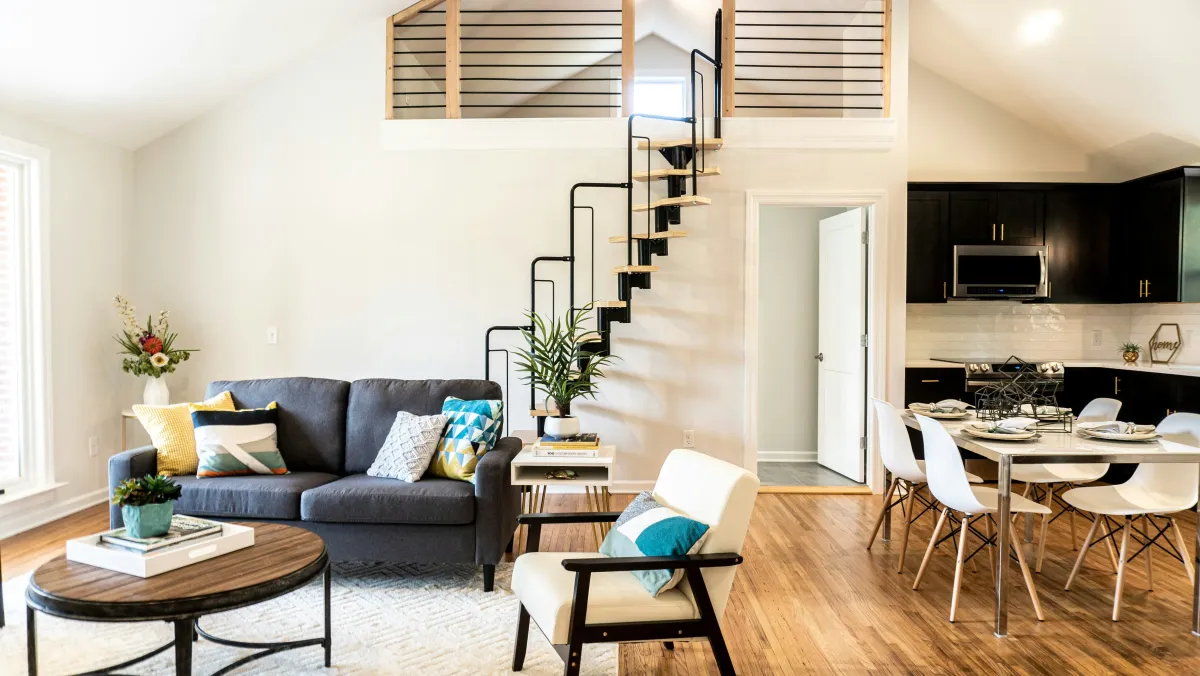
Furniture, appliances and décor in a furnished Airbnb are 5-year property, often the largest single block of a study.
The three mistakes first-time STR owners make
Mistake 1: Not logging hours until April
By far the most common. The first return rolls around, the CPA asks about material participation, and the owner realizes they’ve been hosting for nine months with no hour log. Reconstructing from calendars and message history gets you part of the way, but a log kept during the year is far more persuasive in an exam. Fix this by starting a simple spreadsheet the day you close.
Mistake 2: Skipping cost seg in Year 1
First-year losses are the biggest because bonus depreciation front-loads everything. If you delay cost seg to Year 2 or later, you’re still eligible (via a Form 3115 lookback), but you’ve already filed a Year 1 return on straight-line, and the catch-up lands in a later year, when your material participation may look different. On a typical $400K STR the study fee is $895, against the Year 1 deduction above. If you plan to hold for more than a few years, skipping Year 1 rarely makes sense. Real math for smaller STRs is here.
Mistake 3: Personal use that disqualifies the property
If you use the property personally for more than the greater of 14 days or 10% of the days it is rented at a fair price, the IRS treats it as a residence under IRC §280A. Your deductions are then capped at the rental income, which eliminates the STR loss entirely. “Personal use” includes stays by family members, even at full price unless it is their main home, and anyone paying below-market rent. If you want to stay at your own rental sometimes, keep it to 14 days or fewer and document it. The 10% alternative only helps a property rented more than 140 days a year.
If your expected average stay is over 7 days. Some markets (extended-stay corporate rentals, monthly vacation rentals) default to longer stays. If the average creeps over 7, you’re back in rental-activity territory and the W-2 offset disappears. It’s still a business you can run profitably, but the tax math is less aggressive.
If you’re in the 12% or 22% federal bracket. Deductions are only worth your marginal rate. A $100K deduction is worth $22K at 22% vs $37K at 37%. The strategy still works, but the return is proportional.
That’s the honest version. For most owner-operated STRs where the owner has W-2 income in the 24–37% bracket and plans to hold 3+ years, the playbook above is the single best tax move available in real estate. For a broader view of how cost seg applies across all STR scenarios, see our full Airbnb cost seg guide.
What to do this week
If you’re reading this in Year 1 of your first STR, here’s the short list:
- Start logging hours today. Google Sheet, date + activity + hours, add entries whenever you do something for the rental.
- Check your average stay every month. Total nights ÷ total stays. Flag if you’re trending over 7.
- Order a cost seg study for Year 1. Don’t wait until next April — your Year 1 deductions should reflect the study, which means ordering it before you file. Our calculator gives you a real estimate in 60 seconds.
- Find a CPA who does cost seg regularly if yours hasn’t mentioned any of the above. Our CPA partner directory is one place to start.
- Keep a separate bank account and credit card for the rental. Mixing personal and business expenses makes every deduction harder to support.
If you bought the property in a prior year and never did any of this, the deductions aren’t lost. Form 3115 lets you catch up on missed depreciation without amended returns, at the bonus rate for the year you placed the property in service. The cost seg playbook still works; you just do it as a lookback instead of a Year 1 filing. For the full range of STR deductions beyond depreciation, see 7 STR tax deductions most owners miss.
See your specific STR tax savings
Run your property in 60 seconds. Tied to your purchase price, bracket, and STR classification. No signup, no obligation. See your numbers → · Order your STR study →
Free preliminary depreciation estimate — property summary, basis allocation, five-year schedule. We do the work; you get the PDF.
See my estimated Year-1 savings →For how this compares with the long-term-rental route, see do I need real estate professional status?
Frequently asked
Do I need real estate professional status to offset W-2 with STR losses?
No, and this is one of the biggest advantages of the STR play over long-term rentals. Real Estate Professional Status (REPS) requires 750+ hours and more than half your working time in real estate, which is very hard with a full-time W-2 job. The 7-day rule gives you a different path: if the average guest stay is 7 days or less, the property is not a rental activity, and you need only materially participate in it. For most owners that means 100+ hours and more than any other individual, or 500+ hours. No REPS required.
How much does a cost segregation study cost for a first-time Airbnb?
Cost Seg Smart prices each study by property type and purchase price, and the schedule is published on our pricing page. For a typical first-time STR the fee is in the hundreds of dollars, not the thousands traditional firms commonly charge. On a $400K–$800K furnished STR, the Year 1 bonus deduction is commonly $80K–$170K, which is roughly $20K–$60K of federal tax depending on your bracket, if the loss is usable this year.
What if I bought my Airbnb last year and didn't do cost seg?
You can still do it. Form 3115 (Change in Accounting Method) lets you catch up the depreciation you missed in prior years as a single adjustment on your current return, without amended returns. The catch-up uses the bonus rate for the year the property was placed in service, not today's rate. A property placed in service in 2024 gets 60% bonus on the reclassified components, with the remaining 40% depreciated normally, while one acquired after January 19, 2025 gets 100%. Whether the catch-up offsets W-2 income depends on your material participation in the year you file it.
Can I use a property manager and still qualify?
You can use one, but it makes material participation harder. The 'more hours than anyone else' test means if your manager logs 300 hours and you log 150, you fail — even though you cleared the 100-hour minimum. Some owners use a limited-service property manager (pricing, marketing only) and handle guest communication themselves. Others self-manage entirely. If your manager is full-service and handles everything, the STR tax play generally doesn't work.
Do I need to live near my Airbnb to materially participate?
No. Remote management counts. What matters is the hours you put in and who else participated, not your proximity. Many out-of-state STR owners qualify through guest communication, pricing, remote maintenance coordination and periodic trips to the property. Whether the travel time itself counts is less settled, so log it separately from the work you did on arrival and don't depend on it to clear 100 hours.