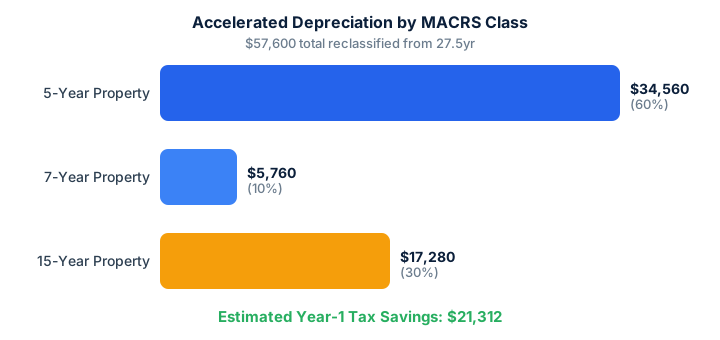
Long-term rental investors face passive activity loss rules that change the cost segregation equation — but the math still works for most investors.
| MACRS Class | Amount | % of Accelerated | Bonus Eligible |
|---|---|---|---|
| 5-Year Property | $34,560 | 60% | Yes — 100% |
| 7-Year Property | $5,760 | 10% | Yes — 100% |
| 15-Year Property | $17,280 | 30% | Yes — 100% |
| 27.5yr Property | $262,400 | 82% | No — standard schedule |
| Total Depreciable Basis | $320,000 | 100% | — |
| Method | Year-1 Deduction | Difference |
|---|---|---|
| Standard Straight-Line (27.5yr) | $11,636 | — |
| With Cost Segregation + Bonus | $57,600 | +$45,964 |
The biggest difference between cost segregation for STRs and long-term rentals is the passive activity loss limitation. Long-term rental income is classified as passive, which means the accelerated depreciation deductions can only offset other passive income — unless you qualify for an exception. This doesn't make cost segregation worthless, but it does change the strategy.
Exception #1: The $25K allowance. If your modified AGI is under $100K, you can deduct up to $25K in passive rental losses against ordinary income. This phases out between $100K-$150K AGI. For investors under the threshold, a $400K rental generating $57K in accelerated depreciation delivers $9,250 in immediate tax savings ($25K × 37%) plus carryforward for the remaining $32K.
Exception #2: Real Estate Professional status. If you (or your spouse) spend 750+ hours per year in real estate activities AND more than half your working time is in real estate, all your rental income becomes non-passive. This is the path portfolio investors use to unlock the full benefit of cost segregation across multiple properties.
Even without either exception, cost segregation creates suspended passive losses that carry forward indefinitely. These losses are released in two scenarios: (1) when you earn enough passive income in future years (from this or other rentals), or (2) when you sell the property — at which point all suspended losses are fully deductible against the gain. Many investors find that the carryforward alone is worth the study cost, because it shelters capital gains at sale.
| Price | Accelerated | Tax Savings | Study Cost | ROI |
|---|---|---|---|---|
| $300K | $43,200 | $15,984 | $795 | 20x |
| $500K | $72,000 | $26,640 | $795 | 34x |
| $750K | $108,000 | $39,960 | $795 | 50x |
| $400K | $57,600 | $21,312 | $795 | 27x |
| $600K | $86,400 | $31,968 | $795 | 40x |
| $1M | $144,000 | $53,280 | $1,195 | 45x |
| Property Type | Accelerated | Tax Savings | Study Cost | ROI |
|---|---|---|---|---|
| Airbnb / Short-Term Rental | $108,800 | $40,256 | $795 | 51x |
| Rental Property | $57,600 | $21,312 | $795 | 27x |
A cost segregation study is an engineering-based analysis that reclassifies components of your property into shorter IRS depreciation categories (5, 7, and 15 years) instead of the default 27.5 or 39 years. This accelerates your depreciation deductions, reducing your tax bill in the early years of ownership.
For long-term rentals, depreciation deductions are generally passive and can only offset passive income. However, there are two key exceptions: (1) if your AGI is under $150K, you can deduct up to $25K in passive losses against ordinary income, and (2) if you qualify as a Real Estate Professional (750+ hours/year in real estate), all rental income becomes non-passive. STR owners who materially participate can deduct against W-2 income regardless.
Yes. The economics of cost segregation are determined by the property value and your tax bracket, not the number of properties you own. A single $400K rental property typically generates $21K in first-year tax savings — more than enough to justify the $795 study cost. The deductions carry forward if they exceed your current-year passive income.
Generally, cost segregation delivers positive ROI on properties valued at $200K and above for investors in the 24%+ tax bracket. The study cost starts at $795 for residential properties, and even a $200K rental generates roughly $10K in first-year tax savings — a 12x return on the study cost.
When you sell a property, the IRS recaptures accelerated depreciation at a maximum rate of 25%. However, the time value of money strongly favors taking the deduction now: $50K in tax savings today is worth far more than paying $12,500 in recapture tax years later. Additionally, a 1031 exchange can defer recapture indefinitely.
Get a professional, IRS-defensible cost segregation study delivered in 3-5 business days. Starting at $795.
Order Your Study →Related Examples