Dallas-Fort Worth has the largest investor-landlord population in Texas, with sprawling suburban SFR corridors and no state income tax to complicate the math.
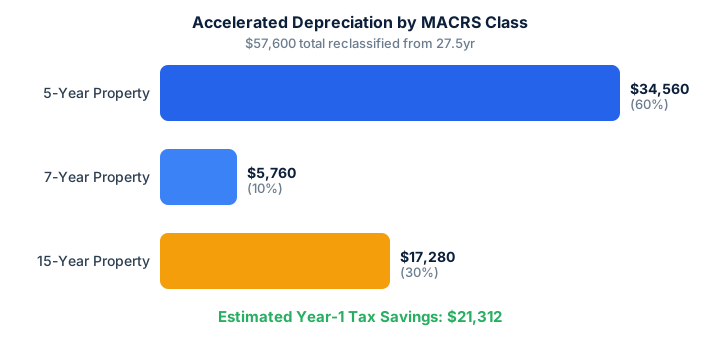
| MACRS Class | Amount | % of Accelerated | Bonus Eligible |
|---|---|---|---|
| 5-Year Property | $34,560 | 60% | Yes — 100% |
| 7-Year Property | $5,760 | 10% | Yes — 100% |
| 15-Year Property | $17,280 | 30% | Yes — 100% |
| 27.5yr Property | $262,400 | 82% | No — standard schedule |
| Total Depreciable Basis | $320,000 | 100% | — |
| Method | Year-1 Deduction | Difference |
|---|---|---|
| Standard Straight-Line (27.5yr) | $11,636 | — |
| With Cost Segregation + Bonus | $57,600 | +$45,964 |
The Dallas-Fort Worth metroplex is the single largest market for investor-owned single-family rentals in Texas — and arguably in the entire Sun Belt. The combination of strong population growth, corporate relocations (Toyota, Schwab, Goldman Sachs), and an affordable suburban housing stock creates a steady pipeline of rental demand. Investors routinely purchase SFRs in suburbs like Frisco, McKinney, Allen, and Prosper for $350K-$500K with immediate rental yields.
Texas has no state income tax, which simplifies the cost segregation calculus: every dollar of accelerated depreciation flows directly to federal tax savings at your marginal rate. For a $400K Dallas rental, cost segregation typically reclassifies $57K into shorter MACRS classes, generating roughly $21K in first-year federal tax savings. There's no state-level recapture or complexity to worry about.
The DFW investor community is unusually organized — local REI meetups, investor-focused brokerages, and property management companies all actively recommend cost segregation as part of the acquisition process. Many Dallas investors time their purchases in Q4 specifically to maximize first-year depreciation deductions. If you close on a property in November or December, you get the full year's cost segregation benefit on your current tax return.
| Price | Accelerated | Tax Savings | Study Cost | ROI |
|---|---|---|---|---|
| $300K | $43,200 | $15,984 | $795 | 20x |
| $500K | $72,000 | $26,640 | $795 | 34x |
| $750K | $108,000 | $39,960 | $795 | 50x |
| $400K | $57,600 | $21,312 | $795 | 27x |
| $600K | $86,400 | $31,968 | $795 | 40x |
| $1M | $144,000 | $53,280 | $1,195 | 45x |
| Property Type | Accelerated | Tax Savings | Study Cost | ROI |
|---|---|---|---|---|
| Airbnb / Short-Term Rental | $108,800 | $40,256 | $795 | 51x |
| Rental Property | $57,600 | $21,312 | $795 | 27x |
A cost segregation study is an engineering-based analysis that reclassifies components of your property into shorter IRS depreciation categories (5, 7, and 15 years) instead of the default 27.5 or 39 years. This accelerates your depreciation deductions, reducing your tax bill in the early years of ownership.
For long-term rentals, depreciation deductions are generally passive and can only offset passive income. However, there are two key exceptions: (1) if your AGI is under $150K, you can deduct up to $25K in passive losses against ordinary income, and (2) if you qualify as a Real Estate Professional (750+ hours/year in real estate), all rental income becomes non-passive. STR owners who materially participate can deduct against W-2 income regardless.
Our studies are delivered in 3-5 business days. You provide the property address, purchase price, and closing date — we handle everything else using assessor records, satellite imagery, and construction cost databases. No site visit or tenant disruption required.
Get a professional, IRS-defensible cost segregation study delivered in 3-5 business days. Starting at $795.
Order Your Study →Related Examples