Atlanta is the cash-flow rental capital of the Southeast, with affordable entry points and rent-to-price ratios that make cost segregation math work even on modest properties.
| MACRS Class | Amount | % of Accelerated | Bonus Eligible |
|---|---|---|---|
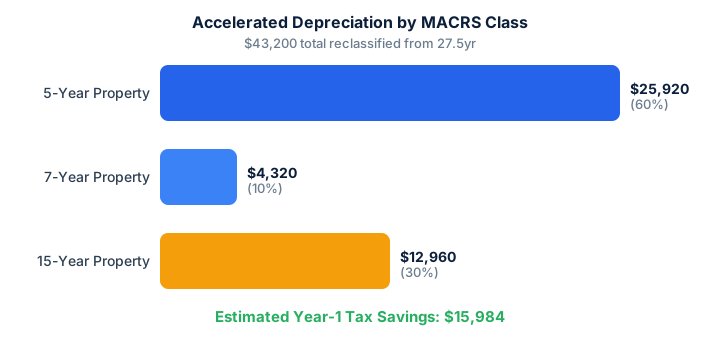
| 5-Year Property | $25,920 | 60% | Yes — 100% |
| 7-Year Property | $4,320 | 10% | Yes — 100% |
| 15-Year Property | $12,960 | 30% | Yes — 100% |
| 27.5yr Property | $196,800 | 82% | No — standard schedule |
| Total Depreciable Basis | $240,000 | 100% | — |
| Method | Year-1 Deduction | Difference |
|---|---|---|
| Standard Straight-Line (27.5yr) | $8,727 | — |
| With Cost Segregation + Bonus | $43,200 | +$34,473 |
Atlanta consistently ranks as one of the top markets for cash-flow rental investors, and for good reason: median home prices remain well below the national average while rents stay strong. Neighborhoods like College Park, East Point, Decatur, and Marietta offer SFR rentals in the $250K-$400K range that generate $1,500-$2,200 monthly rent — some of the best rent-to-price ratios in the country.
At a $300K entry point, cost segregation still delivers compelling economics. The study reclassifies roughly $43K into accelerated MACRS classes, generating about $16K in year-one tax savings against a study cost of $795. For investors building a portfolio of 3-5 Atlanta rentals, running cost segregation on each property creates a stacked depreciation benefit that can shelter most or all of the portfolio's rental income.
Georgia's state income tax (5.49% flat rate) means Atlanta investors get a bonus benefit: the accelerated depreciation reduces both federal and state taxable income. On a $300K property, that's roughly $2,400 in additional state tax savings on top of the $16K federal benefit. Portfolio investors who acquire 2-3 properties per year find that cost segregation becomes a systematic part of their acquisition playbook.
| Price | Accelerated | Tax Savings | Study Cost | ROI |
|---|---|---|---|---|
| $300K | $43,200 | $15,984 | $795 | 20x |
| $500K | $72,000 | $26,640 | $795 | 34x |
| $750K | $108,000 | $39,960 | $795 | 50x |
| $400K | $57,600 | $21,312 | $795 | 27x |
| $600K | $86,400 | $31,968 | $795 | 40x |
| $1M | $144,000 | $53,280 | $1,195 | 45x |
| Property Type | Accelerated | Tax Savings | Study Cost | ROI |
|---|---|---|---|---|
| Airbnb / Short-Term Rental | $81,600 | $30,192 | $795 | 38x |
| Rental Property | $43,200 | $15,984 | $795 | 20x |
A cost segregation study is an engineering-based analysis that reclassifies components of your property into shorter IRS depreciation categories (5, 7, and 15 years) instead of the default 27.5 or 39 years. This accelerates your depreciation deductions, reducing your tax bill in the early years of ownership.
For long-term rentals, depreciation deductions are generally passive and can only offset passive income. However, there are two key exceptions: (1) if your AGI is under $150K, you can deduct up to $25K in passive losses against ordinary income, and (2) if you qualify as a Real Estate Professional (750+ hours/year in real estate), all rental income becomes non-passive. STR owners who materially participate can deduct against W-2 income regardless.
Yes. The economics of cost segregation are determined by the property value and your tax bracket, not the number of properties you own. A single $400K rental property typically generates $21K in first-year tax savings — more than enough to justify the $795 study cost. The deductions carry forward if they exceed your current-year passive income.
Get a professional, IRS-defensible cost segregation study delivered in 3-5 business days. Starting at $795.
Order Your Study →Related Examples