$500K Triplex: Your Cost Segregation Breakdown

Three complete units means three kitchens, three bathrooms, and three times the reclassifiable building components — making triplexes a cost segregation sweet spot.

$76,000 Accelerated Depreciation
$28,120 Est. Year-1 Tax Savings
28x Return on Study Cost

Adjust Your Numbers

Depreciable Basis (80%) $400,000
Accelerated Depreciation $76,000
Est. Year-1 Tax Savings $28,120
Study Cost $995
Return on Study 28x
Order Your Study →

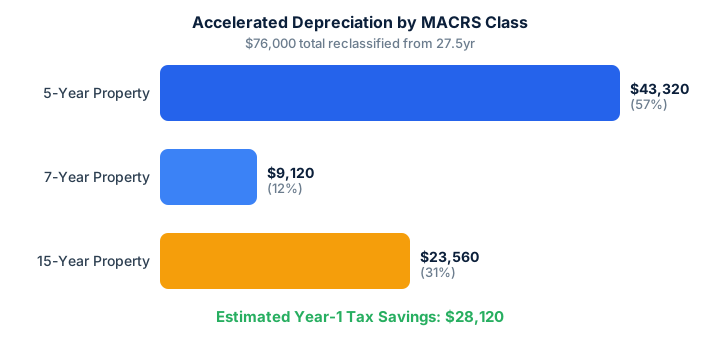
MACRS Depreciation Breakdown

MACRS depreciation breakdown chart for $500,000 Triplex
MACRS Class Amount % of Accelerated Bonus Eligible
5-Year Property $43,320 57% Yes — 100%
7-Year Property $9,120 12% Yes — 100%
15-Year Property $23,560 31% Yes — 100%
27.5yr Property $324,000 81% No — standard schedule
Total Depreciable Basis $400,000 100%
Method Year-1 Deduction Difference
Standard Straight-Line (27.5yr) $14,545
With Cost Segregation + Bonus $76,000 +$61,455
Estimated deduction based on typical cost segregation allocations for triplex properties. Actual study results may vary based on property-specific analysis including age, condition, renovations, and local construction costs.

What This Means for You

Triplex property

A $500K triplex is one of the most efficient property types for cost segregation. With three complete units, you get triple the personal property inventory — three kitchens with cabinets, countertops, and appliances; three bathrooms with vanities, fixtures, and tile; and three sets of flooring, lighting, and interior finishes. The study typically reclassifies $80K into accelerated MACRS classes.

The triplex also benefits from common-area components: shared entryways, exterior lighting, mailbox installations, parking area paving, shared HVAC or boiler systems, and landscaping. These fall into the 7-year or 15-year MACRS classes and add meaningfully to the total accelerated depreciation.

For house-hackers who live in one unit and rent the other two, cost segregation applies to the entire property basis — not just the rented units. At $500K with $80K in accelerated depreciation, you're looking at about $30K in first-year tax savings against a study cost of $995. That's a 30x return, and the deductions can offset rental income from all three units or carry forward to future years.

IRS Compliant Methodology aligned with IRS Audit Techniques Guide
📈
CPA-Ready Reports 30-40 page PDF your CPA can file directly
💰
Money-Back Guarantee Full refund if the study doesn't save you money
📄
See a Sample Download sample report

Compare: $500,000 Across Property Types

Property Type Accelerated Tax Savings Study Cost ROI
Airbnb / Short-Term Rental $136,000 $50,320 $795 63x
Rental Property $72,000 $26,640 $795 34x
Duplex $76,000 $28,120 $995 28x
Condo $60,000 $22,200 $795 28x
Triplex $76,000 $28,120 $995 28x

Frequently Asked Questions

What is a cost segregation study?

A cost segregation study is an engineering-based analysis that reclassifies components of your property into shorter IRS depreciation categories (5, 7, and 15 years) instead of the default 27.5 or 39 years. This accelerates your depreciation deductions, reducing your tax bill in the early years of ownership.

What components get reclassified in a multifamily property?

Multifamily properties have per-unit components (kitchens, bathrooms, flooring, fixtures) plus common-area improvements (hallway lighting, entry systems, mailboxes, parking lots, laundry equipment, security systems). Both categories qualify for accelerated MACRS classification, making multifamily properties especially rich in reclassifiable components.

How long does a cost segregation study take?

Our studies are delivered in 3-5 business days. You provide the property address, purchase price, and closing date — we handle everything else using assessor records, satellite imagery, and construction cost databases. No site visit or tenant disruption required.

Ready to See Your Actual Savings?

Get a professional, IRS-defensible cost segregation study delivered in 3-5 business days. Starting at $795.

Order Your Study →

Related Examples