Lookback Study: Claim Missed Depreciation (Form 3115)
Never did a cost seg study? A lookback study with Form 3115 lets you catch up on missed accelerated depreciation in a single tax year.

Never did a cost seg study? A lookback study with Form 3115 lets you catch up on missed accelerated depreciation in a single tax year.
Regulation reference: Full procedural reference for the lookback method change: Form 3115 + § 481(a) catch-up adjustment under automatic change-number 7 (Rev. Proc. 2019-08).
A lookback cost segregation study catches up on all missed accelerated depreciation from any prior year you’ve owned the property — 2 years back or 20. The cumulative catch-up is claimed in a single tax year as a Section 481(a) adjustment on Form 3115. No amended returns, no advance IRS approval, no statute of limitations. Commonly produces $30,000–$50,000+ in Year 1 deductions.
You Didn’t Miss the Window
A lookback cost segregation study allows property owners who have been depreciating their rental property on a standard 27.5-year or 39-year straight-line schedule to retroactively reclassify building components into shorter 5-year, 7-year, and 15-year MACRS classes and claim all missed accelerated depreciation in a single tax year. The mechanism is IRS Form 3115 (Application for Change in Accounting Method), filed under the automatic consent procedures — no amended returns and no advance IRS approval required. The cumulative “catch-up” adjustment, called a Section 481(a) adjustment, appears on the current-year return. For a property purchased at $600,000 with a $450,000 depreciable basis, a lookback study typically reclassifies $90,000 to $135,000 into accelerated categories, producing $30,000 to $50,000 or more in catch-up deductions depending on how many years of ownership have passed and whether bonus depreciation was available in the placed-in-service year.
How a Lookback Study Works
The process has two parts: the cost segregation study itself, and the Form 3115 filing that your CPA handles.
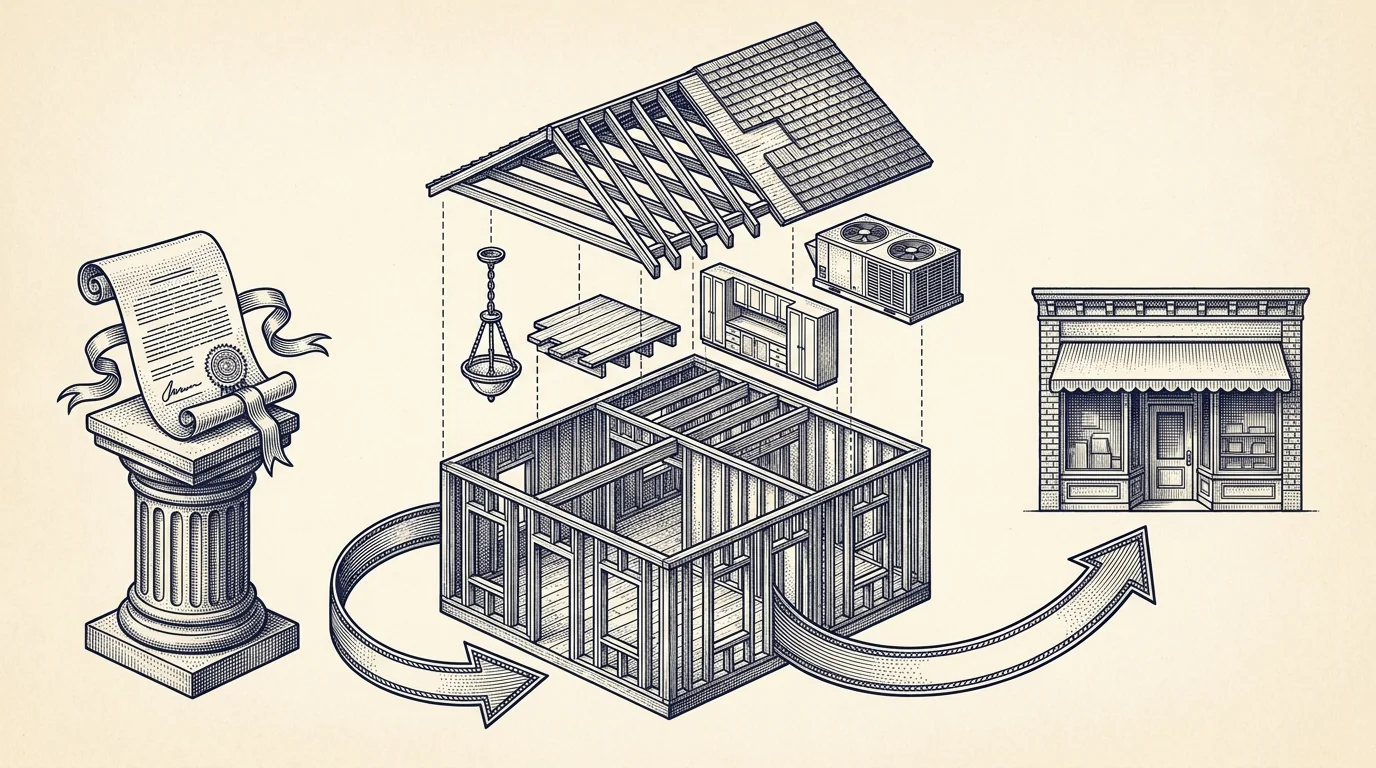
The cost segregation study is the same engineering-based analysis you’d get if you ordered a study on a brand-new purchase. It breaks your property into its component parts — structural elements, mechanical systems, fixtures, finishes, land improvements, and personal property — and assigns each component to its proper MACRS depreciation category (5-year, 7-year, 15-year, or 27.5/39-year).
The difference with a lookback study is what happens next. Instead of applying the reclassified depreciation going forward, your CPA calculates the cumulative difference between what you actually claimed (straight-line, 27.5 or 39 years for everything) and what you could have claimed if the cost segregation study had been in place from day one. That cumulative difference — which can represent multiple years of missed accelerated depreciation — gets reported as a single adjustment on your current-year return via Form 3115.
Why the Numbers Can Be Substantial
Think about it this way. A cost segregation study on a typical residential rental property might reclassify 20–30% of the depreciable basis into accelerated categories (5-year and 15-year property). For a property purchased at $600,000 with a $450,000 depreciable basis, that could mean $90,000–$135,000 in components that should have been depreciated on a faster schedule.
If you’ve owned that property for three or four years and have been depreciating the entire basis over 27.5 years, you’ve been claiming roughly $16,000–$17,000 per year in total depreciation. But with cost segregation applied retroactively — especially if bonus depreciation was available in the year you placed the property in service — the accelerated portion could have been fully deducted in Year 1.
The lookback adjustment captures that entire gap. Multiple years of missed accelerated depreciation, reported as a single current-year deduction. Your CPA calculates the exact “Section 481(a) adjustment” and includes it on your return. We also publish worked examples and the §481(a) calculator at catchupdepreciation.com if you want to see the math on a few sample properties before talking to your CPA.

What You Don’t Have to Do
One of the best parts of the lookback process is what it doesn’t require:
- You don’t amend prior returns. The adjustment flows through your current-year filing. No need to reopen 2021, 2022, or any prior year.
- You don’t need IRS pre-approval. This type of accounting method change falls under automatic consent procedures. Your CPA files the Form 3115 with your return.
- You don’t need a physical inspection. Modern cost segregation studies use engineering databases, property records, and standard construction cost data to classify components remotely.
Your role is straightforward: order the cost segregation study, receive the report, and hand it to your CPA. They handle the 3115 filing and the depreciation schedule adjustments.
Who Should Consider a Lookback Study?
A lookback study may make sense if you:
- Purchased a rental property (residential or commercial) in a prior tax year and never had a cost segregation study performed
- Have been depreciating the entire property on a straight-line 27.5-year or 39-year schedule
- Own a property with significant personal property, fixtures, or land improvements (STRs, restaurants, medical offices, and retail spaces tend to have high reclassification potential)
- Had bonus depreciation available in the year the property was placed in service (100% bonus was available 2018–2022 and again in 2026)
There’s no statutory deadline for filing a lookback study. Whether you bought the property two years ago or ten years ago, the option is generally available. That said, the sooner you act, the sooner you realize the tax benefit — and the more certainty you have about the current tax rules.
What About Depreciation Recapture?
This is a fair question, and one you should discuss with your CPA. When you eventually sell a property, the IRS recaptures depreciation you’ve claimed at a rate of up to 25% (under Section 1250). Accelerating your depreciation through cost segregation doesn’t change the total amount of depreciation you’ll claim over the life of the property — it changes when you claim it.
The economic advantage is the time value of money. Taking a large deduction today and paying recapture years later when you sell is generally favorable, especially if you reinvest the tax deferral into additional properties or other investments. Many investors also use 1031 exchanges to defer the recapture entirely. But this is a conversation to have with your tax advisor based on your specific situation and exit strategy.
How It Works with Cost Seg Smart
We handle lookback studies the same way we handle studies for new acquisitions. You provide your property details — purchase price, property type, year acquired, and any major improvements. We deliver a CPA-ready PDF report with a full component-by-component breakdown, depreciation schedules, and the data your CPA needs to prepare the Form 3115.
how the classification process works →
The study itself typically takes the same business day in most cases. From there, your CPA incorporates it into your current-year tax filing. The whole process — from ordering the study to having the 3115 ready for filing — can happen in a matter of days.
The Bottom Line
If you own rental property and have been depreciating it on a straight-line basis without a cost segregation study, you may be sitting on years of unclaimed accelerated depreciation. A lookback study can help you capture that in a single tax year, without amending old returns and without IRS pre-approval.
This is not a loophole. It’s a well-established IRS procedure (Revenue Procedure 2015-13, as updated) that your CPA can implement. The question isn’t whether it’s legitimate — it’s whether you’re taking advantage of it.
Talk to your CPA. If cost segregation makes sense for your property, there’s no reason to leave those deductions on the table just because you didn’t know about it when you bought the place.
Cost Seg Smart is the modern cost segregation company. We deliver engineering-based, CPA-ready reports in a day or two, not six weeks. Starting at $495, not $5,000. Whether you bought your property last year or a decade ago, you can get your lookback study done right now and hand it to your CPA before your next filing deadline.
Free preliminary depreciation estimate — property summary, basis allocation, five-year schedule. We do the work; you get the PDF.
See my estimated Year-1 savings →Frequently Asked Questions What is a lookback cost segregation study?
A lookback study is a cost segregation study performed on a property you have owned for one or more years and have been depreciating using the standard straight-line method. It reclassifies building components into faster MACRS recovery periods (5-year, 7-year, 15-year) and allows you to catch up on all the missed accelerated depreciation from prior years in a single tax year. Your CPA files IRS Form 3115 (Change in Accounting Method) with your current-year return. The cumulative missed depreciation is claimed as a Section 481(a) adjustment. No amended returns are required. Do I need IRS approval to file a lookback study?
No. A lookback cost segregation study uses the automatic-consent provisions under Revenue Procedure 2015-13 (as updated). Your CPA files Form 3115 with your current-year tax return and the change is effective without IRS pre-approval. This is a well-established procedure that thousands of taxpayers use every year. The IRS does not review or approve Form 3115 filings before they take effect. They are processed automatically. How far back can a lookback study go?
There is no time limit. You can perform a lookback study on a property you purchased 2 years ago or 15 years ago. The Section 481(a) adjustment captures all missed accelerated depreciation from the original placed-in-service date. The longer you have owned the property, the larger the cumulative catch-up deduction tends to be. For properties held 5+ years, the lookback adjustment can be substantial because multiple years of missed 5-year and 15-year component depreciation are claimed at once. How much does a lookback cost segregation study cost?
Cost Seg Smart delivers lookback studies at the same pricing as standard studies: starting at $495 for residential properties and $1,995 for commercial, with reports delivered usually within the same business day. The report includes the component reclassification, depreciation schedules, and the data your CPA needs to prepare Form 3115. Traditional firms charge $5,000-$15,000 for the same deliverable. Every report includes a CPA-Ready Guarantee.
Frequently asked
What is a lookback cost segregation study?
A lookback study is a cost segregation study performed on a property you have owned for one or more years and have been depreciating using the standard straight-line method. It reclassifies building components into faster MACRS recovery periods (5-year, 7-year, 15-year) and allows you to catch up on all the missed accelerated depreciation from prior years in a single tax year. Your CPA files IRS Form 3115 (Change in Accounting Method) with your current-year return. The cumulative missed depreciation is claimed as a Section 481(a) adjustment. No amended returns are required.
Do I need IRS approval to file a lookback study?
No. A lookback cost segregation study uses the automatic-consent provisions under Revenue Procedure 2015-13 (as updated). Your CPA files Form 3115 with your current-year tax return and the change is effective without IRS pre-approval. This is a well-established procedure that thousands of taxpayers use every year. The IRS does not review or approve Form 3115 filings before they take effect. They are processed automatically.
How far back can a lookback study go?
There is no time limit. You can perform a lookback study on a property you purchased 2 years ago or 15 years ago. The Section 481(a) adjustment captures all missed accelerated depreciation from the original placed-in-service date. The longer you have owned the property, the larger the cumulative catch-up deduction tends to be. For properties held 5+ years, the lookback adjustment can be substantial because multiple years of missed 5-year and 15-year component depreciation are claimed at once.
How much does a lookback cost segregation study cost?
Cost Seg Smart delivers lookback studies at the same pricing as standard studies: starting at $495 for residential properties and $1,995 for commercial, with reports delivered usually within the same business day. The report includes the component reclassification, depreciation schedules, and the data your CPA needs to prepare Form 3115. Traditional firms charge $5,000-$15,000 for the same deliverable. Every report includes a CPA-Ready Guarantee.